Results by title
134 books match the query 'Business' and 3 start with i
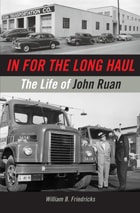
In for the Long Haul
The Life of John RuanWilliam B. Friedricks
University of Iowa Press, 2003
Driven by grit and determination during the Depression, John Ruan parlayed a one-truck business into Ruan Transportation Management Systems, one of the nation’s leading trucking, leasing, and logistics companies. The trucking business made John Ruan one of the wealthiest and most influential people in Iowa and was the foundation for his vast fortune which included interests in insurance, banking, financial services, international trade, and real estate.
In the 1970s and 80s, Ruan led Des Moines’s renaissance with the construction of the 36-story original Ruan Center, the Marriott Hotel tower, and the Two Ruan Center office complex. But his contributions reached far beyond the confines of Iowa. As a philanthropist, Ruan was a long-time sponsor of the World Food Prize, which recognizes the importance of a nutritious and sustainable food supply for all people.
Based on extensive interviews with Ruan, family members, business associates, friends, and colleagues, as well as privately held papers and archives, In for the Long Haul presents a discerning portrait of this hard-charging yet compassionate businessman.
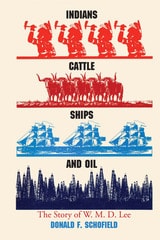
Indians, Cattle, Ships, and Oil
The Story of W. M. D. LeeBy Donald F. Schofield
University of Texas Press, 1985
Indian trader, rancher, harbor developer, oil impresario—these are the many worlds of one of the least chronicled but most fascinating characters of the American West. In the early, bustling years of the frontier, a brazen young man named William McDole Lee moved from Wisconsin to Kansas and then to Texas to forge a life for himself. Becoming a driving entrepreneurial force in Texas's development, Lee soon garnered the alliances and resources necessary to shape the financial destinies of disparate groups throughout the state. His story is expertly told in Donald F. Schofield's Indians, Cattle, Ships, and Oil.
Beginning in 1869 as a trader to the southern Cheyenne and Arapaho tribes and fort provisioner to troops garrisoned at Camp Supply, Indian Territory, Lee gained a partner and amassed a fortune in short order from trading buffalo hides and robes. Vast herds of buffalo grazing on the southern plains were killed largely on his order. When buffalo were no longer a profitable commodity, Lee tackled his next challenge—the cattle trade.
He began with herds branded LR that grazed on pastures near Fort Supply. Then came his LE herd in the Texas Panhandle. Another partnership, with noted cattle rancher Lucien Scott, resulted in the vast LS ranch, one of the most successful operations of its day. Lee even introduced a new breed of cattle, the Aberdeen-Angus, to the western range. But as his partnership faded, Lee moved on to his next undertaking—the development of Texas' first deep-water harbor.
In 1888, Lee and other financiers put up one million dollars to finance a dream: opening international trade from the waters of the Gulf of Mexico to the mainland at the mouth of the Brazos River. Their Brazos River Channel and Dock Company was to construct, own, and operate a deep-water harbor at Velasco, with a railroad link to Houston. Though threats of financial disaster loomed large, the Velasco facility was to welcome, in its day, tugs, barges, and three-masted schooners and to provide impetus for Houston's boom. Yet with success, the mercurial Lee turned to yet another challenge—oil.
Starting still another partnership, Lee committed himself to prospecting for oil on the West Columbia Ridge in Brazoria County. Lee and crew struck oil in 1907, developing one of the first producing wells of Brazoria County, but inadequate drilling equipment hampered further fruitful exploration. Lee moved his rigs to the famed Spindletop, where he perfected the technique of shallow drilling. Though spectacular success in the oil business eluded him, Lee's accomplishments set him squarely among the great entrepreneurs of the Texas oil industry.
Lee's exploits led him to roles in some of the most dramatic moments in Texas and the West—Indian uprisings, buffalo hunts, political scandals, cowboy strikes and shoot-outs, railroad promotions, oil-well blow-outs and gushers. The people he encountered are the famous and infamous of western history: Cheyenne Chief Little Robe and the outlaw "Hurricane Bill" Martin; Indian Agent John D. Miles and Major General John Pope; outlaws Tom Harris and William Bonney, and Sheriff Pat Garrett. Altogether, Lee's biography vividly shows one man's manipulation of people and events during the settlement of the American frontier.
Ivy and Industry
Business and the Making of the American University, 1880-1980Christopher Newfield
Duke University Press, 2003
Newfield views management as neither inherently good nor bad, but rather as a challenge to and tool for negotiating modern life. In Ivy and Industry he integrates business and managerial philosophies from Taylorism through Tom Peters’s “culture of excellence” with the speeches and writings of leading university administrators and federal and state education and science policies. He discusses the financial dependence on industry and government that was established in the university’s early years and the equal influence of liberal arts traditions on faculty and administrators. He describes the arrival of a managerial ethos on campus well before World War II, showing how managerial strategies shaped even fields seemingly isolated from commerce, like literary studies. Demonstrating that business and the humanities have each had a far stronger impact on higher education in the United States than is commonly thought, Ivy and Industry is the dramatic story of how universities have approached their dual mission of expanding the mind of the individual while stimulating economic growth.