Results by title
335 books match the query 'Caribbean & Latin American Studies' and 10 start with i
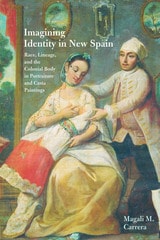
Imagining Identity in New Spain
Race, Lineage, and the Colonial Body in Portraiture and Casta PaintingsBy Magali M. Carrera
University of Texas Press, 2003
Using an interdisciplinary approach that also considers legal, literary, and religious documents of the period, Magali Carrera focuses on eighteenth-century portraiture and casta paintings to understand how the people and spaces of New Spain were conceptualized and visualized.
Winner, Book Award, Association of Latin American Art, 2004
Reacting to the rising numbers of mixed-blood (Spanish-Indian-Black African) people in its New Spain colony, the eighteenth-century Bourbon government of Spain attempted to categorize and control its colonial subjects through increasing social regulation of their bodies and the spaces they inhabited. The discourse of calidad (status) and raza (lineage) on which the regulations were based also found expression in the visual culture of New Spain, particularly in the unique genre of casta paintings, which purported to portray discrete categories of mixed-blood plebeians.
Using an interdisciplinary approach that also considers legal, literary, and religious documents of the period, Magali Carrera focuses on eighteenth-century portraiture and casta paintings to understand how the people and spaces of New Spain were conceptualized and visualized. She explains how these visual practices emphasized a seeming realism that constructed colonial bodies—elite and non-elite—as knowable and visible. At the same time, however, she argues that the chaotic specificity of the lives and lived conditions in eighteenth-century New Spain belied the illusion of social orderliness and totality narrated in its visual art. Ultimately, she concludes, the inherent ambiguity of the colonial body and its spaces brought chaos to all dreams of order.

Imagining the Tropics
Women, Romance, and the Making of Modern TourismElizabeth S. Manley
Rutgers University Press, 2025
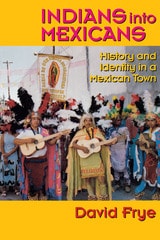
Indians into Mexicans
History and Identity in a Mexican TownBy David Frye
University of Texas Press, 1996
The people of Mexquitic, a town in the state of San Luis Potosí in rural northeastern Mexico, have redefined their sense of identity from "Indian" to "Mexican" over the last two centuries. In this ethnographic and historical study of Mexquitic, David Frye explores why and how this transformation occurred, thereby increasing our understanding of the cultural creation of "Indianness" throughout the Americas.
Frye focuses on the local embodiments of national and regional processes that have transformed rural "Indians" into modern "Mexicans": parish priests, who always arrive with personal agendas in addition to their common ideological baggage; local haciendas; and local and regional representatives of royal and later of national power and control. He looks especially at the people of Mexquitic themselves, letting their own words describe the struggles they have endured while constructing their particular corner of Mexican national identity.
This ethnography, the first for any town in northeastern Mexico, adds substantially to our knowledge of the forces that have rendered "Indians" almost invisible to European-origin peoples from the fifteenth century up to today. It will be important reading for a wide audience not only in anthropology and Latin American studies but also among the growing body of general readers interested in the multicultural heritage of the Americas.

Indigeneity and the Mestizo Question
The Limits of Latin American PhilosophyJorge Sanchez-Perez
Amherst College Press, 2027
In The Limits of Latin American Philosophy: Indigeneity and the Mestizo Question, Jorge Sanchez-Perez argues that the distinction between Latin American philosophy and Indigenous philosophy from Latin America has been neglected. While Latin American philosophers have succeeded in carving out a conceptual space in the landscape of Western philosophy, a space in which issues positions relevant to Latin American concerns are discussed and debated, this space has failed to sufficiently acknowledge the differences with Indigenous philosophy from Latin America. Although both fields can point to some, even if contested, geographical shared space, they emerge from different conceptual backgrounds. While Latin American philosophy emerges as a project in relation, even if as a rejection, to Europe, Indigenous philosophy from Latin America predates the existence of Europe by thousands of years. By defining the countours of Latin American philosophy, The Limits of Latin American Philosophy aims to make room for discussions of Indigenous philosophy from Latin America.
Indigenous Movements, Self-Representation, and the State in Latin America
Edited by Kay B. Warren and Jean E. Jackson
University of Texas Press, 2003
Throughout Latin America, indigenous peoples are responding to state violence and pro-democracy social movements by asserting their rights to a greater measure of cultural autonomy and self-determination. This volume's rich case studies of movements in Colombia, Guatemala, and Brazil weigh the degree of success achieved by indigenous leaders in influencing national agendas when governments display highly ambivalent attitudes about strengthening ethnic diversity.
The contributors to this volume are leading anthropologists and indigenous activists from the United States and Latin America. They address the double binds of indigenous organizing and "working within the system" as well as the flexibility of political tactics used to achieve cultural goals outside the scope of state politics. The contributors answer questions about who speaks for indigenous communities, how indigenous movements relate to the popular left, and how conflicts between the national indigenous leadership and local communities play out in specific cultural and political contexts. The volume sheds new light on the realities of asymmetrical power relations and on the ways in which indigenous communities and their representatives employ Western constructions of subjectivity, alterity, and authentic versus counterfeit identity, as well as how they manipulate bureaucratic structures, international organizations, and the mass media to advance goals that involve distinctive visions of an indigenous future.
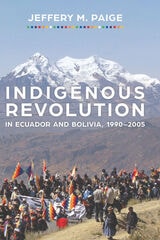
Indigenous Revolution in Ecuador and Bolivia, 1990–2005
Jeffery M. Paige
University of Arizona Press, 2020
Uprisings by indigenous peoples of Ecuador and Bolivia between 1990 and 2005 overthrew the five-hundred-year-old racial and class order inherited from the Spanish Empire. It started in Ecuador with the Great Indigenous Uprising, which was fought for cultural and economic rights. A few years later massive indigenous mobilizations began in Bolivia, culminating in 2005 with the election of Evo Morales, the first indigenous president.
Jeffrey M. Paige, an internationally recognized authority on the sociology of revolutionary movements, interviewed forty-five indigenous leaders who were actively involved in the uprisings. The leaders recount how peaceful protest and electoral democracy paved the path to power. Through the interviews, we learn how new ideologies of indigenous socialism drew on the deep commonalities between the communal dreams of their ancestors and the modern ideology of democratic socialism. This new discourse spoke to the people most oppressed by both withering racism and neoliberal capitalism.
Emphasizing mutual respect among ethnic groups (including the dominant Hispanic group), the new revolutionary dynamic proposes a communal worldview similar to but more inclusive than Western socialism because it adds indigenous cultures and nature in a spiritual whole. Although absent in the major revolutions of the past century, the themes of indigenous revolution—democracy, indigeneity, spirituality, community, and ecology—are critically important.
Paige’s interviews present the powerful personal experiences and emotional intensity of the revolutionary leadership. They share the stories of mass mobilization, elections, and indigenous socialism that created a new form of twenty-first-century revolution with far-reaching applications beyond the Andes.

Inside Tenement Time
Suss, Spirit, and SurveillanceKezia Page
Rutgers University Press, 2025
Inside Tenement Time is the first comprehensive treatment of literary and cultural texts on surveillance in the Caribbean. Covering the long historical arc of the twentieth to the twenty-first centuries, Inside Tenement Time uses Jamaica as a case study to examine moments of crisis and particular spaces, especially urban yard enclaves and their environs, in the Caribbean encounter with surveillance. Making the argument that the Caribbean situation reveals flexible hegemonies rather than provinces of exclusive control, the book demonstrates the countervailing force of sussveillance and spiritveillance, Afro-Indigenous variations on surveillance. Sussveillance and spiritveillance are exemplars of vernacular arts and sciences that operate at and within the frangible borders of state power, exposing the unique dynamics of surveillance in the region and marshalling the acts of imagination with which it contends. For example, the Smile Jamaica concert of 1976, headlined by reggae Superstar Bob Marley, and the reputedly US government-backed 2010 Tivoli Gardens incursion in West Kingston, both moments that have dramatic, even mythic residue in Caribbean and global memory, are among the real-life events brought into conversation with literary representations of this history.
Interrogating the Future of Puerto Rican Studies
Aurora Santiago Ortiz and Jorell A. Meléndez-Badillo, editors
Duke University Press, 2026
Contributors. José Atiles, Bárbara Abadía Rexach, Yarimar Bonilla, daniela crespo-miró, Marie Cruz Soto, Yomaira Figueroa-Vásquez, Marcela Guerrero, Gustavo García López, Mónica Jiménez, Lawrence LaFountain Stokes, Marisol LeBrón, Pedro Lebrón Ortiz, Beatriz Llenín Figueroa, Jorell Meléndez-Badillo, Sarah Molinari, Marisel Moreno, Daniel Nevárez Araújo, Aurora Santiago Ortiz, Karrieann Soto Vega, Daniel Vázquez Sanabria, Roberto Vélez-Vélez, Joaquín Villanueva, Jacqueline Villarrubia-Mendoza
Island Gospel
Pentecostal Music and Identity in Jamaica and the United StatesMelvin L. Butler
University of Illinois Press, 2019
Isle of Rum
Havana Club, Cultural Mediation, and the Fight for Cuban AuthenticityChristopher Chávez
Rutgers University Press, 2024
Rather than laying claim to authentic Cuban culture, Chávez explores which aspects of Cuban culture are deemed most compelling and, therefore, most profitable by corporate marketers. As a joint venture between the Cuban state and Pernod Ricard, a global spirits marketer based in Paris, Havana Club embodies the larger process of economic reform, which was meant to reintegrate Cuba into global markets during Cuba’s Special Period in a Time of Peace.