Results by title
480 books match the query 'Chicago' and 11 start with i
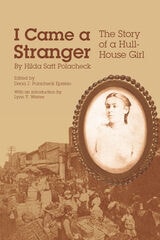
I Came a Stranger
The Story of a Hull-House GirlHilda Satt Polacheck
University of Illinois Press, 1989
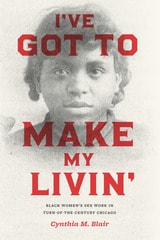
I've Got to Make My Livin'
Black Women's Sex Work in Turn-of-the-Century ChicagoCynthia M. Blair
University of Chicago Press, 2010
For many years, the interrelated histories of prostitution and cities have perked the ears of urban scholars, but until now the history of urban sex work has dealt only in passing with questions of race. In I’ve Got to Make My Livin’, Cynthia Blair explores African American women’s sex work in Chicago during the decades of some of the city’s most explosive growth, expanding not just our view of prostitution, but also of black women’s labor, the Great Migration, black and white reform movements, and the emergence of modern sexuality.
Focusing on the notorious sex districts of the city’s south side, Blair paints a complex portrait of black prostitutes as conscious actors and historical agents; prostitution, she argues here, was both an arena of exploitation and abuse, as well as a means of resisting middle-class sexual and economic norms. Blair ultimately illustrates just how powerful these norms were, offering stories about the struggles that emerged among black and white urbanites in response to black women’s increasing visibility in the city’s sex economy. Through these powerful narratives, I’ve Got to Make My Livin’ reveals the intersecting racial struggles and sexual anxieties that underpinned the celebration of Chicago as the quintessentially modern twentieth-century city.
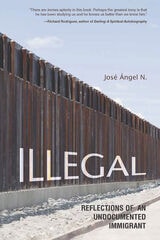
Illegal
Reflections of an Undocumented ImmigrantJose Angel N.
University of Illinois Press, 2014
Arriving in the 1990s with a ninth grade education, N. traveled to Chicago where he found access to ESL and GED classes. He eventually attended college and graduate school and became a professional translator.
Despite having a well-paying job, N. was isolated by a lack of legal documentation. Travel concerns made promotions impossible. The simple act of purchasing his girlfriend a beer at a Cubs baseball game caused embarrassment and shame when N. couldn't produce a valid ID. A frustrating contradiction, N. lived in a luxury high-rise condo but couldn't fully live the American dream. He did, however, find solace in the one gift America gave him–-his education. Ultimately, N.'s is the story of the triumph of education over adversity. In Illegal, he debunks the stereotype that undocumented immigrants are freeloaders without access to education or opportunity for advancement. With bravery and honesty, N. details the constraints, deceptions, and humiliations that characterize alien life "amid the shadows."
Imperial Policing
Weaponized Data in Carceral ChicagoAndy Clarno
University of Minnesota Press, 2024
Exposing the carceral webs and weaponized data that shape Chicago’s police wars
Chicago is a city with extreme concentrations of racialized poverty and inequity, one that relies on an extensive network of repressive agencies to police the poor and suppress struggles for social justice. Imperial Policing examines the role of local law enforcement, federal immigration authorities, and national security agencies in upholding the city’s highly unequal social order.
Collaboratively authored by the Policing in Chicago Research Group, Imperial Policing was developed in dialogue with movements on the front lines of struggles against racist policing in Black, Latinx, and Arab/Muslim communities. It analyzes the connections between three police “wars”—on crime, terror, and immigrants—focusing on the weaponization of data and the coordination between local and national agencies to suppress communities of color and undermine social movements. Topics include high-tech, data-based tools of policing; the racialized archetypes that ground the police wars; the manufacturing of criminals and terrorists; the subversion of sanctuary city protections; and abolitionist responses to policing, such as the Erase the Database campaign.
Police networks and infrastructure are notoriously impenetrable to community members and scholars, making Imperial Policing a rare, vital example of scholars working directly with community organizations to map police networks and intervene in policing practices. Engaging in a methodology designed to provide support for transformative justice organizations, the Policing in Chicago Research Group offers a critical perspective on the abolition of imperial policing, both in Chicago and around the globe.
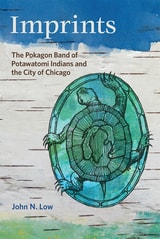
Imprints
The Pokagon Band of Potawatomi Indians and the City of ChicagoJohn N. Low
Michigan State University Press, 2016
Imprints: The Pokagon Band of Potawatomi Indians and the City of Chicago examines the ways some Pokagon Potawatomi tribal members have maintained a distinct Native identity, their rejection of assimilation into the mainstream, and their desire for inclusion in the larger contemporary society without forfeiting their “Indianness.” Mindful that contact is never a one-way street, Low also examines the ways in which experiences in Chicago have influenced the Pokagon Potawatomi. Imprints continues the recent scholarship on the urban Indian experience before as well as after World War II.
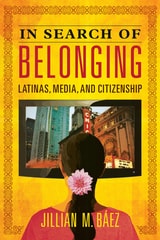
In Search of Belonging
Latinas, Media, and CitizenshipJillian M Baez
University of Illinois Press, 2018
Innovative and informed by a wealth of new evidence, In Search of Belonging answers important questions about the ways Latinas perform citizenship in today’s America.
In Search of a Lost Avant-Garde
An Anthropologist Investigates the Contemporary Art MuseumMatti Bunzl
University of Chicago Press, 2014
Bunzl’s ethnography is designed to show how a commitment to the avant-garde can come into conflict with an imperative for growth, leading to the abandonment of the new and difficult in favor of the entertaining and profitable. Jeff Koons, whose massive retrospective debuted during Bunzl's research, occupies a central place in his book and exposes the anxieties caused by such seemingly pornographic work as the infamous Made in Heaven series. Featuring cameos by other leading artists, including Liam Gillick, Jenny Holzer, Karen Kilimnik, and Tino Sehgal, the drama Bunzl narrates is palpable and entertaining and sheds an altogether new light on the contemporary art boom.
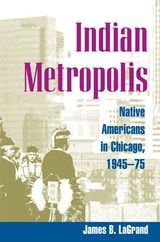
Indian Metropolis
Native Americans in Chicago, 1945-75James B. LaGrand
University of Illinois Press, 2002
Integrating the Inner City
The Promise and Perils of Mixed-Income Public Housing TransformationRobert J. Chaskin and Mark L. Joseph
University of Chicago Press, 2015
In the most thorough examination of mixed-income public housing redevelopment to date, Robert J. Chaskin and Mark L. Joseph draw on five years of field research, in-depth interviews, and volumes of data to demonstrate that while considerable progress has been made in transforming the complexes physically, the integrationist goals of the policy have not been met. They provide a highly textured investigation into what it takes to design, finance, build, and populate a mixed-income development, and they illuminate the many challenges and limitations of the policy as a solution to urban poverty. Timely and relevant, Chaskin and Joseph’s findings raise concerns about the increased privatization of housing for the poor while providing a wide range of recommendations for a better way forward.
Irma
A Chicago Woman's Story, 1871-1966Ellen Fitzsimmons Steinberg
University of Iowa Press, 2004
Irma’s journals and diaries were private accounts in which she chronicled the rhythm of her days and the shape of her life. She recorded her thoughts and short quotations from her reading, jotted down her own poems and short stories, constructed dinner-party menus, and wrote biographical sketches of her family. Interspersed among the records of what she did when and with whom are a number of lengthy reflections on Chicago history, her early life, religious beliefs, education, her aspirations, disappointments, sorrows, and successes. She documented her family’s activities during the Chicago Fire, the city’s rebuilding, early educational curricula in the city’s schools, what it was like to participate in the suffrage movement and vote for the first time, the effect of the Great Depression on the middle class, and World War II as seen from her perspective.
In each chapter, Ellen Steinberg has set Irma’s contemporary entries and later memoirs against the context of the Chicago history that Irma knew so well. Irma’s story will fascinate those interested in diaries and autobiography, women’s history, and Chicago history. From a plethora of rich source materials—including over half a million words of Irma’s writings alone—Steinberg has created a seamless, fascinating narrative about a Chicago woman who, although “nobody famous” (in her words), lived a vital life in a vibrant city.
Islam In Urban America
Sunni Muslims In ChicagoGarbi Schmidt
Temple University Press, 2004