Results by title
233 books match the query 'Cold War' and 7 start with i
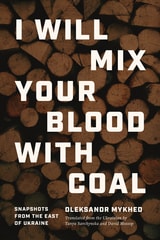
I Will Mix Your Blood with Coal
Snapshots from the East of UkraineOleksandr Mykhed, Tanya Savchynska, and David Mossop
Northwestern University Press, 2025
In 2014, the Russian army, with support from local militants, occupied parts of Ukraine’s two easternmost regions—once the beating industrial heart of the Soviet Union—where coal extraction has since exhausted both the human population and the natural resources. In late 2016, Oleksandr Mykhed set out on a research trip to explore the deep history and contested present of the area from the perspective of a fellow countryman who’d never been there.
Mykhed brings us on a painful yet hopeful journey across the Ukrainian east, sharing conversations with locals, snippets from archival documents, and the complicated perspectives of prominent cultural figures, such as writer Serhiy Zhadan, historian Olena Stiazhkina, and philosopher Ihor Kozlovsky, who was imprisoned and tortured for nearly two years.
I Will Mix Your Blood with Coal invites us to meet generations of coal miners. To learn about the Belgian and British investors who founded the east’s industrial cities. To remember the harrowing events of the First and Second World Wars and the incalculable brutality of Soviet history. To see the activists who are even now working to improve the country. To hear sweet memories of a lost utopia that never existed. Mykhed provides a unique portrait of life in the east during the war, before the full-scale invasion that would change everything.
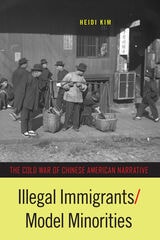
Illegal Immigrants/Model Minorities
The Cold War of Chinese American NarrativeHeidi Kim
Temple University Press, 2021
In the Cold War era, Chinese Americans were caught in a double-bind. The widespread stigma of illegal immigration, as it was often called, was most easily countered with the model minority, assimilating and forming nuclear families, but that in turn led to further stereotypes. In Illegal Immigrants/Model Minorities, Heidi Kim investigates how Chinese American writers navigated a strategy to normalize and justify the Chinese presence during a time when fears of Communism ran high.
Kim explores how writers like Maxine Hong Kingston, Jade Snow Wong, and C. Y. Lee, among others, addressed issues of history, family, blood purity, and law through then-groundbreaking novels and memoirs. Illegal Immigrants/Model Minorities also uses legal cases, immigration documents, and law as well as mass media coverage to illustrate how writers constructed stories in relation to the political structures that allowed or disallowed their presence, their citizenship, and their blended identity.
Kim illuminates the rapidly shifting political and social pressures on Chinese American authors who selectively concealed, revealed, and reconstructed issues of citizenship, belonging, and inclusion in their writing.
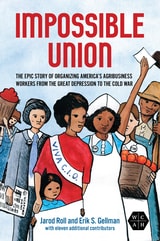
Impossible Union
The Epic Story of Organizing America’s Agribusiness Workers from the Great Depression to the Cold WarJarod Roll and Erik S. Gellman
University of Illinois Press, 2027
Workers of many racial, ethnic, and social identities united under the UCAPAWA-FTA banner. Their grassroots activism and bold national leadership fueled the union’s success despite opposition from employers, the government, and other labor groups. The union’s common sense anti-fascist ideology empowered workers to forge solidarities across their vast differences and linked workers’ rights to campaigns against racism and inequality. UCAPAWA-FTA advocated for an inclusive American democracy that can inform today’s struggles for dignity and security. This unique volume includes a special collection of essays by affiliated scholars that explore specific aspects of the union’s larger history.
Expansive and monumental, Impossible Union chronicles the labor organization that brought personhood and power to America’s marginal yet essential workers.
Additional contributors: Benjamin Makani Fortun, Dorothy Fujita-Rony, Robert Korstad, Bernadette Pérez, Michael Pierce, Charles Romney, Vicki L. Ruiz, Dan Sidorick, Dwana Waugh, John Weber, and Lane Windham
In Sputnik's Shadow
The President's Science Advisory Committee and Cold War AmericaWang, Zuoyue
Rutgers University Press, 2009
In today’s world of rapid advancements in science and technology, we need to scrutinize more than ever the historical forces that shape our perceptions of what these new possibilities can and cannot do for social progress. In Sputnik’s Shadow provides a lens to do just that, by tracing the rise and fall of the President’s Science Advisory Committee from its ascendance under Eisenhower in the wake of the Soviet launching of Sputnik to its demise during the Nixon years. Members of this committee shared a strong sense of technological skepticism; they were just as inclined to advise the president about what technology couldn’t do—for national security, space exploration, arms control, and environmental protection—as about what it could do.
Zuoyue Wang examines key turning points during the twentieth century, including the beginning of the Cold War, the debates over nuclear weapons, the Sputnik crisis in 1957, the struggle over the Vietnam War, and the eventual end of the Cold War, showing how the involvement of scientists in executive policymaking evolved over time. Bringing new insights to the intellectual, social, and cultural histories of the era, this book not only depicts the drama of Cold War American science, it gives perspective to how we think about technological advancements today.
In from the Cold
Latin America's New Encounter with the Cold WarGilbert M. Joseph and Daniela Spenser, eds.
Duke University Press, 2008
The collection's contributors examine international and everyday contests over political power and cultural representation, focusing on communities and groups above and underground, on state houses and diplomatic board rooms manned by Latin American and international governing elites, on the relations among states regionally, and, less frequently, on the dynamics between the two great superpowers themselves. In addition to charting new directions for research on the Latin American Cold War, In From the Cold seeks to contribute more generally to an understanding of the conflict in the global south.
Contributors. Ariel C. Armony, Steven J. Bachelor, Thomas S. Blanton, Seth Fein, Piero Gleijeses, Gilbert M. Joseph, Victoria Langland, Carlota McAllister, Stephen Pitti, Daniela Spenser, Eric Zolov
Invisible Enemies
The American War on Vietnam, 1975-2000Edwin A. Martini
University of Massachusetts Press, 2007
Beginning where most histories of the Vietnam War end, Invisible Enemies examines the relationship between the United States and Vietnam following the American pullout in 1975. Drawing on a broad range of sources, from White House documents and congressional hearings to comic books and feature films, Edwin Martini shows how the United States continued to wage war on Vietnam “by other means” for another twenty-five years. In addition to imposing an extensive program of economic sanctions, the United States opposed Vietnam's membership in the United Nations, supported the Cambodians, including the Khmer Rouge, in their decade-long war with the Vietnamese, and insisted that Vietnam provide a “full accounting” of American MIAs before diplomatic relations could be established. According to Martini, such policies not only worked against some of the stated goals of U.S. foreign policy, they were also in opposition to the corporate economic interests that ultimately played a key role in normalizing relations between the two nations in the late 1990s.
Martini reinforces his assessment of American diplomacy with an analysis of the “cultural front”—the movies, myths, memorials, and other phenomena that supported continuing hostility toward Vietnam while silencing opposing views of the war and its legacies. He thus demonstrates that the “American War on Vietnam” was as much a battle for the cultural memory of the war within the United States as it was a lengthy economic, political, and diplomatic campaign to punish a former adversary.
Iran and Global Decolonisation
Politics and Resistance After EmpireEdited by Robert Steele and Firoozeh Kashani-Sabet
Gingko, 2023
How did Iran’s unique position in the world affect and define its treatment of decolonization? During the final decades of Pahlavi rule in the late 1970s, the country sought to establish close relationships with newly independent counterparts in the Global South. Most scholarly work focused on this period is centered around the Cold War and Iran's relations with the United States, Russia, and Europe. Little attention has been paid to how the country interacted with other regions, such as Africa, Asia, and the Americas. Adding to an important and growing body of literature that discusses the profound and lasting impact of decolonization, Iran and Global Decolonisation contributes to the theoretical debates around the re-shaping of the world brought about by the end of an empire. It considers not only the impact of global decolonization on movements and ideas within Iran but also how Iran’s own experiences of imperialism shaped how these ideas were received and developed.