Results by title
83 books match the query 'College students' and 5 start with i
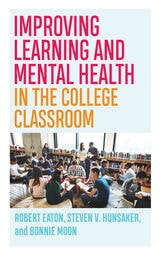
Improving Learning and Mental Health in the College Classroom
Robert Eaton
West Virginia University Press, 2023
How teachers can help combat higher education’s mental health crisis.
Mental health challenges on college campuses were a huge problem before COVID-19, and now they are even more pronounced. But while much has been written about higher education’s mental health crisis, very little research focuses on the role played by those on campus whose influence on student well-being may well be greatest: teachers. Drawing from interviews with students and the scholarship of teaching and learning, this book helps correct the oversight, examining how faculty can—instead of adding to their own significant workloads or duplicating counselors’ efforts—combat student stress through adjustments to the work they already do as teachers.
Improving Learning and Mental Health in the College Classroom provides practical tips that reduce unnecessary discouragement. It demonstrates how small improvements in teaching can have great impacts in the lives of students with mental health challenges, while simultaneously boosting learning for all students.
Instructor Guide for Speechcraft
Discourse Pronunciation for Academic CommunicationWayne B. Dickerson
University of Michigan Press, 2027
Instructor Guide for Speechcraft helps shoulder time-consuming, non-teaching tasks so that instructors can focus on working directly with their students. Four-part lesson plans are adaptable for instructors who want to insert critical pronunciation topics into a non-pronunciation ESL/EFL course. To aid in professional development, each lesson plan includes a commentary on the order of topics in the syllabus and common student questions. Appendices provide pre- and post-tests to make sure that instructors have the resources they need to teach confidently. In addition to the 232 audio recordings for the textbook, instructors can access 37 additional recordings that can be used for class preparation or for in-class progress checks. With the Instructor Guide for Speechcraft, teachers will be able to help their students achieve the clear, intelligible speech they need to pursue their studies in their chosen discipline, to serve as international teaching assistants, and to interact well in their chosen professions.

Insurgent Politics in the Lone Star State
Remembering the Antiwar Movement in Austin, Texas, 1967–1973Martin J. Murray
University of North Texas Press, 2025
Intellectual Property on Campus
Students' Rights and ResponsibilitiesTyAnna K. Herrington
Southern Illinois University Press, 2010
What issues arise when students’ uses of intellectual materials are legally challenged, and how does the academic context affect them? What happens when users of intellectual property, either within or outside the academic structure, violate students’ rights to their intellectual products? In Intellectual Property on Campus, TyAnna K. Herrington addresses these concerns and more, clearing up the confusion often surrounding intellectual property law and its application in an academic setting. Filled with practical information and simple yet thorough explanations, this enlightening volume provides educators and students with a solid basis for understanding the broader impacts of legal and ethical dilemmas involving intellectual materials.
Herrington provides insight for students into how complex concepts such as patent, trademark, copyright, fair use, and plagiarism affect their work. She outlines the potential effects of the choices students make, as well as the benefits and limitations of legal protection for intellectual property, including the thorny issues of authorship and authority under the 1976 Copyright Act. Herrington also explores the topic of student collaboration—now very common on college campuses—and how it affects intellectual property issues and legal relationships, as well as the impact of new technologies, such as blogs, on student work in educational environments.
Intellectual Property on Campus also provides useful information for administrators and educators. In particular, Herrington investigates the possible ramifications of their pedagogical and policy choices, and examines in depth the responsibility of instructors to treat students’ intellectual property legally, ethically, and conscientiously. Cautioning educators about the limitations on their control over intellectual materials in an academic setting, Herrington encourages teachers to minimize their influence over student works, instead giving pupils more freedom to control their own creations.
The volume also investigates the rights, responsibilities, and limitations for users of intellectual property, as opposed to creators, especially as related to student or instructor use of copyrighted materials. Discussed in detail are such issues as fair use and the TEACH Act, as well as the often-intertwined areas of plagiarism, authorship, and copyright. In addition, Herrington addresses recent cultural developments regarding the use and creation of intellectual property by students and instructors.
Written in a jargon-free style that is easy to understand, Intellectual Property on Campus gives students, instructors, and administrators the information they need to navigate the intricate landscape of law and integrity in the realm of academic creation.
Internships in the Private Sector
How You Can Find, Prepare for, and Thrive in ThemCharles A. Fishkin
University of Chicago Press, 2026
Every year, college students across the country seek internships to build experience in their chosen fields. In this highly competitive job market, students and recent graduates need to seek out every possible opportunity to differentiate themselves and demonstrate that they are ready to roll up their sleeves and get to work. One important way to do so is an internship in the private sector, which can lead to a full-time job with a well-regarded organization. Yet the process of finding an internship can appear challenging. This book can make it easier.
For more than a decade, finance professional Charles Fishkin has been preparing students to thrive in internship programs. In this book, he shares his advice for those who are seeking a private-sector internship. With insights relevant to a variety of fields—from finance to the tech sector—he covers the process from start to finish, beginning with exploring the range of internship opportunities available. Several chapters offer advice on best practices for crafting effective resumes, networking, and interviewing to get the position. Fishkin offers checklists, action items, real-life scenarios, and practical suggestions, each arising from the experiences of former interns and hiring managers. The heart of the book focuses on the nine to twelve weeks of the internship itself, with tips on how to interact with supervisors and colleagues, how to learn and apply new skills, and how to solve problems and address challenges that arise.
Internships in the Private Sector is the first full-length guide to securing and making the most of an internship. This book will help level the playing field, providing students with the tools and support they need to perform to the fullest extent of their abilities and lay the foundation for a strong start to their careers.