Results by title
148 books match the query 'Colonization' and 8 start with i
Imperial Transformations in Sixteenth-Century Yucay, Peru
Transcribed and edited by R. Alan Covey and Donato Amado González
University of Michigan Press, 2008
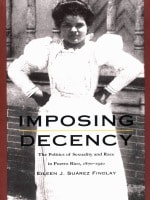
Imposing Decency
The Politics of Sexuality and Race in Puerto Rico, 1870–1920Eileen J. Suárez Findlay
Duke University Press, 2000
In showing how political projects and alliances in Puerto Rico were affected by racially contingent definitions of “decency” and “disreputability,” Findlay argues that attempts at moral reform and the state’s repression of “sexually dangerous” women were weapons used in batttles between elite and popular, American and Puerto Rican, and black and white. Based on a thorough analysis of popular and elite discourses found in both literature and official archives, Findlay contends that racialized sexual norms and practices were consistently a central component in the construction of social and political orders. The campaigns she analyzes include an attempt at moral reform by elite male liberals and a movement designed to enhance the family and cleanse urban space that ultimately translated into repression against symbollically darkened prostitutes. Findlay also explores how U.S. officials strove to construct a new colonial order by legalizing divorce and how feminist, labor, and Afro-Puerto Rican political demands escalated after World War I, often focusing on the rehabilitation and defense of prostitutes.
Imposing Decency forces us to rethink previous interpretations of political chronologies as well as reigning conceptualizations of both liberalism and the early working-class in Puerto Rico. Her work will appeal to scholars with an interest in Puerto Rican or Latin American studies, sexuality and national identity, women in Latin America, and general women’s studies.
Indian Ink
Script and Print in the Making of the English East India CompanyMiles Ogborn
University of Chicago Press, 2007
A commercial company established in 1600 to monopolize trade between England and the Far East, the East India Company grew to govern an Indian empire. Exploring the relationship between power and knowledge in European engagement with Asia, Indian Ink examines the Company at work and reveals how writing and print shaped authority on a global scale in the seventeenth and eighteenth centuries.
Tracing the history of the Company from its first tentative trading voyages in the early seventeenth century to the foundation of an empire in Bengal in the late eighteenth century, Miles Ogborn takes readers into the scriptoria, ships, offices, print shops, coffeehouses, and palaces to investigate the forms of writing needed to exert power and extract profit in the mercantile and imperial worlds. Interpreting the making and use of a variety of forms of writing in script and print, Ogborn argues that material and political circumstances always undermined attempts at domination through the power of the written word.
Navigating the juncture of imperial history and the history of the book, Indian Ink uncovers the intellectual and political legacies of early modern trade and empire and charts a new understanding of the geography of print culture.
Indigenous Textual Cultures
Reading and Writing in the Age of Global EmpireTony Ballantyne, Lachy Paterson, and Angela Wanhalla, editors
Duke University Press, 2020
Contributors. Noelani Arista, Tony Ballantyne, Alban Bensa, Keith Thor Carlson, Evelyn Ellerman, Isabel Hofmeyr, Emma Hunter, Arini Loader, Adrian Muckle, Lachy Paterson, Laura Rademaker, Michael P. J. Reilly, Bruno Saura, Ivy T. Schweitzer, Angela Wanhalla
Infrastructural Development, Corruption, Xenophobia, and Colonization in Central and Southeastern Europe
Silvia Marton
Central European University Press, 2026
Inter/Nationalism
Decolonizing Native America and PalestineSteven Salaita
University of Minnesota Press, 2016
“The age of transnational humanities has arrived.” According to Steven Salaita, the seemingly disparate fields of Palestinian Studses and American Indian studies have more in common than one may think. In Inter/Nationalism, Salaita argues that American Indian and Indigenous studies must be more central to the scholarship and activism focusing on Palestine.
Salaita offers a fascinating inside account of the Boycott, Divestment, and Sanctions (BDS) movement—which, among other things, aims to end Israel’s occupation of Palestinian land. In doing so, he emphasizes BDS’s significant potential as an organizing entity as well as its importance in the creation of intellectual and political communities that put Natives and other colonized peoples such as Palestinians into conversation. His discussion includes readings of a wide range of Native poetry that invokes Palestine as a theme or symbol; the speeches of U.S. President Andrew Jackson and early Zionist thinker Ze’ev Jabotinsky; and the discourses of “shared values” between the United States and Israel.
Inter/Nationalism seeks to lay conceptual ground between American Indian and Indigenous studies and Palestinian studies through concepts of settler colonialism, indigeneity, and state violence. By establishing Palestine as an indigenous nation under colonial occupation, this book draws crucial connections between the scholarship and activism of Indigenous America and Palestine.
Islanded
Britain, Sri Lanka, and the Bounds of an Indian Ocean ColonySujit Sivasundaram
University of Chicago Press, 2013
How did the modern nation of Sri Lanka come to be? In search of an answer to this question, Islanded returns us to the late eighteenth and early nineteenth centuries and to the advance of the British on the kingdom of Kandy. This advance saw the fall of the last foothold of kingly rule, centered in the highlands of the island. The British undertook a process of “islanding” and “partitioning,” which cast the island, its nature and geography, its religious and ethnic character, and its historical traditions and maritime culture as separate from British domains in mainland India and elsewhere.
Kings had seen themselves as rightful rulers of the whole territory of the island. Now, this right was violently extended by British colonists through the application of a model of crown rule and modern bureaucracy that tied ethnicity to language and religion, employing essentialized but not fully realized patterns that would continue to trouble the modern nation. Picking up a range of unusual themes, from migration, orientalism, and ethnography to botany, medicine, and education, Islanded is a groundbreaking text in Sri Lankan history writing, shaping discussions of the imperial transition in South Asia.

Israel and Settler Society
Lorenzo Veracini
Pluto Press, 2006
Veracini challenges two important myths: firstly, that the Israeli-Palestinian dispute is unique and defies comparative approaches; and secondly that the struggle is mainly based in nationality and religion and therefore different to typical colonial conflicts. On the contrary, Veracini shows how Israeli society is organised along apartheid lines -- and that apartheid was not unique to South Africa, but a common feature of colonisation. He examines wars of decolonization, and conflicts where whole native populations were all but eradicated -- as in Australia. Comparing and contrasting these with the more recent history of Israel and Palestine, he offers a critical perspective on colonialism as well as important new insights into patterns of imperialism today.