Results by title
319 books match the query 'Communication Studies' and 11 start with i
Identity Technologies
Constructing the Self OnlineEdited by Anna Poletti and Julie Rak
University of Wisconsin Press, 2013

In the Name of Necessity
Military Tribunals and the Loss of American Civil LibertiesMarouf Hasian
University of Alabama Press, 2005
Examining how claims of necessity have reshaped American liberty in times of war.
Though the war on terrorism is said to have generated unprecedented military situations, arguments for the Patriot Act and military tribunals following 9/11 resemble many historical claims for restricting civil liberties, more often than not in the name of necessity.
Marouf Hasian Jr. examines the major legal cases that show how various generations have represented the need for military tribunals, and how officials historically have applied the term “necessity.” George Washington cited the necessity of martial discipline in executing the British operative Major André. Tribunals tried and convicted more than 200 Sioux warriors during the Dakota Wars. President Lincoln suspended habeas corpus for many civilian and military prisoners during the Civil War. Twentieth Century military and civilian leaders selectively drafted their own codes, leading to the execution of German saboteurs during World War II. Further, General MacArthur’s tribunal to investigate the wartime activities of Japanese General Yamashita raised the specter of “victor’s justice,” anticipating the outcry that attended the Nuremberg trials.
In those cases as in current debates about the prosecution of terrorists, Hasian argues that the past is often cited selectively, neglecting historical contexts and the controversies these cases engendered.

Inconvenient Strangers
Transnational Subjects and the Politics of CitizenshipShui-yin Sharon Yam
The Ohio State University Press, 2019
Inconvenient Strangers: Transnational Subjects and the Politics of Citizenship draws attention to how intersecting networks of power—particularly race and ethnicity, gender, and social class—marginalize transnational subjects who find themselves outside a dominant citizenship that privileges familiarity and socioeconomic and racial superiority. In this study of how neoliberal ideas limit citizenship for marginalized populations in Hong Kong, Shui-yin Sharon Yam examines how three transnational groups—mainland Chinese maternal tourists, Southeast Asian migrant domestic workers, and South Asian permanent residents—engage with the existing citizenry and gain recognition through circulating personal narratives.
Coupling transnational feminist studies with research on emotions, Yam analyzes court cases, interviews, social media discourse, and the personal narratives of Hong Kong’s marginalized groups to develop the concept of deliberative empathy—critical empathy that prompts an audience to consider the structural sources of another’s suffering while deliberating one’s own complicity in it. Yam argues that storytelling and familial narratives can promote deliberative empathy among the audience as both a political and ethical response—carrying the affective power to jolt the dominant citizenry out of their usual xenophobic attitudes and ultimately prompt them to critically consider the human conditions they share with the marginalized and move them toward more ethical coalitions.
Information Sharing
Reference and Presupposition in Language Generation and InterpretationEdited by Kees van Deemter and Rodger Kibble
CSLI, 2002
Innovative Approaches to Teaching Technical Communication
edited by Tracy Bridgeford, Karla Saari Kitalong, and Dickie Selfe
Utah State University Press, 2004
Programs in technical writing, technical communication, and/or professional communication have recently grown in enrollment as the demand among employers for formally prepared technical writers and editors has grown. In response, scholarly treatments of the subject and the teaching of technical writing are also burgeoning, and the body of research and theory being published in this field is many times larger and more accessible than it was even a decade ago.
Although many theoretical and disciplinary perspectives can potentially inform technical communication teaching, administration, and curriculum development, the actual influences on the field's canonical texts have traditionally come from a rather limited range of disciplines. Innovative Approaches to Teaching Technical Communication brings together a wide range of scholars/teachers to expand the existing canon.
Institutional Literacies
Engaging Academic IT Contexts for Writing and CommunicationStuart A. Selber
University of Chicago Press, 2020
Institutional Literacies argues that writing and communication teachers and program directors should collaborate more closely and engage more deeply with IT staff as technology projects are planned, implemented, and expanded. Teachers need to both analyze how their institutions approach information technologies and intervene in productive ways as active university citizens with relevant expertise. To help them do so, the book offers a three-part heuristic, reflecting the reality that academic IT units are complex and multilayered, with historical, spatial, and textual dimensions. It discusses six ways teachers can intervene in the academic IT work of their own institutions: maintaining awareness, using systems and services, mediating for audiences, participating as user advocates, working as designers, and partnering as researchers. With these strategies in hand, educators can be proactive in helping institutional IT approaches align with the professional values and practices of writing and communication programs.
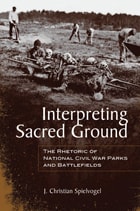
Interpreting Sacred Ground
The Rhetoric of National Civil War Parks and BattlefieldsJ. Christian Spielvogel
University of Alabama Press, 2013
A rhetorical analysis of Civil War battlefields and parks, and the ways various commemorative traditions—and their ideologies of race, reconciliation, emancipation, and masculinity—compete for dominance.
The National Park Service (NPS) is known for its role in the preservation of public sites deemed to have historic, cultural, and natural significance. In Interpreting Sacred Ground, J. Christian Spielvogel studies the NPS’s secondary role as an interpreter or creator of meaning at such sites, specifically Gettysburg National Military Park, Harpers Ferry National Historical Park, and Cold Harbor Visitor Center.
Spielvogel studies in detail the museums, films, publications, tours, signage, and other media at these sites, and he studies and analyzes how they shape the meanings that visitors are invited to construct. Though the NPS began developing interpretive exhibits in the 1990s that highlighted slavery and emancipation as central facets to understanding the war, Spielvogel argues that the NPS in some instances preserves outmoded narratives of white reconciliation and heroic masculinity, obscuring the race-related causes and consequences of the war as well as the war’s savagery.
The challenges the NPS faces in addressing these issues are many, from avoiding unbalanced criticism of either the Union or the Confederacy, to foregrounding race and violence as central issues, preserving clear and accurate renderingsof battlefield movements and strategies, and contending with the various public constituencies with their own interpretive stakes in the battle for public memory.
Spielvogel concludes by arguing for the National Park Service’s crucial role as a critical voice in shaping twentieth-first-century Civil War public memory and highlights the issues the agency faces as it strives to maintain historical integrity while contending with antiquated renderings of the past.

Intersectional Activism in Environmental Communication
Changemakers Respond to Ecological CrisesEmma Frances Bloomfield
Michigan State University Press, 2025

Invention as a Social Act
Karen Burke LevFevre. Foreword by Frank D'Angelo
Southern Illinois University Press, 1986
The act of inventing relates to the process of inquiry, to creativity, to poetic and aesthetic invention.
Building on the work of rhetoricians, philosophers, linguists, and theorists in other disciplines, Karen Burke LeFevre challenges a widely-held view of rhetorical invention as the act of an atomistic individual. She proposes that invention be viewed as a social act, in which individuals interact dialectically with society and culture in distinctive ways.
Even when the primary agent of invention is an individual, invention is pervasively affected by relationships of that individual to others through language and other socially shared symbol systems. LeFevre draws implications of a view of invention as a social act for writers, researchers, and teachers of writing.

Inventive Intercourse
From Rhetorical Conflict to the Ethical Creation of Novel TruthStephen R. Yarbrough
Southern Illinois University Press, 2006
Applying interactionist discourse theory to show how we create novel beliefs
Inventive Intercourse: From Rhetorical Conflict to the Ethical Creation of Novel Truth offers a theory of discursive interaction, illustrating how we can understand human communication without resorting to the notion of language. Using the perspective of interactionist discourse theory, author Stephen Yarbrough investigates how we create novel beliefs, beliefs we could not have inferred from our established beliefs.
The volume considers a central dilemma of post-modern thought: If language is a system of conventions and rules that limit what we can say and think, how can we deliberately produce anything truly novel? While postmodernism concludes that linguistic and conceptual change within our incommensurable worlds is driven by contingency and blind mechanical forces, Yarbrough argues that this view is wrong because the notion that language mediates our perception is wrong.
Beginning with philosopher Donald Davidson’s assertion that "there is no such thing as language" in the sense of a system of conventions and rules, Yarbrough develops an interactionist theory of discourse and uses it to revise the major elements of Aristotelian rhetoric to explain how we deliberately invent novel concepts that we come to believe.
Yarbrough suggests that all conceptual change is initiated by a shift in our ethical apperception of elements of a situation and that an ethical change will have emotional consequences. Changes in our emotional responses to things will change the ways we interact with them, he says, and changes in our interaction with things will create new technical relations which we can communicate to others only by altering our habitual shared way of using signs, metaphors, and other tropes.

Investment Citizenship
Rhetoric and Affect Beyond Late NeoliberalismBlake Abbott
Michigan State University Press, 2027
This book maps the development of a social and rhetorical phenomenon called investment citizenship: a mode of citizen-subjectivity articulated primarily through financial and affective investments. Investment citizenship is both a marker of personal identity and a complex, interwoven set of rhetorics, forces, actions, and assumptions that articulate the role of investment in social life. To that end, it examines three rhetorical couplets—investment and citizenship, financial investment and affective investment, to invest and to be invested—directly and through several cultural phenomena implicated by the emergence of investment rhetoric, such as US government policy, consumerism, ownership, education, and financial planning. Taken together, these couplets both extend and challenge late neoliberalism through the various invocations and implications of investment citizenship that reconfigure the relationship between the individual and society.