Results by title
264 books match the query 'Composition' and 7 start with i
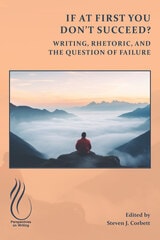
If at First You Don't Succeed?
Writing, Rhetoric, and the Question of FailureSteven J. Corbett
University Press of Colorado, 2025
What does it mean to fail at an important performance, to be a failure, or to fail someone at something? Failure is a universal concept widely applicable to every aspect of writing studies. Perhaps it is the most universal concept applicable to writing studies (or life, for that matter). But what it means to fail can mean vastly different things to vastly different people at vastly different times. In this edited collection, 25 writing studies scholars use failure as a conceptual lens to reflect on their experiences as scholars and teachers. Their contributions address historical and theoretical treatments of failure, offer case studies of failure in teaching and research, and share brief (but bitter/sweet) narratives drawn from personal experiences in the field.
[more]
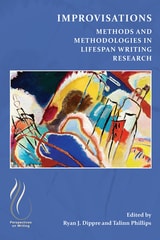
Improvisations
Methods and Methodologies in Lifespan Writing ResearchRyan J. Dippre
University Press of Colorado, 2025
Improvisations provides readers with insights and options as they develop new lifespan writing research projects or seek to re-orient existing projects to incorporate a lifespan lens. In Part 1 of this edited collection, contributors consider research methodologies that have been adapted to the particular demands of lifespan writing research, with each methodology given two chapters: one that outlines the process of taking up the methodology, and another that provides a detailed example of the methodology in action. In Part 2, contributors suggest new methodologies for lifespan writing research and highlight challenges that this line of inquiry presents as an ethical and socially conscious research agenda. These chapters, representing both established experts and new voices in writing, literacy, and education research, will be of use to graduate students and novice researchers, accomplished researchers pivoting to this area of study for the first time, and others who want to learn more about lifespan writing research.
[more]
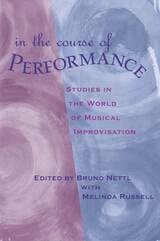
In the Course of Performance
Studies in the World of Musical ImprovisationEdited by Bruno Nettl and Melinda Russell
University of Chicago Press, 1998
In the Course of Performance is the first book in decades to illustrate and explain the practices and processes of musical improvisation. Improvisation, by its very nature, seems to resist interpretation or elucidation. This difficulty may account for the very few attempts scholars have made to provide a general guide to this elusive subject. With contributions by seventeen scholars and improvisers, In the Course of Performance offers a history of research on improvisation and an overview of the different approaches to the topic that can be used, ranging from cognitive study to detailed musical analysis. Such diverse genres as Italian lyrical singing, modal jazz, Indian classical music, Javanese gamelan, and African-American girls' singing games are examined. The most comprehensive guide to the understanding of musical improvisation available, In the Course of Performance will be indispensable to anyone attracted to this fascinating art.
Contributors are Stephen Blum, Sau Y. Chan, Jody Cormack, Valerie Woodring Goertzen, Lawrence Gushee, Eve Harwood, Tullia Magrini, Peter Manuel, Ingrid Monson, Bruno Nettl, Jeff Pressing, Ali Jihad Racy, Ronald Riddle, Stephen Slawek, Chris Smith, R. Anderson Sutton, and T. Viswanathan.
Contributors are Stephen Blum, Sau Y. Chan, Jody Cormack, Valerie Woodring Goertzen, Lawrence Gushee, Eve Harwood, Tullia Magrini, Peter Manuel, Ingrid Monson, Bruno Nettl, Jeff Pressing, Ali Jihad Racy, Ronald Riddle, Stephen Slawek, Chris Smith, R. Anderson Sutton, and T. Viswanathan.
[more]
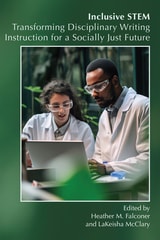
Inclusive STEM
Transforming Disciplinary Writing Instruction for a Socially Just FutureHeather M. Falconer
University Press of Colorado, 2025
Encompassing a diversity of STEM education contexts, this edited collection offers instructional strategies and assignments for creating equitable, inclusive classrooms. With a focus on writing instruction, each chapter presents ways to create space for individuals and voices historically marginalized in STEM disciplines. Contributions move beyond typical disciplinary writing and content instruction and instead focus on work that is intentionally, sometimes subtly, disrupting the assumptions of STEM writing, communication, and knowledge-making. Contributors consider how we can create a sense of belonging for students from groups that have historically been kept out of these disciplines, how faculty can consciously create space for student voices to be heard, and how to do so with an eye toward the discursive practices of STEM disciplines. The chapters in Inclusive STEM offer specific cases—classroom- or research-based contexts—that describe their intents and goals, the interventions they enacted, how students responded, and the unexpected elements that presented themselves. These chapters also reveal the ugly bits: sharing lessons learned and errors made. The collection targets educators who teach disciplinary content, as well as writing in STEM.
[more]
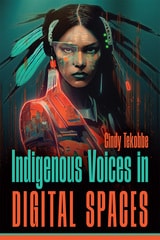
Indigenous Voices in Digital Spaces
Cindy Tekobbe
Utah State University Press, 2024
Indigenous Voices in Digital Spaces applies Indigenous frameworks and epistemologies to online cultural movements through four case studies, including hashtags, memes, cryptocurrency, and digital artistry, and develops decolonizing practices for digital rhetoric, online identity work, and digital literacy practices.
Tekobbe’s methods for analyzing and understanding Indigenous knowledges online center Indigenous storytelling and “thick” (broad, deep, and complex) Indigenous meaning-making. Employing this thickness to interpret Indigenous knowledge ways resists the settler-colonial logics that tend to flatten complex Indigenous concepts into one-note representations of racial stereotypes. Native Americans’ use of social media and digital platforms to support social movements uniquely constructs Indigenous identities as living, producing, and culture-making people, which confronts the commonplace, one-dimensional narrative that Indigenous North Americans either live in isolation or are people of history resigned to the long-forgotten past. Tekobbe’s methods are applicable to additional online research to break through Western paradigms of oppositional critique, the colonial power matrix embedded in hierarchical and taxonomical classification systems, and participant objectification.
Indigenous Voices in Digital Spaces offers new methodological and epistemological opportunities to explore digital communities and technologies, problematizing conventional Western critique. This book is useful to instructors in Indigenous studies, internet studies, digital literacies, cultural studies, and communications, as well as Indigenous and internet studies researchers.
[more]
Institutional Ethnography as Writing Studies Practice
Michelle LaFrance
University Press of Colorado, 2024
The editors and contributors to this collection offer insights into the use of institutional ethnography for three primary purposes: to investigate and interrogate the cultures of work that are of interest to writing studies researchers, to understand more deeply what constitutes this work, and to consider how work takes shape within institutional contexts. Building on prior conversations about institutional ethnography, critical ethnography, and the complexities of writing programs, the editors and chapter authors consider their application to sites of writing and writing instruction. In doing so, they reveal the power of material conditions, institutional and field-based values, and the cultures of writing to shape how people carry out their everyday work in writing programs and other venues in which writing plays a central role. The findings shared in this edited collection provide insights into how institutional ethnography as a form of inquiry can make important contributions to the fields’ many ongoing conversations about the nature of our work, labor, and other writing-related interests.
[more]
Interrogating Gendered Pathologies
Erin A. Clark
Utah State University Press, 2020
Interrogating Gendered Pathologies points out and critiques unjust patterns of pathology. Erin A. Frost and Michelle F. Eble assemble a transdisciplinary approach from/to technologies, rhetorics, philosophies, epistemologies, and biomedical data to consider the effects of biomedicine’s gendered norms on people’s lives. Using a range of complementary and intersectional theoretical approaches, contributors ask questions about rhetoric’s role in healthcare and how it differs depending on patient embodiment and the ways nonnormative bodies are pathologized.
These chapters engage common narratives about the ways in which gender in healthcare is secondary and highlights the stories of people who have battled to prioritize their own bodies through extraordinary difficulties. Employing a multiplicity of voices, the book represents a number of different perspectives on what it might look like to return health and medical data to embodied experience, to consider the effects of gendered and intersectional biomedical norms on lived realities, and to subvert the power of institutions in ways that move us toward biomedical justice.
This collection contributes to the burgeoning field of health and medical rhetorics by rhetorically and theoretically intervening in what are often seen as objective and neutral decisions related to the body and to scientific and medical data about bodies. Interrogating Gendered Pathologies will be of interest to feminist scholars in the field of rhetoric and writing studies, specifically those in the rhetorics of health and medicine, as well as scholars of technical communication, feminist studies, gender studies, technoscience studies, and bioethics.
Contributors: Leslie Anglesey, Mary Assad, Beth Boser, Lillian Campbell, Marleah Dean, Lori Beth De Hertogh, Leandra Hernandez, Elizabeth Horn-Walker, Caitlin Leach, Jordan Liz, Miriam Mara, Cathryn Molloy, Kerri Morris, Maria Novotny, Sage Perdue, Colleen Reilly
[more]