Results by title
474 books match the query 'Computers' and 22 start with i
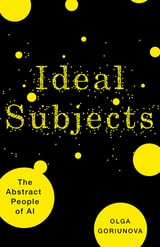
Ideal Subjects
The Abstract People of AIOlga Goriunova
University of Minnesota Press, 2025
How data and artificial intelligence create a new, abstract digital subject
Ideal Subjects examines how samples of our lives and daily behaviors have come to reside in the world of data and artificial intelligence—and what this means for who we are and what we may become. Detailing how AI-facilitated algorithmic prediction and data modeling make “ideal subjects” of us, Olga Goriunova explores the complex ways we relate to these digital abstractions.
As more and more of our experience is funneled through computational records and models, datafied aspects of our lives are segmented and reconfigured to operate as new entities. Rather than viewing these abstract assemblages as extensions of our selves, Goriunova encourages us to consider these products of computational processes as an entirely new kind of subject, one that is both more and less than a human.
Through close readings of contemporary digital practices and data analytics, Goriunova exposes the profound ethical, aesthetic, and political implications of producing and managing these new digital subjects. Highlighting the distinctive impact of computation on contemporary subject formation while placing the present within a history of shifting conceptions of the subject, she gives us much-needed tools for understanding how our intimate selves are rendered by the abstract entities of big data. Ideal Subjects presents an uncanny and deeply fascinating portrait of modern subjectivity in the technological age.
Retail e-book files for this title are screen-reader friendly with images accompanied by short alt text and/or extended descriptions.

Imaging and Sensing for Unmanned Aircraft Systems
Control and Performance, Volume 1Vania V. Estrela
The Institution of Engineering and Technology, 2020

Imaging and Sensing for Unmanned Aircraft Systems
Deployment and Applications, Volume 2Vania V. Estrela
The Institution of Engineering and Technology, 2020

In the Land of the Unreal
Virtual and Other Realities in Los AngelesLisa Messeri
Duke University Press, 2024

Indie Cinema Online
Sarah E.S. Sinwell
Rutgers University Press, 2020
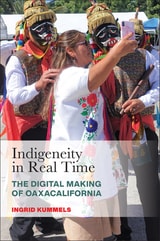
Indigeneity in Real Time
The Digital Making of OaxacaliforniaIngrid Kummels
Rutgers University Press, 2023

Industrial Software Technology
R.J. Mitchell
The Institution of Engineering and Technology, 1987
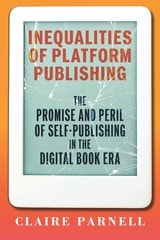
Inequalities of Platform Publishing
The Promise and Peril of Self-Publishing in the Digital Book EraClaire Parnell
University of Massachusetts Press, 2025
Uncovering race, gender, and sexual biases in popular self-publishing platforms
The average reader need not go far in a bookstore before, knowingly or not, they encounter authors who started their careers by self-publishing prior to achieving commercial success. Examples include Margaret Atwood, Andy Weir, Colleen Hoover, Anna Todd, E. L. James, Scarlett St. Clair, and many more. Such stories of self-made writers are compelling and seem more attainable to others with the accessibility of modern publishing platforms such as Amazon, Apple, Google, Kobo, Wattpad, Webtoon, Radish, Inkitt, Qidian, Tapas, and Swoon Reads. However, as Claire Parnell uncovers in her examination of the two most popular—Amazon and Wattpad—these services in fact perpetuate systemic racial, gender, and sexual bias against authors of color and queer authors through their technological, economic, social, and cultural structures.
At a time when there is a real reckoning with the discrimination that has resulted in publishing opportunities for only relatively few privileged authors—who are often White, upper class, and male—self-publishing presents itself as an equalizer of sorts. Exploring that idea, Parnell shows that these platforms are not just intermediaries for information; they structure content and users in multiple, often inequitable, ways through their ability to set market conditions and apply algorithmic sorting. Combining original interviews, walkthrough method, metadata analysis, and more, Parnell finds that self-publishing platforms reproduce challenges for authors from marginalized communities. Far from equalizing the market, the new platforms instead frequently perpetuate the stubborn barriers to mainstream success for BIPOC and queer authors.
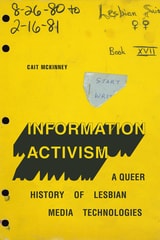
Information Activism
A Queer History of Lesbian Media TechnologiesCait McKinney
Duke University Press, 2020
Information Please
Culture and Politics in the Age of Digital MachinesMark Poster
Duke University Press, 2006
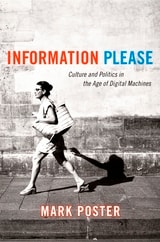
Poster’s critique develops through a series of lively studies. Analyzing the appearance of Sesame Street’s Bert next to Osama Bin Laden in a New York Times news photo, he examines the political repercussions of this Internet “hoax” as well as the unlimited opportunities that Internet technology presents for the appropriation and alteration of information. He considers the implications of open-source licensing agreements, online personas, the sudden rise of and interest in identity theft, peer-to-peer file sharing, and more. Focusing explicitly on theory, he reflects on the limitations of critical concepts developed before the emergence of new media, particularly globally networked digital communications, and he argues that, contrary to the assertions of Michael Hardt and Antonio Negri, new media do not necessarily reproduce neoimperialisms. Urging a rethinking of assumptions ingrained during the dominance of broadcast media, Poster charts new directions for work on politics and digital culture.

Information Security
Foundations, technologies and applicationsAli Ismail Awad
The Institution of Engineering and Technology, 2018
Institutional Literacies
Engaging Academic IT Contexts for Writing and CommunicationStuart A. Selber
University of Chicago Press, 2020
Institutional Literacies argues that writing and communication teachers and program directors should collaborate more closely and engage more deeply with IT staff as technology projects are planned, implemented, and expanded. Teachers need to both analyze how their institutions approach information technologies and intervene in productive ways as active university citizens with relevant expertise. To help them do so, the book offers a three-part heuristic, reflecting the reality that academic IT units are complex and multilayered, with historical, spatial, and textual dimensions. It discusses six ways teachers can intervene in the academic IT work of their own institutions: maintaining awareness, using systems and services, mediating for audiences, participating as user advocates, working as designers, and partnering as researchers. With these strategies in hand, educators can be proactive in helping institutional IT approaches align with the professional values and practices of writing and communication programs.
Intellectual Freedom Manual, Eleventh Edition
Erin Office for Intellectual Freedom
American Library Association, 2026
When someone faces a difficult intellectual freedom (IF) issue, they usually don’t have time to wade through dense text to find the answers they need. Designed as a real-world reference, OIF’s Intellectual Freedom Manual provides trusted, comprehensive guidance for every library worker, from the volunteer to the director, in plain language. Whether you’re developing or reviewing policies, on-boarding new staff or trustees, responding to challenges and controversies, or studying librarianship, you’ll find this a vital tool, with features such as
- contributions that center the voices of Black, Indigenous, and other People of Color (BIPOC) and LGBTQIA+ people, who are often targeted by censorship efforts;
- chapters that begin with an overview explaining the big ideas and offering reflection questions;
- an introduction to IF and why it matters, drawing on ALA's core IF documents and supported with adaptable policy worksheets;
- information and best practice guidance on key topics such as access, children and youth, censorship and internet filtering, collection development and management, copyright, meeting rooms and exhibit spaces, library programming, politics and religion, privacy, and visits and requests from law enforcement;
- stories from real people whose lives have been impacted by IF, showing how library policies shape culture, protect staff and users, and affect real people;
- concise breakdowns of IF issues from legal experts, helping you understand the laws and how they apply in real situations;
- practical advice on advocating for IF, getting help when challenges arise, lobbying, and working with your elected officials;
- a thorough index to help you quickly find the information you need; and
- a helpful glossary and selected bibliography of additional resources.
Intelligence-driven Smart Technologies for Multimedia and Multimodal Data Security
Vinay Kumar Srivastava
The Institution of Engineering and Technology, 2026

Intelligent Distributed Video Surveillance Systems
Sergio A. Velastin
The Institution of Engineering and Technology, 2006

Intelligent Multimedia Processing and Computer Vision
Techniques and applicationsShyam Singh Rajput
The Institution of Engineering and Technology, 2023

Intelligent Multimedia Technologies for Financial Risk Management
Trends, tools and applicationsSimon Grima
The Institution of Engineering and Technology, 2023

Intelligent Network Design Driven by Big Data Analytics, IoT, AI and Cloud Computing
Sunil Kumar
The Institution of Engineering and Technology, 2022
Internet Daemons
Digital Communications PossessedFenwick McKelvey
University of Minnesota Press, 2018
A complete history and theory of internet daemons brings these little-known—but very consequential—programs into the spotlight
We’re used to talking about how tech giants like Google, Facebook, and Amazon rule the internet, but what about daemons? Ubiquitous programs that have colonized the Net’s infrastructure—as well as the devices we use to access it—daemons are little known. Fenwick McKelvey weaves together history, theory, and policy to give a full account of where daemons come from and how they influence our lives—including their role in hot-button issues like network neutrality.
Going back to Victorian times and the popular thought experiment Maxwell’s Demon, McKelvey charts how daemons evolved from concept to reality, eventually blossoming into the pandaemonium of code-based creatures that today orchestrates our internet. Digging into real-life examples like sluggish connection speeds, Comcast’s efforts to control peer-to-peer networking, and Pirate Bay’s attempts to elude daemonic control (and skirt copyright), McKelvey shows how daemons have been central to the internet, greatly influencing everyday users.
Internet Daemons asks important questions about how much control is being handed over to these automated, autonomous programs, and the consequences for transparency and oversight.
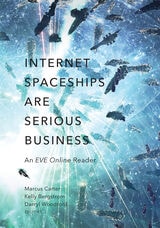
Internet Spaceships Are Serious Business
An EVE Online ReaderMarcus Carter
University of Minnesota Press, 2016
EVE Online is a socially complex, science-fiction-themed universe simulation and massively multiplayer online game (MMOG) first released in 2003. Notorious for its colossal battles and ruthless player culture, it has hundreds of thousands of players today. In this fascinating book, scholars, players, and EVE’s developer (CCP Games) examine the intricate world of EVEOnline--providing authentic accounts of lived experience within a game with more than a decade of history and millions of “real” dollars behind it.
Internet Spaceships Are Serious Business features contributions from outstanding EVE Online players, such as The Mittani, an infamous member of the game’s community, as well as academics from around the globe. They cover a wide range of subjects: the game’s technicalities and its difficulty; its projection of humanity’s future in space; the configuration of its unique, single-server game world; the global nature of warfare in its “nullsec” territory (and how EVE players have formed a global concept of time); stereotypes of Russian players; espionage play; in-game memorials to Vile Rat (aka U.S. State Department official Sean Smith, murdered in the 2012 Benghazi attack); its gendered playing experience; and CCP Games’ relationship with players; and its history and legacy.
Internet Spaceships Are Serious Business is a must for EVE Online players interested in a broad perspective on their all-consuming game. It is also accessible to scholars, game designers seeking to understand and replicate the successful aspects unique to EVE Online, and even those who have never played this notoriously complex game.
Contributors: William Sims Bainbridge, National Science Foundation; Chribba; Jedrzej Czarnota; Kjartan Pierre Emilsson; Dan Erdman; Rebecca Fraimow; Martin R. Gibbs, U of Melbourne; Catherine Goodfellow; Kathryn Gronsbell; Keith Harrison; Kristin MacDonough; Mantou (Zhang Yuzhou); Oskar Milik; The Mittani (Alexander Gianturco); Joji Mori; Richard Page; Christopher Paul, Seattle U; Erica Titkemeyer, U of North Carolina at Chapel Hill; Nick Webber, Birmingham City U.

Internet and Wireless Security
Robert Temple
The Institution of Engineering and Technology, 2002

Introduction to Probability for Data Science
Stanley Chan
Michigan Publishing Services, 2021
- Motivation: In the ocean of mathematical definitions, theorems, and equations, why should we spend our time on this particular topic but not another?
- Intuition: When going through the deviations, is there a geometric interpretation or physics beyond those equations?
- Implication: After we have learned a topic, what new problems can we solve?