Results by title
75 books match the query 'Confederate States of America' and 2 start with i
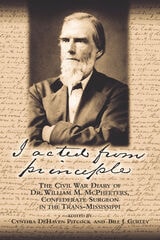
I Acted from Principle
The Civil War Diary of Dr. William M. McPheeters, Confederate Surgeon in the Trans-MississippiCynthia DeHaven Pitcock
University of Arkansas Press, 2000
At the start of the Civil War, Dr. William McPheeters was a distinguished physician in St. Louis, conducting unprecedented public-health research, forging new medical standards, and organizing the state's first professional associations. But Missouri was a volatile border state. Under martial law, Union authorities kept close watch on known Confederate sympathizers. McPheeters was followed, arrested, threatened, and finally, in 1862, given an ultimatum: sign an oath of allegiance to the Union or go to federal prison. McPheeters "acted from principle" instead, fleeing by night to Confederate territory. He served as a surgeon under Gen. Sterling Price and his Missouri forces west of the Mississippi River, treating soldiers' diseases, malnutrition, and terrible battle wounds. From almost the moment of his departure, the doctor kept a diary. It was a pocket-size notebook which he made by folding sheets of pale blue writing paper in half and in which he wrote in miniature with his steel pen. It is the first known daily account by a Confederate medical officer in the Trans-Mississippi Department. It also tells his wife's story, which included harassment by Federal military officials, imprisonment in St. Louis, and banishment from Missouri with the couple's two small children. The journal appears here in its complete and original form, exactly as the doctor first wrote it, with the addition of the editors' full annotation and vivid introductions to each section.
[more]
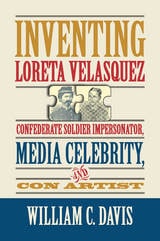
Inventing Loreta Velasquez
Confederate Soldier Impersonator, Media Celebrity, and Con ArtistWilliam C. Davis
Southern Illinois University Press, 2016
She went by many names—Mary Ann Keith, Ann Williams, Lauretta Williams, and more—but history knows her best as Loreta Janeta Velasquez, a woman who claimed to have posed as a man to fight for the Confederacy. In Inventing Loreta Velasquez, acclaimed historian William C. Davis delves into the life of one of America’s early celebrities, peeling back the myths she herself created to reveal a startling and even more implausible reality.
This groundbreaking biography reveals a woman quite different from the public persona she promoted. In her bestselling memoir, The Woman in Battle, Velasquez claimed she was an emphatic Confederate patriot, but in fact she never saw combat. Instead, during the war she manufactured bullets for the Union and persuaded her Confederate husband to desert the Army.
After the Civil War ended, she wore many masks, masterminding ambitious confidence schemes worth millions, such as creating a phony mining company, conning North Carolina residents to back her financially in a fake immigration scheme, and attracting investors to build a railroad across western Mexico. With various husbands, Velasquez sought her fortune both in the American West and in the Klondike, though her endeavors cost one husband his life. She also became a social reformer advocating on behalf of better prison conditions, the Cuban revolt against Spain, and the plight of Cuban refugees. Further, Velasquez was one of the first women to venture into journalism and presidential politics. Always a sensational press favorite, she displayed throughout her life an uncanny ability to manipulate popular media and to benefit from her fame in a way that prefigured celebrities of our own time, including using her testimony in a Congressional inquiry about Civil War counterfeiting as a means of promoting her latest business ventures.
So little has been known of Velasquez’s real life that some postmodern scholars have glorified her as a “woman warrior” and used her as an example in cross-gender issues and arguments concerning Hispanic nationalism. Davis firmly refutes these notions by bringing the historical Velasquez to the surface. The genuine story of Velasquez’s life is far more interesting than misguided interpretations and her own fanciful inventions.
[more]