Results by title
244 books match the query 'Crime' and 5 start with i
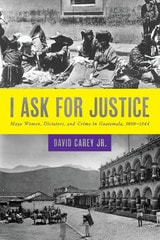
I Ask for Justice
Maya Women, Dictators, and Crime in Guatemala, 1898–1944By David Carey Jr.
University of Texas Press, 2013
This study of the Guatemalan legal system during the regimes of two of Latin America’s most repressive dictators reveals the surprising extent to which Maya women used the courts to air their grievances and defend their human rights.
Winner, Bryce Wood Book Award, Latin American Studies Association, 2015
Given Guatemala’s record of human rights abuses, its legal system has often been portrayed as illegitimate and anemic. I Ask for Justice challenges that perception by demonstrating that even though the legal system was not always just, rural Guatemalans considered it a legitimate arbiter of their grievances and an important tool for advancing their agendas. As both a mirror and an instrument of the state, the judicial system simultaneously illuminates the limits of state rule and the state’s ability to co-opt Guatemalans by hearing their voices in court.
Against the backdrop of two of Latin America’s most oppressive regimes—the dictatorships of Manuel Estrada Cabrera (1898–1920) and General Jorge Ubico (1931–1944)—David Carey Jr. explores the ways in which indigenous people, women, and the poor used Guatemala’s legal system to manipulate the boundaries between legality and criminality. Using court records that are surprisingly rich in Maya women’s voices, he analyzes how bootleggers, cross-dressers, and other litigants crafted their narratives to defend their human rights. Revealing how nuances of power, gender, ethnicity, class, and morality were constructed and contested, this history of crime and criminality demonstrates how Maya men and women attempted to improve their socioeconomic positions and to press for their rights with strategies that ranged from the pursuit of illicit activities to the deployment of the legal system.
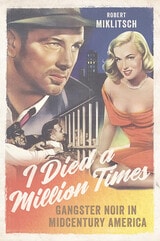
I Died a Million Times
Gangster Noir in Midcentury AmericaRobert Miklitsch
University of Illinois Press, 2020
With the Senate's organized crime hearings and the brighter-than-bright myth of the American Dream as a backdrop, Miklitsch examines the style and history, and the production and cultural politics, of classic pictures from The Big Heat and The Asphalt Jungle to lesser-known gems like 711 Ocean Drive and post-Fifties movies like Ocean’s Eleven. Miklitsch pays particular attention to trademark leitmotifs including the individual versus the collective, the family as a locus of dissension and rapport, the real-world roots of the heist picture, and the syndicate as an octopus with its tentacles deep into law enforcement, corporate America, and government. If the memes of gangster noir remain prototypically dark, the look of the films becomes lighter and flatter, reflecting the influence of television and the realization that, under the cover of respectability, crime had moved from the underworld into the mainstream of contemporary everyday life.
Imperial Policing
Weaponized Data in Carceral ChicagoAndy Clarno
University of Minnesota Press, 2024
Exposing the carceral webs and weaponized data that shape Chicago’s police wars
Chicago is a city with extreme concentrations of racialized poverty and inequity, one that relies on an extensive network of repressive agencies to police the poor and suppress struggles for social justice. Imperial Policing examines the role of local law enforcement, federal immigration authorities, and national security agencies in upholding the city’s highly unequal social order.
Collaboratively authored by the Policing in Chicago Research Group, Imperial Policing was developed in dialogue with movements on the front lines of struggles against racist policing in Black, Latinx, and Arab/Muslim communities. It analyzes the connections between three police “wars”—on crime, terror, and immigrants—focusing on the weaponization of data and the coordination between local and national agencies to suppress communities of color and undermine social movements. Topics include high-tech, data-based tools of policing; the racialized archetypes that ground the police wars; the manufacturing of criminals and terrorists; the subversion of sanctuary city protections; and abolitionist responses to policing, such as the Erase the Database campaign.
Police networks and infrastructure are notoriously impenetrable to community members and scholars, making Imperial Policing a rare, vital example of scholars working directly with community organizations to map police networks and intervene in policing practices. Engaging in a methodology designed to provide support for transformative justice organizations, the Policing in Chicago Research Group offers a critical perspective on the abolition of imperial policing, both in Chicago and around the globe.
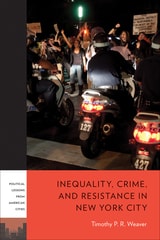
Inequality, Crime, and Resistance in New York City
Timothy P. R. Weaver
Temple University Press, 2025
Weaver brings these clashes to the fore by showing how New York City politics has been shaped by these conflicting orders. He examines the transformation of the city’s political economy in the aftermath of the 1975 fiscal crisis through neoliberal real estate development and privatization, the conservative rise of law-and-order politics in the 1970s to 1990s, and the efforts of the city’s egalitarians to respond to each of these shifts through social movements such as Occupy and Black Lives Matter.
Inequality, Crime, and Resistance in New York City belies glib assumptions about the city’s liberal character. Weaver reveals the metropolis not as a homogenous political whole, but as a site in which the victories and defeats of rival political forces change the terms of local citizenship for the millions of residents who call the city home.
In the series Political Lessons from American Cities
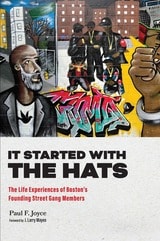
It Started with the Hats
The Life Experiences of Boston’s Founding Street Gang MembersPaul F. Joyce, with a foreword by J. Larry Mayes
Southern Illinois University Press, 2024
In the late 1980s, the introduction of crack cocaine and easy access to guns led to the emergence of the street gang culture and an explosion of gun violence in Boston. Black and Latino youth were both perpetrators and victims of firearm violence as the city grappled with a staggering number of shootings and homicides. Officers within the Boston Police Department struggled to find new and creative ways to combat the growing violence and neutralize gang influence. Paul Joyce was one of those officers.
Throughout his extensive career with the Boston Police, Joyce was at the forefront of the Department’s anti-gang and youth violence initiatives, including during the height of gang and gun violence in the late 1980s through early 1990s. Later in his career, after thirty-one years in policing, Joyce transitioned to academia as a criminologist, seeking to better understand the lives of the gang members he had encountered during his time as an officer. He interviewed thirty Black and Latino men who witnessed and led the emergence of the street gang phenomenon in Boston. Joyce’s strong relationship with community leaders led to the recruitment of the men, who ultimately entrusted him with their life stories and their inner worlds. Using the men’s own words to describe the tragedies they endured, the crimes they committed, and the penalties they paid, Joyce now shares their stories of life before, during, and after gang membership.
Joyce examines the influences that motivated the men toward joining gangs, their gang experiences, and the turning points that shaped their paths later in life, whether leading to desistance from or continued persistence in criminal behavior. Joyce explores their lives from childhood into adulthood, providing a deep analysis of the factors that influenced the entire trajectory of gang members’ lives. By utilizing this life-course approach, Joyce adds to the discourse regarding what influences a gang member’s ability or inability to transition out of criminality and the gang life.
This uniquely candid look at gang membership, humanized by the perspectives of the men who experienced it, provides invaluable insight into the complex interplay of the social, cultural, and personal factors that shape individuals’ life courses. This, in turn, has important implications regarding the types of outside interventions that would be the most effective in making a positive difference in the lives of current and former gang members.