Results by title
176 books match the query 'Deaf' and 10 start with i
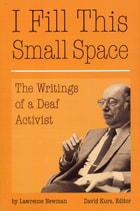
I Fill This Small Space
The Writings of a Deaf ActivistLawrence Newman
Gallaudet University Press, 2009
Lawrence Newman became deaf at the age of five in 1930, and saw his father fight back tears knowing that his son would never hear again. The next time he saw his father cry was in 1978, when Newman received an honorary doctorate from Gallaudet University, his alma mater. Newman was recognized for his achievements as a life-long advocate for deaf education, including receiving California’s Teacher of the Year award in 1968. Perhaps his greatest influence, however, stemmed from his many articles and columns that appeared in various publications, the best of which are featured in I Fill This Small Space: The Writings of a Deaf Activist.
Editor David Kurs has organized Newman’s writings around his passions — deaf education, communication and language, miscellaneous columns and poems on Deaf life, and humorous insights on his activism. His articles excel both as seamless arguments supporting his positions and as windows on the historical conflicts that he fought: against the Least Restrictive Environment in favor of residential deaf schools; for sign language, Total Communication, and bilingual education; and as a deaf teacher addressing parents of deaf children. A gifted writer in all genres, Newman amuses with ease (“On Mini and Midi-Skirts”), and moves readers with his heartfelt verse (“Girl with a Whirligig”). Newman ranges wide in his ability, but he always maintains his focus on equal tights for deaf people, as he demonstrates in his title poem “I Fill This Small Space:”
I fill this small space, this time
Who is to say yours is better
Than mine or mine yours
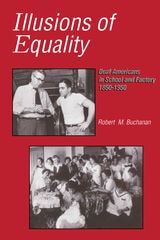
Illusions of Equality
Deaf Americans in School and Factory, 1850-1950Robert M. Buchanan
Gallaudet University Press, 1999
The working lives of Deaf Americans from the mid-1850s to the post-World War II era depended upon strategies created by Deaf community leaders to win and keep jobs through periods of low national employment as well as high. Deaf people typically sought to de-emphasize their identity as sign language users to be better integrated into the workforce. But in his absorbing new book Illusions of Equality, Robert Buchanan shows that events during the next century would thwart these efforts.
The residential schools for deaf students established in the 19th century favored a bilingual approach to education that stressed the use of American Sign Language while also recognizing the value of learning English. But the success of this system was disrupted by the rise of oralism, with its commitment to teaching deaf children speech and its ban of sign language. Buchanan depicts the subsequent ramifications in sobering terms: most deaf students left school with limited educations and abilities that qualified them for only marginal jobs. He also describes the insistence of the male hierarchy in the Deaf community on defending the tactics of individual responsibility through the end of World War II, a policy that continually failed to earn job security for Deaf workers. Illusions of Equality is an original, edifying work that will be appreciated by scholars and students for years to come.
In Our Hands
Educating Healthcare InterpretersLaurie Swabey
Gallaudet University Press, 2012
Deaf Americans have identified healthcare as the most difficult setting in which to obtain a qualified interpreter. Yet, relatively little attention has been given to developing evidence-based resources and a standardized body of knowledge to educate healthcare interpreters. In Our Hands: Educating Healthcare Interpreters addresses these concerns by delineating the best practices for preparing interpreters to facilitate full access for deaf people in healthcare settings.
The first section of this volume begins with developing domains and competencies toward a teaching methodology for medical and mental health interpreters. The next chapter describes a discourse approach that relies on analyzing actual transcripts and recordings to train healthcare interpreters. Other chapters feature a model mental health interpreter training program in Alabama; using a Demand-Control Schema for experiential learning; the risk of vicarious trauma to interpreters; online educational opportunities; and interpreting for deaf health care professionals. The second section offers four perspectives on education, including healthcare literacy of the clients; the education of Deaf interpreters; the development of standards for spoken-language healthcare interpreters; and the perspectives of healthcare interpreter educators in Europe. The range and depth of In Our Hands takes significant strides in presenting educational opportunities that can enhance the critical services provided by healthcare interpreters to deaf clients.

In Our Own Hands
Essays in Deaf History, 1780–1970Brian H. Greenwald
Gallaudet University Press, 2016
These essays reveal how deaf people used their agency to engage in vigorous debates about issues that constantly tested the values of deaf people as Americans. The debates overlapped with social trends and spilled out into particular physical and social spaces such as clubs and churches, as well as within families. These previously unexplored areas in Deaf history intersect with important subthemes in American history, such as Southern history, religious history, and Western history.
The contributors demonstrate that as deaf people pushed for their rights as citizens, they met with resistance from hearing people, and the results of their efforts were decidedly mixed. These works reinforce the Deaf community’s longstanding desire to be part of the nation. In Our Own Hands contributes to an increased understanding of the struggle for citizenship and expands our current understanding of race, gender, religion, and other trends in Deaf history.

In Silence
Growing Up Hearing in a Deaf WorldRuth Sidransky
Gallaudet University Press, 2006
Inside her family’s apartment, Sidransky knew a warm, secure place. She recalls her earliest memories of seeing words fall from her parents’ hands. She remembers her father entertaining the family endlessly with his stories, and her mother’s story of tying a red ribbon to herself and her infant daughter to know when she needed anything in the night.
Outside the apartment, the cacophonous hearing world greeted Sidransky’s family with stark stares of curiosity as though they were “freaks.” Always upbeat, her proud father still found it hard to earn a living. When Sidransky started school, she was placed in a class for special needs children until the principal realized that she could hear and speak.
Sidransky portrays her family with deep affection and honesty, and her frank account provides a living narrative of the Deaf experience in pre- and post-World War II America. In Silence has become an invaluable chronicle of a special time and place that will affect all who read it for years to come.

Indian Sign Language
A Linguistic Analysis of Its GrammarSamar Sinha
Gallaudet University Press, 2017
Samar Sinha presents pioneering research into the grammatical properties of Indian Sign Language (ISL), a language used by members of the Deaf community in India. This detailed and well-illustrated study describes the grammar of ISL and is supplemented by comparative and theoretical analyses in the core areas of sublexical structure, morphology, and syntax. Sinha offers a field-based, comprehensive analysis that covers topics such as
o sign formation parameters
o syllable structure
o sonority hierarchy
o semantics of space
o pluralization strategies
o phi-features
o indexing and localization
o agreement
o word order
He provides a description of the Indian Deaf community that serves to frame his analysis of ISL and highlights the need for greater awareness and acknowledgment of the language and its users. The lack of research on ISL in Indian academia has slowed efforts toward the standardization of ISL and the development of pedagogical materials. This work adds to the growing understanding of natural human language in general and ISL in particular. It also contributes to the empowerment of the Deaf community in India and will strengthen the efforts carried out by d/Deaf activists and researchers.
Interpreting in Legal Settings
Debra Russell
Gallaudet University Press, 2009
The work of interpreters in legal settings, whether they are spoken or signed language interpreters, is filled with enormous complexity and challenges. This engrossing volume presents six, data-based studies from both signed and spoken language interpreter researchers on a diverse range of topics, theoretical underpinnings, and research methodologies.
In the first chapter, Ruth Morris analyzes the 1987 trial of Ivan (John) Demjanjuk in Jerusalem, and reveals that what might appear to be ethical breaches often were no more than courtroom dynamics, such as noise and overlapping conversation. Waltraud Kolb and Franz Pöchhacker studied 14 asylum appeals in Austria and found that interpreters frequently aligned themselves with the adjudicators. Bente Jacobsen presents a case study of a Danish-English interpreter whose discourse practices expose her attempts to maintain, mitigate, or enhance face among the participants.
In the fourth chapter, Jemina Napier and David Spencer investigate the effectiveness of interpreting in an Australian courtroom to determine if deaf citizens should participate as jurors. Debra Russell analyzed the effectiveness of preparing sign language interpreter teams for trials in Canada and found mixed results. The final chapter presents Zubaidah Ibrahim-Bell’s research on the inadequate legal services in Malaysia due to the fact that only seven sign interpreters are available. Taken together, these studies point to a “coming of age” of the field of legal interpreting as a research discipline, making Interpreting in Legal Settings an invaluable, one-of-a-kind acquisition.

Islay
A NovelDouglas Bullard
Gallaudet University Press, 2013
Now, a new edition of the classic novel Islay promises to entertain a contemporary audience with its Deaf American dream first conceived by Douglas Bullard in 1986. Islay is the name of an imaginary island state coveted by Lyson Sulla, a Deaf man who is tired of feeling that “hearing think deaf means dumb, pat head.” Sulla signs this to his wife Mary in explanation of his desire to tum Islay into a state solely for Deaf people, with himself as governor. From there, his peripatetic quest begins.
Sulla initiates his plan by driving to Islay to survey the lay of the land. There, he meets Gene Owls, another Deaf man who also has designs on the island. Sulla then embarks on travels around the nation recruiting Deaf people to join his crusade. Along the way, he meets a Deaf doctor, a bowling alley owner, a family of peddlers, a Deaf minister, and a willing businessman. Far from a heroic character, Sulla engages in each encounter in an earthy, self-sewing fashion that sends up all parties involved, hearing and Deaf.
Islay uniquely blends classic English forms of satire with the direct, down-to-earth expression of American Sign Language ingenuously rendered throughout. Deaf himself, Bullard has created a wonderfully amusing story that features Deaf people seeking their American dream in a manner both serious and joyous at the same time.
Issues Unresolved
New Perspectives on Language and Deaf EducationAmatzia Weisel
Gallaudet University Press, 1998
Part 1, Communication: Signed and Spoken Languages, addresses matters that range from considering critical periods for language acquisition, researched by Susan D. Fischer, to assessing the impact of immigration policies on the ethnic composition of Australia’s deaf community, intriguing work by Jan Branson and Don Miller.
Part 2, Communication: Accessibility to Speech, continues the debate with works on the perception of speech by deaf and hard of hearing children, contributed by Arthur Boothroyd, and automatic speech recognition and its applications, delineated by Harry Levitt.
Educational issues are brought to the forefront in Part 3 in such engrossing studies as Lea Lurie and Alex Kozulin’s discourse on the application of an instrumental-enrichment cognitive intervention program with deaf immigrant children from Ethiopia. Stephen Powers offers another perspective in this section with his retrospective evaluation of a distance education training course for teachers of the deaf.
Part 4, Psychological and Social Adjustment reviews progress in this area, with Anne de Klerk’s exposition on the Rotterdam Deaf Awareness Program, and Corinne J. Lewkowitz and Lynn S. Liben’s research on the development of deaf and hearing children’s sex-role attitudes and self-endorsements. These and the many other contributions by renowned international scholars in the field make Issues Unresolved a compelling new standard for all involved in deaf education.
It's a Small World
International Deaf Spaces and EncountersMichele Friedner
Gallaudet University Press, 2015