Results by title
170 books match the query 'Death, Grief, Loss' and 9 start with i
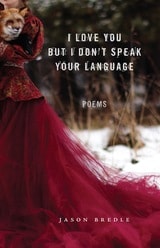
I Love You But I Don't Speak Your Language
PoemsJason Bredle
University of Massachusetts Press, 2026
Poems that question the world with tenderness and restless introspection
In I Love You But I Don’t Speak Your Language, brushes with the profound may lead to brushes with the mundane, or vice versa. Cause and effect become unreasoned and transcendent, at times lifting the arbitrary into the sublime or the sublime into happenstance. Intuitive leaps pull us through oscillations between humor, introspection, and the surreal. These poems don’t follow a straight path; instead, they capture the way thoughts shift, contradict, and collide.
Inspired by the poet’s dreams, as well as travels throughout central Europe, the West Indies, and Central and South America, the poems are alive in voice and detail, yet the speaker’s connections, and more so, disconnections, turn toward isolationism, solitude, and loneliness. At times, the collection leans into restless emotion: “I want to cry / when I think of how / I’ll look back at this moment someday / and cry.” Other moments pull the reader to “a far away place / of limitless palm trees and sunsets.” This is poetry that doesn’t try to fit into a traditional form. It questions, observes, and rethinks the world around it. Some moments might seem absurd, others deeply reflective, but all of them work together to create a book that is both thought-provoking and unpredictable.
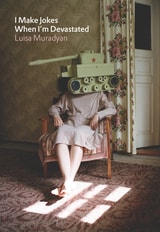
I Make Jokes When I'm Devastated
Luisa Muradyan
Bridwell Press, 2024
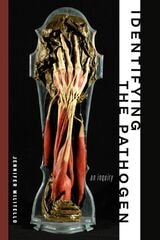
Identifying the Pathogen
Jennifer Militello
Tupelo Press, 2026
Composed as a lab notebook recording various surgeries, autopsies, and experiments, Identifying the Pathogen tells the story of a scientist on an obsessive quest to document an ailment that resists classification. The book considers the body in response to the COVID-19 pandemic, woven through with the story of Anna Morandi Manzolini—an eighteenth-century Italian anatomist and artist who struggled to support a husband suffering from depression—as well as several essays detailing accounts of a ruptured appendix, a splintered cello, and an ill-fated rock climbing excursion.
Imaginary Royalty
Miranda Field
Four Way Books, 2017

Indirect Light
Malachi Black
Four Way Books, 2024
Reliving the overdoses of beloved friends, Malachi Black closes this book’s opening poem with a resuscitating command: “Doctor, / turn back. One of us lives.” Indirect Light is a testament to and apologia for this assertion of vitality, each eponymous poem an elegy dedicated to one of Black’s dearly departed. Though this book mourns an irretrievable past, it wages war against amnesia, refusing to let death erase the vibrancy of their lives. These poems preserve “the breath we left beside us on the train tracks,” “the watery inscriptions of nearby dogwood branches / dipped in shade,” “our bookbags’ mouths / pouting open on our laps,” “our street-scabbed bodies / briefly tinseled in the sun.”
Insofar as this collection returns to friends and kin to honor them by the indirect light of memory, it also seeks to memorialize the author’s personal experience of adolescence and addiction amidst the opioid epidemic. It is a lament for all that’s lost and a paean to the near misses and the just enough: a dim glow you can see by, a cup of coffee passed during NA, a prayer during detox to “be // as empty / as the sky” if floating means survival.
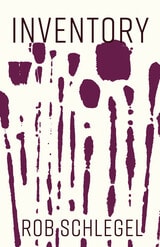
Inventory
Rob Schlegel
University of Chicago Press, 0
A book-length poem serving as a son’s elegy for his late father, an artist and forest steward.
Rob Schlegel’s long poem Inventory emerges from three discrete inventories the poet must catalog in the aftermath of a sudden loss: a selection of his father’s art to be organized for a posthumous exhibition, two hundred acres of trees in a forest stewarded by his father in western Oregon, and his own emotional landscape in the aftermath of his father’s death. As Schlegel moves through these collections of objects and emotions, he learns how to navigate grief. His father’s paintings act as an inventory of the poet’s own life, with each landscape recalling a moment in time, each sketch holding a story. Celebrating a close relationship while mourning its loss, Schlegel reflects on the ties between art and grief, parents and children, people and trees.
At the time of his father’s death, an extreme heatwave was moving across the region, broadening the scope of grief from the personal and familial to encompass tragedies on a larger scale. Social disintegration and climate disaster weave through the lives of a family in mourning as they navigate the complexity of how to sit with loss, change, love, and art. Through quiet, measured verse and arresting simplicity, Inventory extends the ekphrastic tradition into a contemporary elegy rich in both profound sadness and optimism for the future.
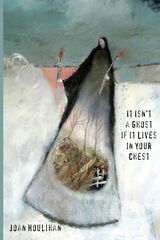
It Isn’t a Ghost if It Lives in Your Chest
Joan Houlihan
Four Way Books, 2021
Houlihan’s sixth collection of lyric poems reflects upon the persistence of what is lost and the accidental ruptures of trauma that allow re-entry into our world. These poems are at once despairing and hopeful.
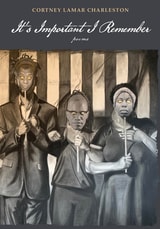
It's Important I Remember
PoemsCortney Lamar Charleston
Northwestern University Press, 2026
An incantation of strength and solace for persisting in twenty-first-century America
“History doesn’t repeat, it rhymes.” In his sweeping third collection, Charleston brings a poet’s ear for echo and rhythm to bear on American history and life after 2016. For Charleston, these rhymes cut two ways: the long tradition of American racism and fascism, and the steady pulse of Black persistence. The collection’s titular invocation frames each poem, at times an oratory to rally a crowd, in other moments a private prayer whispered as the speaker gathers himself to face another day. Charleston insists that should we cede memory of our national biography—whether to repression or indifference—we will witness the country’s dissolution into something unrecognizable to many, yet all too familiar to its most marginalized people. But with each reiteration and riff, he also invokes a tenuous hope—that if we summon an American history of Black resistance, we might still make a more perfect union.
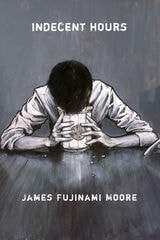
indecent hours
James Fujinami Moore
Four Way Books, 2022
For award-winning poet James Fujinami Moore, the past is never past. In this brutal debut, sensual, political, and imagined worlds collide, tracing a history of diaspora and trauma that asks: what do we do in the aftermath of violence, and why do we long to inflict it? From Vegas boxing rings and the restless sands of Manzanar to the scrolling horrors of a Facebook feed, Moore’s poems trace over intimate details with surprising humor, fierce eroticism, and a restless eye.