Results by title
91 books match the query 'Desire' and 4 start with i

Imaginatelligence
Desire and Disaffection in Posthuman FuturesNatasha Lushetich
University of Minnesota Press, 2027
A new vision of imagination as a shared force across species, systems, and matter
Imaginatelligence addresses the contemporary “crisis” in imagination by advancing a nonanthropocentric, posthumanist account of this vital function. Rather than treating imagination as a uniquely human faculty, Natasha Lushetich presents it as an activity that stretches across species and remains inseparable from potentiality. If imagination arises from sensing, conjecturing, intelliging, and improvising, there is little reason to confine it to human experience alone. In this view, imagination becomes a distributed force, operating across biological, technological, and material domains.
Lushetich begins by considering the demise of human imagination alongside the neglect of other-than-human forms. She then considers creativity across nonhuman beings, examining cross-species intelligence and extending to iterative processes in what are typically regarded as inanimate objects. If the activities of organic and machinic agents are comparable, Lushetich argues, disciplinary divisions separating them become increasingly untenable.
Drawing on posthumanist approaches to liminality, distributed agency, and shared memory, Imaginatelligence proposes the emergence of a multispecies imaginatelligence. This perspective not only redefines imagination but also demonstrates how a cross-disciplinary configuration of imagination—linking critical thought, artistic practice, and scientific inquiry—is both possible and necessary. Lushetich reaffirms the relevance of critical posthumanism for everyday practice and for imagining the possibility of a future multispecies society.
Retail e-book files for this title are screen-reader friendly.
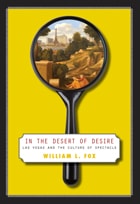
In the Desert of Desire
Las Vegas and the Culture of SpectacleWilliam L. Fox
University of Nevada Press, 2007
Las Vegas, says William Fox, is a pay-as-you-play paradise that succeeds in satisfying our fantasies of wealth and the excesses of pleasure and consumption that go with it. In this context, Fox examines how Las Vegas’s culture of spectacle has obscured the boundaries between high art and entertainment extravaganza, nature and fantasy, for-profit and nonprofit enterprises. His purview ranges from casino art galleries—including Steve Wynn’s private collection and a branch of the famed Guggenheim Museum—to the underfunded Las Vegas Art Museum; from spectacular casino animal collections like those of magicians Siegfried and Roy and Mandalay Bay’s Shark Reef exhibit to the city’s lack of support for a viable public zoo; from the environmental and psychological impact of lavish water displays in the arid desert to the artistic ambiguities intrinsic to Las Vegas’s floating world of showgirls, lapdancers, and ballet divas. That Las Vegas represents one of the world’s most opulent displays of private material wealth in all its forms, while providing miserly funding for local public amenities like museums and zoos, is no accident, Fox maintains. Nor is it unintentional that the city’s most important collections of art and exotic fauna are presented in the context of casino entertainment, part of the feast of sensation and excitement that seduces millions of visitors each year. Instead, this phenomenon shows how our insatiable modern appetite for extravagance and spectacle has diminished the power of unembellished nature and the arts to teach and inspire us, and demonstrates the way our society privileges private benefit over public good. Given that Las Vegas has been a harbinger of national cultural trends, Fox’s commentary offers prescient insight into the increasing commercialization of nature and culture across America.

Inaugural Wounds
The Shaping of Desire in Five Nineteenth-Century English NarrativesRobert E. Lougy
Ohio University Press, 2004
Desire, Jacques Lacan suggests, is a condition or expression of our wounded nature. But because such desire is also unconscious, it can be expressed only indirectly, for what we consciously desire is hardly ever what we really want. Desire makes itself known, but disguises its presence—appearing, for example, in unconscious but repetitive, and sometimes even self-destructive, patterns of behavior.
Informed by the voices of Freud and Lacan regarding the nature of language and desire, Inaugural Wounds examines the ways in which five major nineteenth-century English writers explored the trajectories and shapes of desire. Arguing that we need to give to novels the same kind of close scrutiny we give to poetry, author Robert Lougy suggests that when we do so, we discover that they often astound us by the resonance and range of their language, as well as by their ability to take us to strange and haunting places.
The five narratives examined—Charles Dickens’s Martin Chuzzlewit, William Thackeray’s Journey from Cornhill to Grand Cairo, Elizabeth Gaskell’s Ruth, Wilkie Collins’s The Woman in White, and Thomas Hardy’s Jude the Obscure—testify to the mysterious origins of desire. Although each of the novels tells its own story in its own way, they share a fascination with the nature of desire itself.
Drawing upon recent work that has challenged historicist approaches toward nineteenth-century British literature, Professor Lougy uses the insights of psychoanalysis to enable us to more fully appreciate the depth and power of these novels. Of great value to Victorian and psychoanalytic scholars, Inaugural Wounds will be useful for teaching undergraduates as well.
Intimate Domain
Desire, Trauma, and Mimetic TheoryMartha J. Reineke
Michigan State University Press, 2014