Results by title
56 books match the query 'Diversity' and 3 start with i

Immigration, Diversity, and Broadcasting in the United States 1990—2001
Vibert C. Cambridge
Ohio University Press, 2004
The last decade of the twentieth century brought a maturing of the new racial and ethnic communities in the United States and the emergence of diversity and multiculturalism as dominant fields of discourse in legal, educational, and cultural contexts. Immigration, Diversity, and Broadcasting in the United States, 1990—2001 is a contribution to our understanding of the web of relationships that existed at the intersection of immigration, race, ethnicity, and broadcasting in America during this period. Professor Vibert C. Cambridge investigates and questions how broadcasting in the United States responded to the changing racial and ethnic composition of the society. What patterns could be drawn from these responses? What roles were served? What roles are currently being served? What stimulated the changing of roles? Ultimately, Immigration, Diversity, and Broadcasting in the United States evaluates the performance of the American broadcasting industry. The answers to this book’s core questions provide insights into how the American broadcasting industry responded to freedom, equality, diversity, information quality, social order, and solidarity at century’s end.
[more]
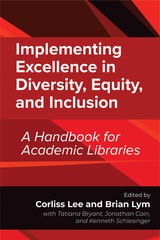
Implementing Excellence in Diversity, Equity, and Inclusion
A Handbook for Academic LibrariesCorliss Lee
American Library Association, 2022
“[T]he diversity of perspectives presented within this publication will build on the reader’s existing knowledge to bring nuances and alternative approaches to these enduring, seemingly intractable challenges within the LIS profession and within society.”
—from the Foreword by Mark A. Puente
Academic library workers often make use of systemic, bureaucratic, political, collegial, and symbolic dimensions of organizational behavior to achieve their diversity, equity, and inclusion goals, but many are also doing the crucial work of pushing back at the structures surrounding them in ways small and large.
Implementing Excellence in Diversity, Equity, and Inclusion captures emerging practices that academic libraries and librarians can use to create more equitable and representative institutions. 19 chapters are divided into 6 sections:
Chapters cover topics including active diversity recruitment strategies; inclusive hiring; gendered ageism; librarians with disabilities; diversity and inclusion with student workers; residencies and retention; creating and implementing a diversity strategic plan; cultural competency training; libraries’ responses to Canadian Truth and Reconciliation Commission Calls to Action; and accountability and assessment. Authors provide practical guiding principles, effective practices, and sample programs and training.
Implementing Excellence in Diversity, Equity, and Inclusion explores how academic libraries have leveraged and deployed their institutions’ resources to effect DEI improvements while working toward implementing systemic solutions. It provides means and inspiration for continuing to try to hire, retain, and promote the change we want to see in the world regardless of existing structures and systems, and ways to improve those structures and systems for the future.
—from the Foreword by Mark A. Puente
Academic library workers often make use of systemic, bureaucratic, political, collegial, and symbolic dimensions of organizational behavior to achieve their diversity, equity, and inclusion goals, but many are also doing the crucial work of pushing back at the structures surrounding them in ways small and large.
Implementing Excellence in Diversity, Equity, and Inclusion captures emerging practices that academic libraries and librarians can use to create more equitable and representative institutions. 19 chapters are divided into 6 sections:
- Recruitment, Retention and Promotion
- Professional Development
- Leveraging Collegial Networks
- Reinforcing the Message
- Organizational Change
- Assessment
Chapters cover topics including active diversity recruitment strategies; inclusive hiring; gendered ageism; librarians with disabilities; diversity and inclusion with student workers; residencies and retention; creating and implementing a diversity strategic plan; cultural competency training; libraries’ responses to Canadian Truth and Reconciliation Commission Calls to Action; and accountability and assessment. Authors provide practical guiding principles, effective practices, and sample programs and training.
Implementing Excellence in Diversity, Equity, and Inclusion explores how academic libraries have leveraged and deployed their institutions’ resources to effect DEI improvements while working toward implementing systemic solutions. It provides means and inspiration for continuing to try to hire, retain, and promote the change we want to see in the world regardless of existing structures and systems, and ways to improve those structures and systems for the future.
[more]

Inclusion, Diversity and Innovation in Translation Education
Edited by Alejandro Bolaños García-Escribano and Mazal Oaknín
University College London, 2024
Diversity equity and inclusion meet foreign language and translation education.
In Inclusion, Diversity and Innovation in Translation Education, editors Alejandro Bolaños, García-Escribano, and Mazal Oaknín, emphasize the latest developments in literary and audiovisual translation education and teaching foreign languages while exploring the relevance of equality, diversity, and inclusion. They propose best practices and pieces of training, inviting readers to incorporate social issues affecting marginalized groups in their language and translation teaching practices.
In Inclusion, Diversity and Innovation in Translation Education, editors Alejandro Bolaños, García-Escribano, and Mazal Oaknín, emphasize the latest developments in literary and audiovisual translation education and teaching foreign languages while exploring the relevance of equality, diversity, and inclusion. They propose best practices and pieces of training, inviting readers to incorporate social issues affecting marginalized groups in their language and translation teaching practices.
[more]