Results by title
577 books match the query 'Earth Sciences' and 13 start with i

Ice Age Peoples of North America
Robonson Bonnichsen
Oregon State University Press, 1999
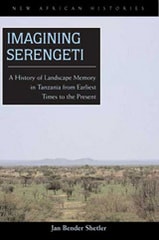
Imagining Serengeti
A History of Landscape Memory in Tanzania from Earliest Times to the PresentJan Bender Shetler
Ohio University Press, 2007
Many students come to African history with a host of stereotypes that are not always easy to dislodge. One of the most common is that of Africa as safari grounds—as the land of expansive, unpopulated game reserves untouched by civilization and preserved in their original pristine state by the tireless efforts of contemporary conservationists. With prose that is elegant in its simplicity and analysis that is forceful and compelling, Jan Bender Shetler brings the landscape memory of the Serengeti to life. She demonstrates how the social identities of western Serengeti peoples are embedded in specific spaces and in their collective memories of those spaces. Using a new methodology to analyze precolonial oral traditions, Shetler identifies core spatial images and reevaluates them in their historical context through the use of archaeological, linguistic, ethnographic, ecological, and archival evidence. Imagining Serengeti is a lively environmental history that will ensure that we never look at images of the African landscape in quite the same way.
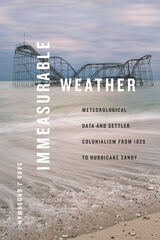
Immeasurable Weather
Meteorological Data and Settler Colonialism from 1820 to Hurricane SandySara J. Grossman
Duke University Press, 2023

Immortal River
The Upper Mississippi in Ancient and Modern TimesCalvin R. Fremling
University of Wisconsin Press, 2005
Like the Mississippi itself, Immortal River often leaves the main channel to explore the river's backwaters, floodplain, and drainage basin. The book's focus is the Upper Mississippi, from Minneapolis, Minnesota, to Cairo, Illinois. But it also includes information about the river's headwaters in northern Minnesota and about the Lower Mississippi from Cairo south to the river's mouth ninety miles below New Orleans. It offers an understanding of the basic geology underlying the river's landscapes, ecology, environmental problems, and grandeur.

In Search of the Rain Forest
Candace Slater, ed.
Duke University Press, 2004
From diverse disciplines—history, archaeology, sociology, literature, law, and cultural anthropology—the contributors provide case studies from Latin America, Asia, and Africa. They point the way toward a search for a rain forest that is both a natural entity and a social history, an inhabited place and a shifting set of ideas. The essayists demonstrate how the single image of a wild and yet fragile forest became fixed in the popular mind in the late twentieth century, thereby influencing the policies of corporations, environmental groups, and governments. Such simplistic conceptions, In Search of the Rain Forest shows, might lead companies to tout their “green” technologies even as they try to downplay the dissenting voices of native populations. Or they might cause a government to create a tiger reserve that displaces peaceful peasants while opening the doors to poachers and bandits. By encouraging a nuanced understanding of distinctive, constantly evolving forests with different social and natural histories, this volume provides an important impetus for protection efforts that take into account the rain forest in all of its complexity.
Contributors. Scott Fedick, Alex Greene, Paul Greenough, Nancy Peluso, Suzana Sawyer, Candace Slater, Charles Zerner

Indian Ink
Script and Print in the Making of the English East India CompanyMiles Ogborn
University of Chicago Press, 2007
A commercial company established in 1600 to monopolize trade between England and the Far East, the East India Company grew to govern an Indian empire. Exploring the relationship between power and knowledge in European engagement with Asia, Indian Ink examines the Company at work and reveals how writing and print shaped authority on a global scale in the seventeenth and eighteenth centuries.
Tracing the history of the Company from its first tentative trading voyages in the early seventeenth century to the foundation of an empire in Bengal in the late eighteenth century, Miles Ogborn takes readers into the scriptoria, ships, offices, print shops, coffeehouses, and palaces to investigate the forms of writing needed to exert power and extract profit in the mercantile and imperial worlds. Interpreting the making and use of a variety of forms of writing in script and print, Ogborn argues that material and political circumstances always undermined attempts at domination through the power of the written word.
Navigating the juncture of imperial history and the history of the book, Indian Ink uncovers the intellectual and political legacies of early modern trade and empire and charts a new understanding of the geography of print culture.
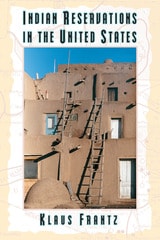
Indian Reservations in the United States
Territory, Sovereignty, and Socioeconomic ChangeKlaus Frantz
University of Chicago Press, 1999
Informed by both historical research and extensive fieldwork, this book pays special attention to the natural resource base and economic outlook of the reservations, as well as the crucial issue of tribal sovereignty. Chapters also cover the demography of American Indian groups and their socioeconomic status (including standard of living, employment, and education). A new afterword treats some of the developments since the book's initial publication in German, such as the effects of the 1988 Indian gaming law that allowed Indian reservations to operate gambling establishments (with mixed success).
"Provides a good overview of the basic questions and problems facing reservation Indians today."—Peter Bolz, Journal of American History (on the German edition)

Insurgent Democracy
The Nonpartisan League in North American PoliticsMichael J. Lansing
University of Chicago Press, 2015
Michael J. Lansing aims to change that. Insurgent Democracy offers a new look at the Nonpartisan League and a new way to understand its rise and fall in the United States and Canada. Lansing argues that, rather than a spasm of populist rage that inevitably burned itself out, the story of the League is in fact an instructive example of how popular movements can create lasting change. Depicting the League as a transnational response to economic inequity, Lansing not only resurrects its story of citizen activism, but also allows us to see its potential to inform contemporary movements.

Into the Cool
Energy Flow, Thermodynamics, and LifeEric D. Schneider and Dorion Sagan
University of Chicago Press, 2005
Working from the precept that "nature abhors a gradient," Into the Cool details how complex systems emerge, enlarge, and reproduce in a world tending toward disorder. From hurricanes here to life on other worlds, from human evolution to the systems humans have created, this pervasive pull toward equilibrium governs life at its molecular base and at its peak in the elaborate structures of living complex systems. Schneider and Sagan organize their argument in a highly accessible manner, moving from descriptions of the basic physics behind energy flow to the organization of complex systems to the role of energy in life to the final section, which applies their concept of energy flow to politics, economics, and even human health.
A book that needs to be grappled with by all those who wonder at the organizing principles of existence, Into the Cool will appeal to both humanists and scientists. If Charles Darwin shook the world by showing the common ancestry of all life, so Into the Cool has a similar power to disturb—and delight—by showing the common roots in energy flow of all complex, organized, and naturally functioning systems.

Iowa's Geological Past
Three Billion Years Of ChangeWayne I. Anderson
University of Iowa Press, 1998
Iowa's rock record is the product of more than three billion years of geological processes. The state endured multiple episodes of continental glaciation during the Pleistocene Ice Age, and the last glacier retreated from Iowa a mere (geologically speaking) twelve thousand years ago. Prior to that, dozens of seas came and went, leaving behind limestone beds with rich fossil records. Lush coal swamps, salty lagoons, briny basins, enormous alluvial plains, ancient rifts, and rugged Precambrian mountain belts all left their mark. In Iowa's Geological Past, Wayne Anderson gives us an up-to-date and well-informed account of the state's vast geological history from the Precambrian through the end of the Great Ice Age.
Anderson takes us on a journey backward into time to explore Iowa's rock-and-sediment record. In the distant past, prehistoric Iowa was covered with shallow seas; coniferous forests flourished in areas beyond the continental glaciers; and a wide variety of animals existed, including mastodon, mammoth, musk ox, giant beaver, camel, and giant sloth.
The presence of humans can be traced back to the Paleo-Indian interval, 9,500 to 7,500 years ago. Iowa in Paleozoic time experienced numerous coastal plain and shallow marine environments. Early in the Precambrian, Iowa was part of ancient mountain belts in which granite and other rocks were formed well below the earth's surface.
The hills and valleys of the Hawkeye State are not everlasting when viewed from the perspective of geologic time. Overall, Iowa's geologic column records an extraordinary transformation over more than three billion years. Wayne Anderson's profusely illustrated volume provides a comprehensive and accessible survey of the state's remarkable geological past.

Iowa's Minerals
Their Occurance, Origins, Industries and LorePaul Garvin
University of Iowa Press, 1998
Island Life
Or, the Phenomena and Causes of Insular Faunas and Floras, Including a Revision and Attempted Solution of the Problem of Geological ClimatesAlfred Russel Wallace
University of Chicago Press, 2013

Isle of Fire
The Political Ecology of Landscape Burning in MadagascarChristian A. Kull
University of Chicago Press, 2004