352 books match the query 'Electronics' and 18 start with i
cover of IP Core Protection and Hardware-Assisted Security for Consumer Electronics

IP Core Protection and Hardware-Assisted Security for Consumer Electronics

Anirban Sengupta

The Institution of Engineering and Technology, 2019

IP Core Protection and Hardware-Assisted Security for Consumer Electronics presents established and novel solutions for security and protection problems related to IP cores (especially those based on DSP/multimedia applications) in consumer electronics. The topic is important to researchers in various areas of specialization, encompassing overlapping topics such as EDA-CAD, hardware design security, VLSI design, IP core protection, optimization using evolutionary computing, system-on-chip design and application specific processor/hardware accelerator design.
[more]
cover of Implementation of Self-tuning Controllers

Implementation of Self-tuning Controllers

K. Warwick

The Institution of Engineering and Technology, 1988
This text is an extremely useful guide for those wishing to investigate the application of self-tuning control systems. The contents have been chosen in order to restrict the amount of theoretical detail to that necessary for explanation purposes, whilst application examples and programming suggestions are highlighted. The overall text is suitable for those wishing to gain the flavour of adaptive control, although those already familiar with selftuning techniques will find the problem solutions discussed to be most attractive. Parameter estimation, numerical solutions and software aspects are all considered at length, while simplified procedures and predictive self-tuning schemes are shown in terms of fundamental concepts.
[more]
cover of Inductive Devices in Power Electronics: Materials, measurement, design and applications

Inductive Devices in Power Electronics

Materials, measurement, design and applications

Peter Zacharias

The Institution of Engineering and Technology, 2025

During the rapid developments in semiconductor technology, the role of inductive components as a limitation for further improvements became clear. The challenges involve the magnetization losses and unwanted eddy currents at higher switching frequencies, which in turn limit the reduction of device volumes. New materials and design approaches offer solutions. Furthermore, new topologies of power converters in connection with flexible digital controls and design of magnetic components offer ways to reduce the required component volume and increase the power density, which is especially important for mobile applications.
[more]
cover of Industrial Digital Control Systems

Industrial Digital Control Systems

K. Warwick

The Institution of Engineering and Technology, 1988

This book provides an introduction to the techniques employed in the design and implementation of digital control systems. The text has arisen out of a highly successful IEE Vacation School held annually at Oxford University and the contents have been tailored to a digestible level and breadth by means of the feedback provided from previous School participants. As well as a tutorial approach to the description of basic concepts and general ideas used, most chapters include numerous worked examples and details of particular applications in order to enhance the theory introduced. The importance of putting over a technique by making use of practical examples is highlighted by the inclusion of several chapters in which selected case studies are presented detailing applications of both the more conventional and the more modern digital control ideas.
[more]
cover of Informational Peripheries: Rethinking the Urban in a Digital Age

Informational Peripheries

Rethinking the Urban in a Digital Age

Edited by Ayona Datta and Fenna Imara Hoefsloot

University College London, 2025

An examination of how urban peripheries are being redefined in the digital era.

Moving beyond current scholarship in urban and regional studies, this volume presents a case for “informational peripheries” as an analytical lens to understand the uneven, fragmented, and disconnected geographies of urban peripheries in the Global South. While this concept is parallel to and overlaps with the urban periphery, the circulation—or restriction—of information has taken on additional significance with the coming of a digital age. The periphery is no longer confined to the slums or suburbia at a city's edge; it now also encompasses uneven and fragmented digital infrastructures. 

Providing empirical and theoretical contributions from cities in the Global South, this book advances scholarship in Southern urbanism, smart cities, and peripheral urbanization, conceptualizing the diverse ways in which informational peripheries are resisted, adapted, complied with, and lived in. 
 
[more]
cover of Insulators for High Voltages

Insulators for High Voltages

J.S.T. Looms

The Institution of Engineering and Technology, 1988
This book is a guide to the whole field of high voltage insulators as used in electrical power networks, traction and production. It covers the historical development of the shapes - sometimes strange ones - of modern types, decribes the principal materials - both ceramic and polymeric - and their fabrication, explains the physical principles of contamination and flashover, and reviews the mass of data on research and testing.
[more]
cover of Integral Equation Methods for Electromagnetics

Integral Equation Methods for Electromagnetics

John L. Volakis

The Institution of Engineering and Technology, 2012
This text/reference is a detailed look at the development and use of integral equation methods for electromagnetic analysis, specifically for antennas and radar scattering. Developers and practitioners will appreciate the broad-based approach to understanding and utilizing integral equation methods and the unique coverage of historical developments that led to the current state-of-the-art. In contrast to existing books, Integral Equation Methods for Electromagnetics lays the groundwork in the initial chapters so students and basic users can solve simple problems and work their way up to the most advanced and current solutions.
[more]
cover of Integrated Fault Diagnosis and Control Design of Linear Complex Systems

Integrated Fault Diagnosis and Control Design of Linear Complex Systems

Mohammadreza Davoodi

The Institution of Engineering and Technology, 2018
As control systems become more complex and are expected to perform tasks in unknown and extreme environments, they may be subject to various types of faults in their sensors, actuators or other components. It is crucial to be able to diagnose the occurrence of faults and to repair them in order to maintain, guarantee, and improve the overall safety, reliability, and performance of the systems. This book addresses the design challenges of developing and implementing novel integrated fault diagnosis and control technologies for complex linear systems.
[more]
cover of Intelligent Control Systems using Computational Intelligence Techniques

Intelligent Control Systems using Computational Intelligence Techniques

A.E. Ruano

The Institution of Engineering and Technology, 2005
Intelligent Control techniques are becoming important tools in both academia and industry. Methodologies developed in the field of soft-computing, such as neural networks, fuzzy systems and evolutionary computation, can lead to accommodation of more complex processes, improved performance and considerable time savings and cost reductions. Intelligent Control Systems using Computational Intellingence Techniques details the application of these tools to the field of control systems. Each chapter gives and overview of current approaches in the topic covered, with a set of the most important references in the field, and then details the author's approach, examining both the theory and practical applications.
[more]
cover of Intelligent Distributed Video Surveillance Systems

Intelligent Distributed Video Surveillance Systems

Sergio A. Velastin

The Institution of Engineering and Technology, 2006
There is a growing interest in the development and deployment of surveillance systems in public and private locations. Conventional approaches rely on the installation of wide area CCTV (Closed Circuit Television), but the explosion in the numbers of cameras that have to be monitored, the increasing costs of providing monitoring personnel and the limitations that humans have to maintain sustained levels of concentration severely limit the effectiveness of these systems. Advances in information and communication technologies, such as computer vision for face recognition and human behaviour analysis, digital annotation and storage of video, transmission of video/audio streams over wired and wireless networks, can potentially provide significant improvements in this field.
[more]
cover of Introduction to Adaptive Arrays

Introduction to Adaptive Arrays

Robert A. Monzingo

The Institution of Engineering and Technology, 2011
This second edition is an extensive modernization of the bestselling introduction to the subject of adaptive array sensor systems. With the number of applications of adaptive array sensor systems growing each year, this look at the principles and fundamental techniques that are critical to these systems is more important than ever before.
[more]
cover of Introduction to Biomechatronics

Introduction to Biomechatronics

Graham M. Brooker

The Institution of Engineering and Technology, 2012
This is the age of biomechatronics, a time where mechanics and electronics can interact with human muscle, skeleton, and nervous systems to assist or replace limbs, senses, and even organs damaged by trauma, birth defects, or disease. Introduction to Biomechatronics provides biomedical engineering students and professionals with the fundamental mechatronic (mechanics, electronics, robotics) engineering knowledge they need to analyze and design devices that improve lives. The first half of the book provides the engineering background to understand all the components of a biomechatronic system: the human subject, stimulus or actuation, transducers and sensors, signal conditioning elements, recording and display, and feedback elements. It also includes the major functional systems of the body to which biomechatronics can be applied including: biochemical, nervous, cardiovascular, respiratory, and musculoskeletal. The second half discusses five broadly based inventions from a historical perspective and supported by the relevant technical detail and engineering analysis. It begins with the development of hearing prostheses including middle-ear implantable hearing devices and the amazingly successful cochlear implant. This is followed by sensory substitution and visual prostheses that researchers hope will do the same for the blind as the cochlear implant has done for the deaf. The last three chapters are more mechatronic in focus, examining artificial hearts, respiratory aids from the iron lung to the latest CPAP devices, and finally artificial limbs from the first hooks and peg legs to limbs that move and have a sense of touch.
[more]
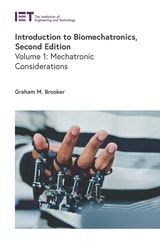
cover of Introduction to Biomechatronics: Mechatronic considerations, Volume 1

Introduction to Biomechatronics

Mechatronic considerations, Volume 1

Graham M. Brooker

The Institution of Engineering and Technology, 2025
Introduction to Biomechatronics, Second Edition, combines fundamental mechatronic (mechanics, electronics, robotics) engineering knowledge with state-of-the-art device designs that improve quality of life for patients worldwide. This new edition is comprehensively updated and includes new chapters on brain-machine interfaces and exoskeletons.
[more]
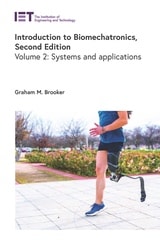
cover of Introduction to Biomechatronics: Systems and applications, Volume 2

Introduction to Biomechatronics

Systems and applications, Volume 2

Graham M. Brooker

The Institution of Engineering and Technology, 2025
Introduction to Biomechatronics, Second Edition, combines fundamental mechatronic (mechanics, electronics, robotics) engineering knowledge with state-of-the-art device designs that improve quality of life for patients worldwide. This new edition is comprehensively updated and includes new chapters on brain-machine interfaces and exoskeletons.
[more]
cover of Introduction to Electronic Warfare Modeling and Simulation

Introduction to Electronic Warfare Modeling and Simulation

David L. Adamy

The Institution of Engineering and Technology, 2006

This unique book covers the whole field of electronic warfare modeling and simulation at a systems level, including chapters that describe basic electronic warfare (EW) concepts. Written by a well-known expert in the field with more than 24 years of experience, the book explores EW applications and techniques and the radio frequency spectrum, with primary emphasis on HF (high frequency) to microwave. A detailed resource for entry-level engineering personnel in EW, military personnel with no radio or communications engineering background, technicians and software professionals, the work helps you understand the basic concepts required for modeling and simulation, as well as fidelity and other practical aspects of simulation design and application. You get clear explanations of important mathematical concepts, such as decibel notation and spherical trigonometry. This informative reference explains how to facilitate the generation of realistic computer models of EW equipment. Moreover, it describes specific types of EW equipment, how they work and how each is mathematically modeled. The book concludes with a description of the various types of models and simulations and the ways they are applied to training and equipment testing tasks.
[more]
cover of Introduction to RF Stealth

Introduction to RF Stealth

David L. Lynch Jr.

The Institution of Engineering and Technology, 2004
This is the only book focused on the complete aspects of RF Stealth design. It is the first book to present and explain first order methods for the design of active and passive stealth properties. Everything from Electronic Order of Battle to key component design is covered.
[more]
cover of Introduction to Sensors for Ranging and Imaging

Introduction to Sensors for Ranging and Imaging

Graham Brooker

The Institution of Engineering and Technology, 2009

This is a comprehensive textbook and reference that provides a solid background in active sensing technology. Beginning with a historical overview and an introductory section on signal generation, filtering and modulation, it follows with a section on radiometry (infrared and microwave) as a background to the active sensing process. The core of the book is concerned with active sensing, starting with the basics of time-of-flight sensors (operational principles, components), and goes through the derivation of the radar range equation, and the detection of echo signals, both fundamental to the understanding of radar, sonar and lidar imaging. Several chapters cover signal propagation of both electromagnetic and acoustic energy, target characteristics, stealth and clutter. The remainder of the book involves the basics of the range measurement process, active imaging with an emphasis on noise and linear frequency modulation techniques, Doppler processing, and target tracking.
[more]
cover of Ionospheric Radio

Ionospheric Radio

Kenneth Davies

The Institution of Engineering and Technology, 1990

Ionospheric Radio replaces an earlier publication Ionospheric Propogation and is aimed at professional scientists, engineers, and students who need an intermediate-level reference and/or text. Students of aeronomy and radio wave propogation are introduced to basic wave theory in absorbing, anisotropic and dispersive media, and to the physics of production, loss and movement of plasma in the ionosphere in the presence of the geomagnetic field. Various radio techniques are described, and applications to the interpretation of ionospheric structures and dynamics are presented. The application of ionospheric data to radio communications problems includes the use of numerical and physical models and prediction techniques, and methods for calculating signal strengths are presented. Topics include Earth-space propagation, ionospheric modification, ionospheric disturbances, propagation by scattering from plasma irregularities, topside sounding, and propagation on frequencies from the extremely low to the super high. Reference lists are extensive and a section of questions tests the reader's understanding of the material.
[more]