Results by title
87 books match the query 'Emotions' and 3 start with i
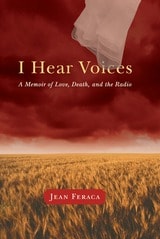
I Hear Voices
A Memoir of Love, Death, and the RadioJean Feraca
University of Wisconsin Press, 2007
Jean Feraca’s road to self-fulfillment has been as quirky and demanding as the characters in her incredible memoir. A veteran of several decades of public radio broadcasting, Feraca is also a writer and a poet. She is a talk show host beloved for her unique mixture of the humanities, poetry, and journalism, and is the creator of the pioneering international cultural affairs radio program Here on Earth: Radio without Borders.
In this searing memoir, Feraca traces her own emergence. She pulls back the curtain on her private life, revealing unforgettable portraits of the characters in her brawling Italian-American family: Jenny, the grandmother, the devil woman who threw Casey Stengel down an excavation pit; Dolly, the mother, a cross between Long John Silver and the Wife of Bath, who in battling mental illness becomes the scourge of a Lutheran nursing home; and Stephen, the brilliant but troubled older brother, an anthropologist adopted by a Sioux tribe. In a new chapter that reinforces and ties together the book’s exploration of the multiple forms of love, Jean introduces us to Roger, a Wildman and her husband’s best friend with whom she, too, develops an extraordinary intimacy. A selection of fifteen of Feraca’s poems add counterpoint to her engaging prose.

Interior States
Institutional Consciousness and the Inner Life of Democracy in the Antebellum United StatesChristopher Castiglia
Duke University Press, 2008
In the late eighteenth century and early nineteenth, as discourses of interiority gained prominence, so did powerful counter-narratives. Castiglia reveals the flamboyant pages of antebellum popular fiction to be an archive of unruly democratic aspirations. Through close readings of works by Maria Monk and George Lippard, Walt Whitman and Timothy Shay Arthur, Hannah Webster Foster and Hannah Crafts, and Nathaniel Hawthorne and Herman Melville, Castiglia highlights a refusal to be reformed or self-contained. In antebellum authors’ representations of nervousness, desire, appetite, fantasy, and imagination, he finds democratic strivings that refused to disappear. Taking inspiration from those writers and turning to the present, Castiglia advocates a humanism-without-humans that, denied the adjudicative power of interiority, promises to release democracy from its inner life and to return it to the public sphere where U.S. citizens may yet create unprecedented possibilities for social action.
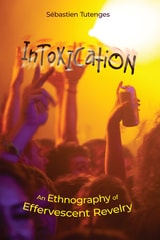
Intoxication
An Ethnography of Effervescent RevelrySébastien Tutenges
Rutgers University Press, 2023
For two decades, Sébastien Tutenges has conducted research in bars, nightclubs, festivals, drug dens, nightlife resorts, and underground dance parties in a quest to answer a fundamental question: Why do people across cultures gather regularly to intoxicate themselves?
Vivid and at times deeply personal, this book offers new insights into a wide variety of intoxicating experiences, from the intimate feeling of connection among concertgoers to the adrenaline-fueled rush of a fight, to the thrill of jumping off a balcony into a swimming pool. Tutenges shows what it means and feels to move beyond the ordinary into altered states in which the transgressive, spectacular, and unexpected take place.
He argues that the primary aim of group intoxication is the religious experience that Émile Durkheim calls collective effervescence, the essence of which is a sense of connecting with other people and being part of a larger whole. This experience is empowering and emboldening and may lead to crime and deviance, but it is at the same time vital to our humanity because it strengthens social bonds and solidarity.
The book fills important gaps in Durkheim’s social theory and contributes to current debates in micro-sociology as well as cultural criminology and cultural sociology. Here, for the first time, readers will discover a detailed account of collective effervescence in contemporary society that includes: an explanation of what collective effervescence is; a description of the conditions that generate collective effervescence; a typology of the varieties of collective effervescence; a discussion of how collective effervescence manifests in the realm of nightlife, politics, sports, and religion; and an analysis of how commercial forces amplify and capitalize on the universal human need for intoxication.
This book is also freely available online as an open access digital edition.
Download the open access ebook here. (https://www.rutgersuniversitypress.org/media/wysiwyg/documents/intoxication.pdf)