Results by title
99 books match the query 'Environment' and 6 start with i
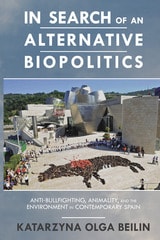
In Search of an Alternative Biopolitics
Anti-Bullfighting, Animality, and the Environment in Contemporary SpainKatarzyna Olga Beilin
The Ohio State University Press, 2015
Analyses of the synergy of press debates on bullfighting and the War on Terror, as well as media debates on King Juan Carlos’s hunt in Botswana and his resignation, reveal how the concepts structuring human/animal relations condition national biopolitics. Beilin traces a main principle, where sacrifice of some lives is deemed necessary for the sake of others, from bullfighting, through environmental destruction and immigration policies, to bioeconomy. Ultimately, In Search of an Alternative Biopolitics argues that to address ever-increasing threats of global warming and future catastrophes, we urgently need to redefine concepts structuring the human and the nonhuman realms.
In The Nature Of Things
Language, Politics, and the EnvironmentJane Bennett
University of Minnesota Press, 1993
Informed by recent developments in literary criticism and social theory, In the Nature of Things addresses the presumption that nature exists independent of culture and, in particular, of language. The theoretical approaches of the contributors represent both modernist and postmodernist positions, including feminist theory, critical theory, Marxism, science fiction, theology, and botany. They demonstrate how the concept of nature is invoked and constituted in a wide range of cultural projects—from the Bible to science fiction movies, from hunting to green consumerism. Ultimately, it weeks to link the work of theorists concerned with nature and the environment to nontheorists who share similar concerns.
Contributors include R. McGreggor Cawley, Romand Coles, William E. Connolly, Jan E. Dizard, Valerie Hartouni, Cheri Lucas Jennings, Bruce H. Jennings, Timothy W. Luke, Shane Phelan, John Rodman, Michael J. Shapiro, and Wade Sikorski.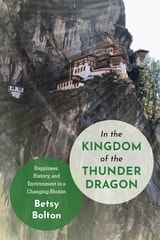
In the Kingdom of the Thunder Dragon
Happiness, History, and Environment in a Changing BhutanBetsy Bolton
Lever Press, 2025
International views on Bhutan tend to be sharply split between admiration for its democratizing development strategies and opposition to its human rights abuses—a division partly maintained by Bhutan’s tight limits on immigration and foreign travel within the country. In the first book-length study of its kind, In the Kingdom of the Thunder Dragon explores the tensions and contradictions of Bhutan’s rapid political and economic transformation from the perspective of a Fulbright scholar helping start a new master’s program in the remote east of the country.
Mingling personal narrative with historical context to engage undergraduate students and general readers, In the Kingdom of the Thunder Dragon explores Bhutan’s Vajrayana Buddhist heritage and ongoing embrace of tradition alongside development, the country’s newly minted democracy amidst a complicated history of citizenship and belonging, and the challenges the nation faces in a period of increasing globalization. Betsy Bolton further explores Bhutan’s recent events surrounding the 1990s expulsion of the Lhotshampa people and the development of GNH in the early 2000s. From here, Bolton illuminates how these historical narratives and issues have impacted Bhutanese citizens and students through stories gathered at educational and artistic institutions, festivals and community events. In the Kingdom of the Thunder Dragon is a fresh, accessible approach to Bhutanese history and will interest general readers as well as scholars of Asia, history, economics, sociology, and environmental studies.

Indigenous Knowledge and the Environment in Africa and North America
David M. Gordon
Ohio University Press, 2012
Indigenous knowledge has become a catchphrase in global struggles for environmental justice. Yet indigenous knowledges are often viewed, incorrectly, as pure and primordial cultural artifacts. This collection draws from African and North American cases to argue that the forms of knowledge identified as “indigenous” resulted from strategies to control environmental resources during and after colonial encounters.
At times indigenous knowledges represented a “middle ground” of intellectual exchanges between colonizers and colonized; elsewhere, indigenous knowledges were defined through conflict and struggle. The authors demonstrate how people claimed that their hybrid forms of knowledge were communal, religious, and traditional, as opposed to individualist, secular, and scientific, which they associated with European colonialism.
Indigenous Knowledge and the Environment offers comparative and transnational insights that disturb romantic views of unchanging indigenous knowledges in harmony with the environment. The result is a book that informs and complicates how indigenous knowledges can and should relate to environmental policy-making.
Contributors: David Bernstein, Derick Fay, Andrew H. Fisher, Karen Flint, David M. Gordon, Paul Kelton, Shepard Krech III, Joshua Reid, Parker Shipton, Lance van Sittert, Jacob Tropp, James L. A. Webb, Jr., Marsha Weisiger
Indigenous Perspective to Climate and Environment
Darren Parry
University of Utah Press, 2024
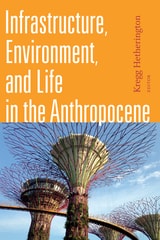
Infrastructure, Environment, and Life in the Anthropocene
Kregg Hetherington, editor
Duke University Press, 2019
Contributors. Nikhil Anand, Andrea Ballestero, Bruce Braun, Ashley Carse, Gastón R. Gordillo, Kregg Hetherington, Casper Bruun Jensen, Joseph Masco, Shaylih Muehlmann, Natasha Myers, Stephanie Wakefield, Austin Zeiderman