314 books match the query 'Environmental aspects' and 11 start with i
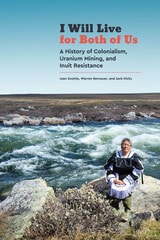
cover of I Will Live for Both of Us: A History of Colonialism, Uranium Mining, and Inuit Resistance

I Will Live for Both of Us

A History of Colonialism, Uranium Mining, and Inuit Resistance

Joan Scottie

University of Manitoba Press, 2022

[more]
cover of Images of Germany in American Literature

Images of Germany in American Literature

Waldemar Zacharasiewicz

University of Iowa Press, 2007

Although German Americans number almost 43 million and are the largest ethnic group in the United States, scholars of American literature have paid little attention to this influential and ethnically diverse cultural group. In a work of unparalleled depth and range, Waldemar Zacharasiewicz explores the cultural and historical background of the varied images of Germany and Germans throughout the past two centuries. Using an interdisciplinary approach known as comparative imagology, which borrows from social psychology and cultural anthropology, Zacharasiewicz samples a broad spectrum of original sources, including literary works, letters, diaries, autobiographical accounts, travelogues, newspaper reports, films, and even cartoons and political caricatures.
    Starting with the notion of Germany as the ideal site for academic study and travel in the nineteenth century and concluding with the twentieth-century image of Germany as an aggressive country, this innovative work examines the ever-changing image of Germans and Germany in the writings of Louisa May Alcott, Samuel Clemens, Henry James, William James, George Santayana, W. E. B. Du Bois, John Dewey, H. L. Mencken, Katherine Anne Porter, Kay Boyle, Thomas Wolfe, Upton Sinclair, Gertrude Stein, Kurt Vonnegut, Thomas Pynchon, William Styron, Walker Percy, and John Hawkes, among others.

   
[more]
cover of Imperial Creatures: Humans and Other Animals in Colonial Singapore, 1819-1942

Imperial Creatures

Humans and Other Animals in Colonial Singapore, 1819-1942

Timothy P. Barnard

National University of Singapore Press, 2019

One of the areas of fastest-growing interest in the humanities and social sciences in recent years has been the history of animals. Imperial Creatures fills a gap in that field by looking across species at animals in a urban colonial setting. If imperialism is a series of power relationships, Timothy P. Barnard argues, then it necessarily involves not only the subjugation of human communities, but also of animals. What was the relationship between those two processes in colonial Singapore? How did interactions with animals enable changes in interactions between people?

Through a multidisciplinary consideration of fauna, Imperial Creatures weaves together a series of tales to document how animals were cherished, monitored, employed, and slaughtered in a colonial society. All animals, including humans, Barnard shows, have been creatures of imperialism in Singapore. Their stories teach us lessons about the structures that upheld such a society and how it developed over time, lessons of relevance to animal historians, to historians of Singapore, and to urban historians and imperial historians with an interest in environmental themes.
[more]
cover of In Our Backyard: Keeyask and the Legacy of Hydroelectric Development

In Our Backyard

Keeyask and the Legacy of Hydroelectric Development

Aimée Craft

University of Manitoba Press, 2022
[more]
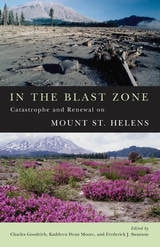
cover of In the Blast Zone: Catastrophe and Renewal on Mt. St. Helens

In the Blast Zone

Catastrophe and Renewal on Mt. St. Helens

Charles Goodrich

Oregon State University Press, 2008

As it erupted in 1980, Mount St. Helens captured the attention of the region, nation, and world, and it continues to fascinate us today: a constant reminder that we live in volcano country. In lucid prose and poetry by some of America's leading writers and scientists, In the Blast Zone explores this story of destruction and renewal in all its human, geological, and ecological dimensions. Most popular accounts of the momentous eruption have focused on the devastation it caused. More recent scientific work on Mount St. Helens tells a story of unexpectedly rapid and varied ecological and geological change.

In the Blast Zone is the first book to present a cross-pollination of literary and scientific perspectives on the mountain's history of cataclysm and renewal. Most of the contributors to this volume camped together on Mount St. Helens for four days, hiking, observing, and sharing ideas. They asked the question: What can this radically altered landscape tell us about nature and how to live our lives? In the Blast Zone collects some of their answers. While introducing ecological and geological insights, it also tells compelling stories about how science and literature inform our lives and our relationship to nature.

These writings will startle readers with new recognition of the matchless gifts of Mount St. Helens: the gifts of beauty, of illumination, of hope. The Contributors Gary Braasch, John Calderazzo, Christine Colasurdo, Charlie Crisafulli, John Daniel, Jerry Franklin, Charles Goodrich, Robin Kimmerer, Ursula K. LeGuin, Tim McNulty, Kathleen Dean Moore, Nalini Nadkarni, Robert Michael Pyle, Scott Russell Sanders, James Sedell, Gary Snyder, Kim Stafford, Frederick J. Swanson, Tony Vogt, Ann Zwinger, Susan Zwinger

[more]
cover of In the Shadow of the Palms: More-Than-Human Becomings in West Papua

In the Shadow of the Palms

More-Than-Human Becomings in West Papua

Sophie Chao

Duke University Press, 2022
With In the Shadow of the Palms, Sophie Chao examines the multispecies entanglements of oil palm plantations in West Papua, Indonesia, showing how Indigenous Marind communities understand and navigate the social, political, and environmental demands of the oil palm plant. As Chao notes, it is no secret that the palm oil sector has destructive environmental impacts: it greatly contributes to tropical deforestation and is a major driver of global warming. Situating the plant and the transformations it has brought within the context of West Papua’s volatile history of colonization, ethnic domination, and capitalist incursion, Chao traces how Marind attribute environmental destruction not just to humans, technologies, and capitalism but also to the volition and actions of the oil palm plant itself. By approaching cash crops as both drivers of destruction and subjects of human exploitation, Chao rethinks capitalist violence as a multispecies act. In the process, Chao centers how Marind fashion their own changing worlds and foreground Indigenous creativity and decolonial approaches to anthropology.
[more]
cover of Infertile Environments: Epigenetic Toxicology and the Reproductive Health of Chinese Men

Infertile Environments

Epigenetic Toxicology and the Reproductive Health of Chinese Men

Janelle Lamoreaux

Duke University Press, 2023
In Infertile Environments, Janelle Lamoreaux investigates how epigenetic research into the effects of toxic exposure conceptualizes and configures environments. Drawing on fieldwork in a Nanjing, China, toxicology lab that studies the influence of pesticides and other pollutants on male reproductive and developmental health, Lamoreaux shows how the lab’s everyday research practices bring national, hormonal, dietary, maternal, and laboratory environments into being. She situates the lab’s work within broader Chinese history as well as the contemporary cultural and political moment, in which declining fertility rates and reproductive governance and technology are growing concerns. She also points to how toxicology in China is a transnational endeavor tied to both local conditions and international research agendas and infrastructures, which highlights the myriad scales and scope of epigenetic environments. At a moment of growing concerns about toxins, endocrine-disrupting chemicals, and climate change, Lamoreaux demonstrates that epigenetic research’s proliferation of environments produces new kinds of toxic relations that impact multiple generations of humans.
[more]
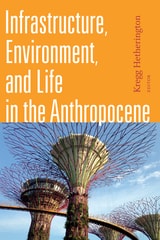
cover of Infrastructure, Environment, and Life in the Anthropocene

Infrastructure, Environment, and Life in the Anthropocene

Kregg Hetherington, editor

Duke University Press, 2019

Infrastructure, Environment, and Life in the Anthropocene explores life in the age of climate change through a series of infrastructural puzzles—sites at which it has become impossible to disentangle the natural from the built environment. With topics ranging from breakwaters built of oysters, underground rivers made by leaky pipes, and architecture gone weedy to neighborhoods partially submerged by rising tides, the contributors explore situations that destabilize the concepts we once relied on to address environmental challenges. They take up the challenge that the Anthropocene poses both to life on the planet and to our social-scientific understanding of it by showing how past conceptions of environment and progress have become unmoored and what this means for how we imagine the future.

Contributors. Nikhil Anand, Andrea Ballestero, Bruce Braun, Ashley Carse, Gastón R. Gordillo, Kregg Hetherington, Casper Bruun Jensen, Joseph Masco, Shaylih Muehlmann, Natasha Myers, Stephanie Wakefield, Austin Zeiderman
[more]
cover of Interspecies Politics: Nature, Borders, States

Interspecies Politics

Nature, Borders, States

Rafi Youatt

University of Michigan Press, 2020

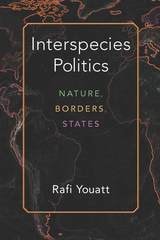
This book explores the ways that international politics is a form of interspecies politics, one that involves the interactions, ideas, and practices of multiple species, both human and nonhuman, to generate differences and create commonalities. While we frequently think of having an international politics “of” the environment, a deep and thoroughgoing anthropocentrism guides our idea of what political life can be, which prevents us from thinking about a politics “with” the environment. This anthropocentric assumption about politics drives both ecological degradation and deep forms of interhuman injustice and hierarchy.

Interspecies Politics challenges that assumption, arguing that a truly ecological account of interstate life requires us to think about politics as an activity that crosses species lines. It therefore explores a postanthropocentric account of international politics, focusing on a series of cases and interspecies practices in the American borderlands, ranging from the US-Mexico border in southern Texas, to Guantánamo Bay in Cuba, to Isle Royale, near the US-Canadian border. The book draws on international relations, environmental political theory, anthropology, and animal studies, to show how key international dimensions of states—sovereignty, territory, security, rights—are better understood as forms of interspecies assemblage that both generate new forms of multispecies inclusion, and structure forms of violence and hierarchy against human and nonhuman alike.
[more]
cover of Interwoven Rosewood: Collaborative Ecologies, Colonial Entanglements, and Indigenous Resistance

Interwoven Rosewood

Collaborative Ecologies, Colonial Entanglements, and Indigenous Resistance

Julie Velásquez Runk, the Wounaan National Congress, and the Wounaan Local Congress of Majé

University of Arizona Press, 2026

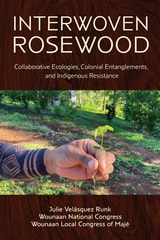
Interwoven Rosewood is a collaborative exploration of the global rosewood trade and its entanglements with Indigenous lifeways, colonial histories, and environmental crises. Co-authored by Julie Velásquez Runk and members of the Wounaan National Congress and its Local Congress of the Majé community, this book traces the story of cocobolo rosewood from Wounaan lands in Panama to international markets, revealing how centuries of settler colonialism and extractive capitalism continue to shape landscapes, livelihoods, and relationships. At its heart, the book is a meditation on well-being and belonging—how people live in relation to land, each other, and the more-than-human world.
 
Drawing on more than a decade of community-based research and six collaborative book workshops, the authors weave together first-person narratives, ecological analysis, historical context, and Indigenous knowledge. The result is a richly textured account that challenges dominant narratives of environmental degradation by centering Wounaan experiences of joy, resistance, and conviviality. The book’s structure reflects its method: interwoven chapters authored or spoken by Wounaan colleagues, grounded in consent protocols and shaped by ancestral storytelling traditions.
 
Accessibly written, Interwoven Rosewood is ideal for courses in environmental conservation, Indigenous studies, anthropology, Latin American studies, and political ecology. With its interdisciplinary reach and classroom-ready discussion questions, the book invites readers to reflect on the global forces behind environmental catastrophe—and the enduring power of Indigenous ways of knowing, being, and becoming.
[more]
cover of Island Futures: Caribbean Survival in the Anthropocene

Island Futures

Caribbean Survival in the Anthropocene

Mimi Sheller

Duke University Press, 2020

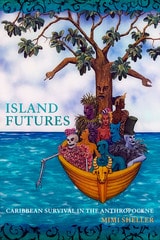
In Island Futures Mimi Sheller delves into the ecological crises and reconstruction challenges affecting the entire Caribbean region during a time of climate catastrophe. Drawing on fieldwork on postearthquake reconstruction in Haiti, flooding on the Haitian-Dominican border, and recent hurricanes, Sheller shows how ecological vulnerability and the quest for a "just recovery" in the Caribbean emerge from specific transnational political, economic, and cultural dynamics. Because foreigners are largely ignorant of Haiti's political, cultural, and economic contexts, especially the historical role of the United States, their efforts to help often exacerbate inequities. Caribbean survival under ever-worsening environmental and political conditions, Sheller contends, demands radical alternatives to the pervasive neocolonialism, racial capitalism, and US military domination that have perpetuated what she calls the "coloniality of climate." Sheller insists that alternative projects for Haitian reconstruction, social justice, and climate resilience—and the sustainability of the entire region—must be grounded in radical Caribbean intellectual traditions that call for deeper transformations of transnational economies, ecologies, and human relations writ large.
[more]