434 books match the query 'Ethics & Moral Philosophy' and 7 start with i
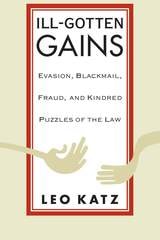
cover of Ill-Gotten Gains: Evasion, Blackmail, Fraud, and Kindred Puzzles of the Law

Ill-Gotten Gains

Evasion, Blackmail, Fraud, and Kindred Puzzles of the Law

Leo Katz

University of Chicago Press, 1996

In Ill-Gotten Gains, Leo Katz describes the underlying principles that not only guide the law but also moral decisions. Mixing wit with insight, anecdotes with analysis, Katz uncovers what is really at stake in crimes such as insider trading, blackmail, and plagiarism. With its startling conclusions and myriad twists, this book will fascinate all those intrigued by the perplexing relationship between morality and law.

"An ambitious and well-written book of legal and moral theory to overthrow both utilitarianism and its cousin, the economic approach to law."—Richard A. Posner, New Republic

"A good, well-written book full of interesting examples."—Library Journal

"[An] elegant defense of circumvention and subterfuge . . . a heroically counterintuitive book."—Malcolm Gladwell, New Yorker
[more]
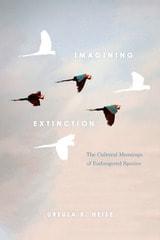
cover of Imagining Extinction: The Cultural Meanings of Endangered Species

Imagining Extinction

The Cultural Meanings of Endangered Species

Ursula K. Heise

University of Chicago Press, 2016

We are currently facing the sixth mass extinction of species in the history of life on Earth, biologists claim—the first one caused by humans. Activists, filmmakers, writers, and artists are seeking to bring the crisis to the public’s attention through stories and images that use the strategies of elegy, tragedy, epic, and even comedy. Imagining Extinction is the first book to examine the cultural frameworks shaping these narratives and images.

Ursula K. Heise argues that understanding these stories and symbols is indispensable for any effective advocacy on behalf of endangered species. More than that, she shows how biodiversity conservation, even and especially in its scientific and legal dimensions, is shaped by cultural assumptions about what is valuable in nature and what is not. These assumptions are hardwired into even seemingly neutral tools such as biodiversity databases and laws for the protection of endangered species. Heise shows that the conflicts and convergences of biodiversity conservation with animal welfare advocacy, environmental justice, and discussions about the Anthropocene open up a new vision of multispecies justice. Ultimately, Imagining Extinction demonstrates that biodiversity, endangered species, and extinction are not only scientific questions but issues of histories, cultures, and values.
[more]
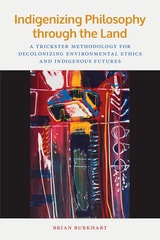
cover of Indigenizing Philosophy through the Land: A Trickster Methodology for Decolonizing Environmental Ethics and Indigenous Futures

Indigenizing Philosophy through the Land

A Trickster Methodology for Decolonizing Environmental Ethics and Indigenous Futures

Brian Burkhart

Michigan State University Press, 2019
Land is key to the operations of coloniality, but the power of the land is also the key anticolonial force that grounds Indigenous liberation. This work is an attempt to articulate the nature of land as a material, conceptual, and ontological foundation for Indigenous ways of knowing, being, and valuing. As a foundation of valuing, land forms the framework for a conceptualization of Indigenous environmental ethics as an anticolonial force for sovereign Indigenous futures. This text is an important contribution in the efforts to Indigenize Western philosophy, particularly in the context of settler colonialism in the United States. It breaks significant ground in articulating Indigenous ways of knowing and valuing to Western philosophy—not as artifact that Western philosophy can incorporate into its canon, but rather as a force of anticolonial Indigenous liberation. Ultimately, Indigenizing Philosophy through the Land shines light on a possible road for epistemically, ontologically, and morally sovereign Indigenous futures.
[more]
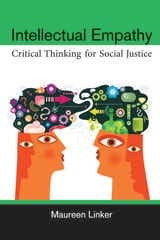
cover of Intellectual Empathy: Critical Thinking for Social Justice

Intellectual Empathy

Critical Thinking for Social Justice

Maureen Linker

University of Michigan Press, 2014
Intellectual Empathy provides a step-by-step method for facilitating discussions of socially divisive issues. Maureen Linker, a philosophy professor at the University of Michigan–Dearborn, developed Intellectual Empathy after more than a decade of teaching critical thinking in metropolitan Detroit, one of the most racially and economically divided urban areas, at the crossroads of one of the Midwest’s largest Muslim communities. The skills acquired through Intellectual Empathy have proven to be significant for students who pursue careers in education, social work, law, business, and medicine.

Now, Linker shows educators, activists, business managers, community leaders—anyone working toward fruitful dialogues about social differences—how potentially transformative conversations break down and how they can be repaired. Starting from Socrates’s injunction know thyself, Linker explains why interrogating our own beliefs is essential. In contrast to traditional approaches in logic that devalue emotion, Linker acknowledges the affective aspects of reasoning and how emotion is embedded in our understanding of self and other. Using examples from classroom dialogues, online comment forums, news media, and diversity training workshops, readers learn to recognize logical fallacies and critically, yet empathically, assess their own social biases, as well as the structural inequalities that perpetuate social injustice and divide us from each other.
[more]
cover of Intuition in Medicine: A Philosophical Defense of Clinical Reasoning

Intuition in Medicine

A Philosophical Defense of Clinical Reasoning

Hillel D. Braude

University of Chicago Press, 2012

Intuition is central to discussions about the nature of scientific and philosophical reasoning and what it means to be human. In this bold and timely book, Hillel D. Braude marshals his dual training as a physician and philosopher to examine the place of intuition in medicine.
Rather than defining and using a single concept of intuition—philosophical, practical, or neuroscientific—Braude here examines intuition as it occurs at different levels and in different contexts of clinical reasoning. He argues that not only does intuition provide the bridge between medical reasoning and moral reasoning, but that it also links the epistemological, ontological, and ethical foundations of clinical decision making. In presenting his case, Braude takes readers on a journey through Aristotle’s Ethics—highlighting the significance of practical reasoning in relation to theoretical reasoning and the potential bridge between them—then through current debates between regulators and clinicians on evidence-based medicine, and finally applies the philosophical perspectives of Reichenbach, Popper, and Peirce to analyze the intuitive support for clinical equipoise, a key concept in research ethics. Through his phenomenological study of intuition Braude aims to demonstrate that ethical responsibility for the other lies at the heart of clinical judgment.
 
Braude’s original approach advances medical ethics by using philosophical rigor and history to analyze the tacit underpinnings of clinical reasoning and to introduce clear conceptual distinctions that simultaneously affirm and exacerbate the tension between ethical theory and practice. His study will be welcomed not only by philosophers but also by clinicians eager to justify how they use moral intuitions, and anyone interested in medical decision making.
[more]
cover of Irrationalism: Lukacs and the Marxist View of Reason

Irrationalism

Lukacs and the Marxist View of Reason

Tom Rockmore

Temple University Press, 1991

This is the first detailed study, following the recent collapse of political Marxism in Eastern Europe, of twentieth-century Hungarian philosopher Georg Lukács and his position as the leading proponent of the Marxist theory of reason. Lukács's History and Class Consciousness has been called one of the three most influential philosophical works of this century, and he, the outstanding Marxist philosopher. Marxism has long suffered relative neglect in philosophical discussion as a result of its own invidious distinction between itself and the supposed irrationality of what it regards as bourgeois philosophy.

Tom Rockmore offers a uniquely detailed philosophical analysis of Lukács's entire position as a theory of reason, based on the distinction between reason and unreason, or irrationalism. The author gives special emphasis to Lukács's connection to German neo-Kantianism, particularly Lask, and on his last, unfinished work.

Rockmore begins with an account of the roots of Lukács's Marxism, followed by an in-depth analysis of his often mentioned, but still incompletely understood, seminal essay "Reification and the Class Consciousness of the Proletariat." He then traces the evolution and later demise of the distinction between reason and irrationalism in Lukács's final thought. The author thus makes available for the first time in English a strictly philosophical discussion of Georg Lukács's Marxist phase and brings consideration of his thought into the wider philosophical discussion.

[more]
cover of Is There a Measure on Earth?: Foundations for a Nonmetaphysical Ethics

Is There a Measure on Earth?

Foundations for a Nonmetaphysical Ethics

Werner Marx

University of Chicago Press, 1987

The search for an ethics rooted in human experience is the crux of this deeply compassionate work, here translated from the 1983 German edition. Distinguished philosopher Werner Marx provides a close reading, critique, and Weiterdenken, or "further thinking," of Martin Heidegger's later work on death, language, and poetry, which has often been dismissed as both obscure and obscurantist. In it Marx seeks, and perhaps finds, both a measure for distinguishing between good and evil and a motive for preferring the former.

The poet Hölderlin posed the question, "Is there a measure on earth?" His own answer was emphatic, "There is none," for he was convinced that the measure for man was to be found only in the domain of the heavenly beings. Such metaphysical assumptions, as well as the attempt to found ethical conduct in the nature of man as a rational being, have been rejected by many contemporary thinkers, particularly Heidegger. Yet these thinkers have not been able to provide a satisfactory alternative to metaphysical foundations of the standards for responsible human conduct.

Marx, therefore, goes beyond Heidegger in demonstrating how several of his most basic notions could be relevant to a secular morality in our age. It is death, Marx claims, that unsettles man and transforms his conduct toward his fellow man. the common experience of mortality nourishes ethical life—and leads to the measures of compassion, love, and recognition of one's fellow human beings.

"It is only on the basis of these 'traditional virtues,'" Marx writes, "that we can find a motive for averting the impending dangers which have often enough been described so vividly and convincingly."
[more]