Results by title
338 books match the query 'Ethnology' and 16 start with i

If Truth Be Told
The Politics of Public EthnographyDidier Fassin, editor
Duke University Press, 2017
Contributors. Jonathan Benthall, Lucas Bessire, João Biehl, Gabriella Coleman, Manuela Ivone Cunha, Vincent Dubois, Nadia Abu El-Haj, Didier Fassin, Kelly Gillespie, Ghassan Hage, Sherine Hamdy, Federico Neiburg, Unni Wikan
Images of Contemporary Iceland
Everyday Lives and Global ContextsGisli Palsson
University of Iowa Press, 1996
The Anthropology of Iceland presents the first perspectives on Icelandic anthropology from both Icelandic and foreign anthropologists. The thirteen essays in this volume are divided into four themes: ideology and action; kinship and gender; culture, class, and ethnicity; and the Commonwealth period of circa 930 to 1220, which saw the flowering of sagas. Insider and outsider viewpoints on such topics as the Icelandic women's movement, the transformation of the fishing industry, the idea of mystical power in modern Iceland, and archaeological research in Iceland merge to form an international, comparative discourse.
Individually and collectively, by bringing the insights of anthropology to bear on Iceland, the native and foreign authors of this volume carry Iceland into the realm of modern anthropology, advancing our understanding of the island's people and the practice of anthropology.

Impasse of the Angels
Scenes from a Moroccan Space of MemoryStefania Pandolfo
University of Chicago Press, 1997
Impasse of the Angels explores what it means to be a subject in the historical and poetic imagination of a southern Moroccan society. Passionate and lyrical, ironic and tragic, the book listens to dissonant, often idiosyncratic voices—poetic texts, legends, social spaces, folktales, conversations—which elaborate in their own ways the fractures, wounds, and contradictions of the Maghribî postcolonial present. Moving from concrete details in a traditional ethnographic sense to a creative, experiential literary style, Impasse of the Angels is a tale of life and death compellingly addressing readers from anthropology, literature, philosophy, postcolonial criticism, and Middle Eastern studies.
Improvising Theory
Process and Temporality in Ethnographic FieldworkAllaine Cerwonka and Liisa H. Malkki
University of Chicago Press, 2007
Scholars have long recognized that ethnographic method is bound up with the construction of theory in ways that are difficult to teach. The reason, Allaine Cerwonka and Liisa H. Malkki argue, is that ethnographic theorization is essentially improvisatory in nature, conducted in real time and in necessarily unpredictable social situations. In a unique account of, and critical reflection on, the process of theoretical improvisation in ethnographic research, they demonstrate how both objects of analysis, and our ways of knowing and explaining them, are created and discovered in the give and take of real life, in all its unpredictability and immediacy.
Improvising Theory centers on the year-long correspondence between Cerwonka, then a graduate student in political science conducting research in Australia, and her anthropologist mentor, Malkki. Through regular e-mail exchanges, Malkki attempted to teach Cerwonka, then new to the discipline, the basic tools and subtle intuition needed for anthropological fieldwork. The result is a strikingly original dissection of the processual ethics and politics of method in ethnography.

In Oceania
Visions, Artifacts, HistoriesNicholas Thomas
Duke University Press, 1997
In Oceania documents and analyzes the "rhetorical artifacts" of explorers, missionaries, fiction and travel writers, and the people of the Pacific themselves to illustrate how Oceanic identities have been represented over time. Not content with conventional methods of anthropology or history, Thomas draws on postcolonial theory and literary analysis in extraordinarily wide-ranging analyses of texts, visual images, and historical processes. He demonstrates how cultures of the Pacific Islands have dealt with colonialist ventures, modernity, and the debate about the recuperation of histories and traditions. The picture Thomas paints of Oceania, however, is not one of a group of societies stripped of meaning, but one that shows how the interactions between indigenous cultures and European influences have created entirely new identities.
In Sorcery's Shadow
A Memoir of Apprenticeship among the Songhay of NigerPaul Stoller and Cheryl Olkes
University of Chicago Press, 1989

In The Metro
Marc Auge
University of Minnesota Press, 2002
In a Wounded Land
Conservation, Extraction, and Human Well-Being in Coastal TanzaniaVinay R. Kamat
University of Arizona Press, 2024
Focusing on the human element of marine conservation and the extractive industry in Tanzania, this volume illuminates what happens when impoverished people living in underdeveloped regions of Africa are suddenly subjected to state-directed conservation and natural resource extraction projects, implemented in their landscapes of subsistence. In a Wounded Land draws on ethnographically rich case studies and vignettes collected over a ten-year period in several coastal villages on Tanzania’s southeastern border with Mozambique. In seven chapters, the book demonstrates how state power, processes of displacement and dispossession, forms of local resistance and acquiescence, environmental and social justice, and human well-being become interconnected.
Written in lucid, accessible language, this is the first book that reveals the social implications of the co-presence of a marine park and a gas project at a time when internationally funded conservation initiatives and extraction projects among rural African populations are engendering rapid social transformation.
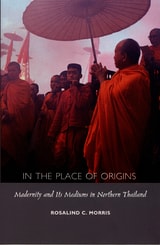
In the Place of Origins
Modernity and Its Mediums in Northern ThailandRosalind C. Morris
Duke University Press, 2000
Through her careful examination of the transformations of spirit mediumship wrought by the mass media, Morris takes readers into the world of the northern Thai past to discover the anticipations of future histories. In this process, she finds new objects for anthropological inquiry, including romantic love and epistolary poetry. She then turns her eye toward the relationships between commodification and prosaic form and photography and the discourses of gendered and national identity. Attending to these issues as they manifest themselves in the practices of mediums, Morris describes both the mundane activities of spirit mediums and the grand ambitions to political authority that are embodied in the increasingly spectacular forms of possession that are becoming so popular with both tourists and local culture brokers. In the Place of Origins traverses this ground with accounts of right-wing militarism and ritual revival during the 70s, and of the democracy movement of 1992, when a global mass media was galvanized by images of military repression and the spectacle of traditional ritual power in cursing. Finally, considering the claims that mediums make to magical power in the face of both AIDS and the Asian economic crisis, Morris reveals the potency of extrajudicial forms of power and violence in the late modern era.
This provocative study will interest anthropologists, historians, Asianists, and those involved in gender, performance, media, and literary studies.
In the Skin of the City
Spatial Transformation in LuandaAntónio Tomás
Duke University Press, 2022
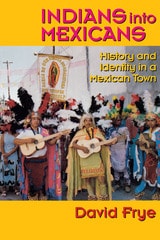
Indians into Mexicans
History and Identity in a Mexican TownBy David Frye
University of Texas Press, 1996
The people of Mexquitic, a town in the state of San Luis Potosí in rural northeastern Mexico, have redefined their sense of identity from "Indian" to "Mexican" over the last two centuries. In this ethnographic and historical study of Mexquitic, David Frye explores why and how this transformation occurred, thereby increasing our understanding of the cultural creation of "Indianness" throughout the Americas.
Frye focuses on the local embodiments of national and regional processes that have transformed rural "Indians" into modern "Mexicans": parish priests, who always arrive with personal agendas in addition to their common ideological baggage; local haciendas; and local and regional representatives of royal and later of national power and control. He looks especially at the people of Mexquitic themselves, letting their own words describe the struggles they have endured while constructing their particular corner of Mexican national identity.
This ethnography, the first for any town in northeastern Mexico, adds substantially to our knowledge of the forces that have rendered "Indians" almost invisible to European-origin peoples from the fifteenth century up to today. It will be important reading for a wide audience not only in anthropology and Latin American studies but also among the growing body of general readers interested in the multicultural heritage of the Americas.
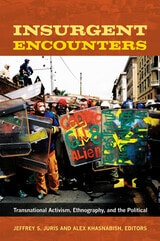
Insurgent Encounters
Transnational Activism, Ethnography, and the PoliticalJeffrey S. Juris and Alex Khasnabish, eds.
Duke University Press, 2013
Contributors. Giuseppe Caruso, Maribel Casas-Cortés, Janet Conway, Stéphane Couture, Vinci Daro, Manisha Desai, Sylvia Escárcega, David Hess, Jeffrey S. Juris, Alex Khasnabish, Lorenzo Mosca, Michal Osterweil, Geoffrey Pleyers, Dana E. Powell, Paul Routledge, M. K. Sterpka, Tish Stringer
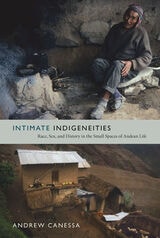
Intimate Indigeneities
Race, Sex, and History in the Small Spaces of Andean LifeAndrew Canessa
Duke University Press, 2012
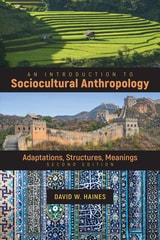
Introduction to Sociocultural Anthropology
Adaptations, Structures, MeaningsDavid Haines
University Press of Colorado, 2017
An Introduction to Sociocultural Anthropology exposes students to the cultural detail and personal experiences that lie in the anthropological record and extends their anthropological understanding to contemporary issues.
The book is divided into three parts that focus on the main themes of the discipline: ecological adaptations, structural arrangements, and interpretive meanings. Each chapter provides an overview of a particular topic and then presents two case examples that illuminate the range of variation in traditional and contemporary societies. New case examples include herders’ climate change adaptations in the Arctic, matrilineal Muslims in Indonesia, Google’s AI winning the Asian game Go, mass migration in China, cross-cultural differences in the use of social media, and the North American response to the Syrian refugee crisis. Instructors will also have digital access to all the book’s illustrations for class review.
Covering the full range of sociocultural anthropology in a compact approach, this revised and updated edition of Cultural Anthropology: Adaptations, Structures, Meanings is a holistic, accessible, and socially relevant guide to the discipline for students at all levels.
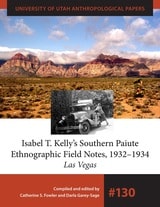
Isabel T. Kelly's Southern Paiute Ethnographic Field Notes, 1932-1934
Compiled and Edited by Catherine S. Fowler and Darla Garey-Sage
University of Utah Press, 2016
University of Utah Anthropological Paper No. 130
This publication presents the first volume (Las Vegas) of the early ethnographic field work of anthropologist Isabel T. Kelly. From 1932 to 1934, Kelly interviewed thirty Southern Paiute people from southeastern California, southern Nevada, and southern Utah about “the old ways.” During this time, she filled thirty-one notebooks, made several maps, took roughly fifty photographs, collected nearly 300 ethnobotanical specimens, purchased and shipped over 400 ethnographic artifacts to museums, and traveled more than 7,000 miles. Her notes comprise the most extensive primary ethnographic documentation of Southern Paiute/Chemehuevi lifeways of the middle to late nineteenth and early twentieth centuries existing today.
Although Kelly intended to publish these notes, she was unable to before her death. Fowler and Garey-Sage have now synthesized the first set of these handwritten field notes and sketches, providing commentary and illustrations to put them in context for the modern reader. Kelly’s data, most of which could not be gathered anew today, are offered here for the use of generations to come.
Islands at the Crossroads
Migration, Seafaring, and Interaction in the CaribbeanL. Antonio Curet
University of Alabama Press, 2011