Results by title
162 books match the query 'Europe, Eastern' and 5 start with i
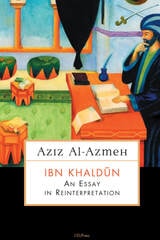
Ibn Khaldun
An Essay in ReinterpretationAziz Al-Azmeh
Central European University Press, 2003
Since its publication in 1981, this book has established itself as the major new interpretation of the historical concept of Ibn Khaldûn, the great figure of Arab-Islamic letters and of historical thought overall--a figure generally thought to be on a par with Thucydides, Vico, Herder and others of similar stature.
The author has eschewed the ahistorical interpretations to which Ibn Khaldûn has normally been subjected, both by authors who have sought unduly to modernise his thought, and by those who sought to freeze it in stereotypical models of Islamic philosophy.
Ibn Khaldûn is not only a true historical source of his time; he is also taken as the unchallenged sociological and cultural interpreter of medieval North Africa and much of medieval and modern Arab-Islamic culture as well. The validity of his discourse is considered to be so universal as to confer upon his ideas the status of progenitor--or, at least, anticipator--of a great variety of modern ideas.
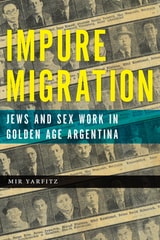
Impure Migration
Jews and Sex Work in Golden Age ArgentinaMir Yarfitz
Rutgers University Press, 2019

Insatiability
Stanislaw Ignacy Witkiewicz, translated from the Polish by Louis Iribarne
Northwestern University Press, 1994
Intellectuals and Politics in Central Europe
Ivan Bernik
Central European University Press, 1999
Intellectuals and the Articulation of the Nation
Ronald Grigor Suny and Michael D. Kennedy, Editors
University of Michigan Press, 1999
What kinds of intellectual practices are influential in the making and remaking of nations? How do literary texts shape nation-making? When are intellectuals most and least relevant to developing the nation? How do liberal, socialist, and nationalist intellectuals shape national ideologies? One of the principal debates in the study of nations concerns the relative significance of elites, specifically intellectuals, in inventing the nation. Intellectuals and the Articulation of the Nation delimits the capacities of intellectuals for shaping nations, as well as the ways in which the development of nations shapes intellectual practices. The introductory chapter presents the principal debates around nation-making and the identity and practices of intellectuals. Contributors from anthropology, history, literature, political science and sociology then explore the capacities and limits of intellectuals in the formation and restructuring of national identities in general, and in Eastern Europe and the former Soviet Union in particular. Each essay is followed by a brief intellectual autobiography in which the author's own relationship to nations is explored. The editors conclude the volume by developing a general theory of national intellectual practice. The principal focus of this book—the mutual articulation of intellectuals and nations—is a key subject for students and scholars of history, cultural studies, political science, anthropology, and sociology.