Results by title
145 books match the query 'Family relationships' and 7 start with i
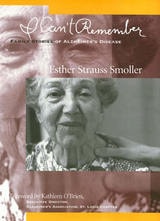
I Can't Remember
Family Stories of Alzheimer's DiseaseEsther Strauss Smoller
Temple University Press, 1997
I Can't Remember is an intimate photo essay of four families and their process of coping with Alzheimer's disease -- a process of coming to terms with the practical and emotional consequences of a disease that changes the entire family dynamic. Family members tell their stories of first denying that their loved one cold be suffering from Alzheimer's, then dealing with the changing relationships among family members and the intensifying emotions, as old family troubles are stirred up and new feelings of despair and love appear.
Photographs and personal narratives are woven together to show both the unpleasant and the beautiful sides of the struggle for connection between spouses and across generations. Smoller has a gift for capturing people as they interact, whether it's arguing around the kitchen table or dancing cheek to cheek.
Each family's story is different, but all four families share common pain and frustration. A highway patrolman who has early onset Alzheimer's describes what it is like to have Alzheimer's. His wife tells a parallel story of life together after hearing the diagnosis. A daughter gives the following account of her mother: "I though that it would be helpful if mother spent time in my home in Colorado. Before this visit, I was in denial, convinced that she suffered from depression and not Alzheimer's disease. ... On the plane trip to Colorado, I was brought into the stark, cold reality that Mom had Alzheimer's. She did not know where she was or where she was going. Upon arrival, she did not recognize my home, although she had visited me numerous times in the past. She tried sleeping in the bathtub the first night."
Another daughter relates that she was unaware of the onset of Alzheimer's in her mother, because her mother was such a "wonderful actress." Eventually the memory problems were no longer confined to where things belonged in the kitchen, but extended into driving off at random, driving in circles in a parking lot in the middle of the night or as much as 75 miles away from home.
I Can't Remember gives an intimate glimpse into the hearts and minds of caregivers and patients. Supportive social networks are essential for healthy life. This book provides the impetus caregivers need to develop contacts that can provide support. Smoller offers a glimpse of the frustration and losses faced by those who deal with Alzheimer's, as well as the potential to transcend those losses -- even is only for a time -- through love and hope.
[more]

I Have Not Loved You With My Whole Heart
Cris Harris
Oregon State University Press, 2021
I Have Not Loved You With My Whole Heart is a memoir of trauma, healing, faith, and violence. At its center is the author’s father, the Rev. Renne Harris, a heavy-handed, alcoholic Episcopal priest who came out in the height of the AIDS crisis and died of HIV in 1995.
In a book rich with remembrances of the Pacific Northwest of the 1970s–1990s, Cris Harris pulls the reader through turning points in a household crowded with abuse, addiction, neglect, acceptance, and grief, as well as the healing that comes after reconciliation. In recognizing perpetrators of violence as complex people—as selves we can recognize—Harris wrestles with paradox: the keening dissonance of loving people with hard edges, the humor of horrible situations, and how humor can cover for anger. He shows how violence can mark us and courageously lays bare those marks, owning them as his own precious history, born of a fierce species of love.
I Have Not Loved You With My Whole Heart will speak to readers whose family members came out late in life, and to those who lost loved ones in the AIDS crisis of the late 1980s and 1990s. Those with complicated relationships to faith, survivors of abuse, and anyone who has lived with family crisis will also find healing in these pages.
[more]
In Reunion
Transnational Korean Adoptees and the Communication of FamilyDocan-Morgan, Sara
Temple University Press, 2024
“Do you know your real parents?” is a question many adoptees are asked. In In Reunion, Sara Docan-Morgan probes the basic notions of family, adoption, and parenthood by exploring initial meetings and ongoing relationships that transnational Korean adoptees have had with their birth parents and other birth family members. Drawing from qualitative interviews with adult Korean adoptees in the United States and Denmark, as well as her own experiences as an adoptee, Docan-Morgan illuminates the complexities of communication surrounding reunion.
The paradoxes of adoption and reunion—shared history without blood relations, and blood relations without shared history—generate questions: What does it mean to be “family”? How do people use communication to constitute family relationships? How are family relationships created, maintained, and negotiated over time? In Reunion details adoptive and cultural identities, highlighting how adoptees often end up shouldering communicative responsibility in their family relationships. Interviews reveal how adoptees navigate birth family relationships across language and culture while also attempting to maintain relationships with their adoptive family members.
Docan-Morgan details the challenges, rewards, and contradictions of reunion. She also offers practical recommendations for transnational adoptees in reunion, adoptees considering reunion, adoptive families, and adoption practitioners.
In tracing the stories of the intercultural dynamics inherent in adoptees’ reunions, Docan-Morgan demonstrates the effort, flexibility, empathy, self-reflection, and time required to navigate long-term relationships with birth families.
[more]
Indigenous Men and Masculinities
Legacies, Identities, RegenerationRobert Alexander Innes
University of Manitoba Press, 2015
[more]
Inequalities of Love
College-Educated Black Women and the Barriers to Romance and FamilyAveril Y. Clarke
Duke University Press, 2011
Inequalities of Love uses the personal narratives of college-educated black women to describe the difficulties they face when trying to date, marry, and have children. While conventional wisdom suggests that all women, regardless of race, must sacrifice romance and family for advanced educations and professional careers, Averil Y. Clarke’s research reveals that educated black women’s disadvantages in romance and starting a family are consequences of a system of racial inequality and discrimination. The author analyzes the accounts of black women who repeatedly return to incompatible partners as they lose hope of finding “Mr. Right” and reject unwed parenting because it seems to affirm a negative stereotype of black women’s sexuality that is inconsistent with their personal and professional identities. She uses national survey data to compare college-educated black women’s experiences of romance, reproduction, and family to those of less-educated black women and those of white and Hispanic women with degrees. She reports that degreed black women’s lives include less marriage and sex, and more unwanted pregnancy, abortion, and unwed childbearing than college-educated white and Hispanic women. Black women’s romantic limitations matter because they constitute deprivation and constraint in romance and because they illuminate important links between race, class, and gender inequality in the United States. Clarke’s discussion of the inequities that black women experience in romance highlights the connections between individuals’ sexual and reproductive decisions, their performance of professional or elite class identities, and the avoidance of racial stigma.
[more]
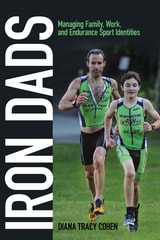
Iron Dads
Managing Family, Work, and Endurance Sport IdentitiesDiana Tracy Cohen
Rutgers University Press, 2016
Among the most difficult athletic events a person can attempt, the iron-distance triathlon—a 140.6 mile competition—requires an intense prerace training program. This preparation can be as much as twenty hours per week for a full year leading up to a race. In Iron Dads, Diana Tracy Cohen focuses on the pressures this extensive preparation can place on families, exploring the ways in which men with full-time jobs, one or more children, and other responsibilities fit this level of training into their lives.
An accomplished triathlete as well as a trained social scientist, Cohen offers much insight into the effects of endurance-sport training on family, parenting, and the sense of self. She conducted in-depth interviews with forty-seven iron-distance competitors and three prominent men in the race industry, and analyzed triathlon blog postings made by Iron Dads. What sacrifices, Cohen asks, are required—both at home and at work—to cross the iron-distance finish line? What happens when work, family, and sport collide? Is it possible for fathers to meet their own parenting expectations while pursuing such a time-consuming regimen? With the tensions of family economics, how do you justify spending $5,000 on a racing bike? At what point does sport become work? Cohen discovered that, by fostering family involvement in this all-consuming effort, Iron Dads are able to maintain a sense of themselves not only as strong, masculine competitors, but also as engaged fathers.
Engagingly written and well researched, Iron Dads provides a penetrating, firsthand look at extreme endurance sports, including practical advice for aspiring racers and suggestions for making triathlons more family-friendly.
[more]
It Shouldn't Be This Way
The Failure of Long-Term CareRobert L. Kane
Vanderbilt University Press, 2005
The failure of long-term care is the country's best-kept embarrassing secret. Almost every adult in the United States will either enter a nursing home or have to deal with a parent or other relative who does. Studies show that 40 percent of all adults who live to age sixty-five will enter a nursing home before they die, while even more will use another form of long-term care.
Part memoir, part practical guide, part prescription for change, It Shouldn't Be This Way is a unique look at the problems of long-term care. Robert L. Kane, a highly experienced physician and gerontologist, and his sister, Joan C. West, tell the painful story of what happened to their mother after she suffered a debilitating stroke and spent the last years of her life in rehabilitation, assisted-living facilities, and finally a nursing home. Along the way, her adult children encountered some professionals who were kind and considerate but also many frustrations—inadequate care and the need to hire private duty aides, as well as poor communication and lack of coordination throughout the system. The situation, they found, proved far more difficult than it needed to be.
As the authors recount their mother's story, they impart various lessons they learned from each phase of the experience. They alert those who are confronting such situations for the first time about what they will likely face and how to approach the problems. Closing with a broader look at why long-term care is the way it is, they propose steps to make necessary reforms, including the development of national organizations to work for change. Their message to families, care professionals, and policy-makers could not be more urgent.
[more]