Results by title
75 books match the query 'Folk & Traditional' and 2 start with i

I Belong to This Band, Hallelujah!
Community, Spirituality, and Tradition among Sacred Harp SingersLaura Clawson
University of Chicago Press, 2011
The Sacred Harp choral singing tradition originated in the American South in the mid-nineteenth century, spread widely across the country, and continues to thrive today. Sacred Harp isn’t performed but participated in, ideally in large gatherings where, as the a cappella singers face each other around a hollow square, the massed voices take on a moving and almost physical power. I Belong to This Band, Hallelujah! is a vivid portrait of several Sacred Harp groups and an insightful exploration of how they manage to maintain a sense of community despite their members’ often profound differences.
Laura Clawson’s research took her to Alabama and Georgia, to Chicago and Minneapolis, and to Hollywood for a Sacred Harp performance at the Academy Awards, a potent symbol of the conflicting forces at play in the twenty-first-century incarnation of this old genre. Clawson finds that in order for Sacred Harp singers to maintain the bond forged by their love of music, they must grapple with a host of difficult issues, including how to maintain the authenticity of their tradition and how to carefully negotiate the tensions created by their disparate cultural, religious, and political beliefs.
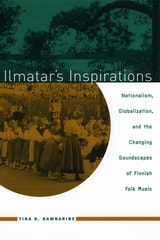
Ilmatar's Inspirations
Nationalism, Globalization, and the Changing Soundscapes of Finnish Folk MusicTina K. Ramnarine
University of Chicago Press, 2003
Kalevala (the Finnish national epic). In Ilmatar's Inspirations, Tina K. Ramnarine explores creative processes and the critical role that music has played in Finnish nationalism by focusing on Finnish "new folk music" in the shifting spaces between the national imagination and the global marketplace.
Through extensive interviews and observations of performances, Ramnarine reveals how new folk musicians think and talk about past and present folk music practices, the role of folk music in the representation of national identity, and the interactions of Finnish folk musicians with performers from around the globe. She focuses especially on two internationally successful groups—JPP, a group that plays fiddle dance music, and Värttinä, an ensemble that highlights women's vocal traditions. Analyzing the multilayered processes—musical, institutional, political, and commercial—that have shaped and are shaped by new folk music in Finland, Ramnarine gives us an entirely new understanding of the connections between music, place, and identity.