Results by title
377 books match the query 'French' and 9 start with i
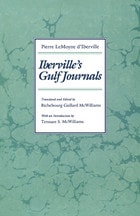
Iberville's Gulf Journals
Pierre Le Moyne d'Iberville, translated by Richebourg Gaillard McWilliams
University of Alabama Press, 1991
Europe's expansion into the New World during the 16th, 17th, and 18th centuries was a story of power alignment and cultural transmission as well as dramatic individual effort. Spain had her conquistadores, France her coureurs de bois, and England her sea dogs. Isolated from the authority of home governments, tempted by the abundance of gold, fur, and fish in the New World, these adventurers so vital to national policies of expansion developed their own personal creeds of conquest and colonization. Their individual exploits not only represent a humanistic theme essential in Europe's movement westward but heighten the analyses of cultural institutions of the era. It is within such a multidisciplinary light that one can experience the Gulf Coast adventures of Pierre LeMoyne d'Iberville.

Imagining Mary Tudor, Queen of France
JoAnn DellaNeva
University of Delaware Press, 2027
This book examines early modern texts that portray Mary Tudor’s girlhood and betrothal to a foreign prince, her brief marriage to the aging king of France, and her untimely widowhood, as well as retrospective accounts that depict her life in France, her relationships with her husband and his heir apparent, and her surreptitious romance and clandestine marriage to an English duke. Here, texts from England are put into conversation with a significant body of work that was written in French, Spanish, Italian, and Latin, culminating in an examination of a novel from North America that passed itself off as a genuine sixteenth-century memoir. Author JoAnn DellaNeva also examines a spectrum of extra-literary texts—such as dialogues, popular songs, letters, speeches, portraiture, tapestries, fashion, jewelry, and book illuminations—for the ways they too helped shape Mary’s image. In so doing, she analyzes the intersection of history and literature, demonstrating how porous the borders between these disciplines can be. Through a series of close readings that are informed by an examination of the cultural context behind these texts, Imagining Mary Tudor, Queen of France seeks to explain how Mary’s fictional biography proved to be so slippery, vacillating between portrayals of her as a virtuous, generally powerless woman and as a wily and wicked minx.
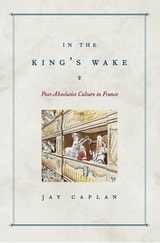
In the King's Wake
Post-Absolutist Culture in FranceJay Caplan
University of Chicago Press, 1999
While absolutist culture had focused on value directly represented in people (e.g., those of noble blood) and things (e.g., coins made of precious metals), post-absolutist culture instead explored the capacity of signs to stand for something real (e.g., John Law's banknotes or Marivaux's plays in which actions rather than birth signify nobility). Between the image of the Sun King and visions of the godlike Romantic self, Caplan discovers a post-absolutist France wracked by surprisingly modern conflicts over the true sources of value and legitimacy.
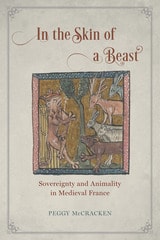
In the Skin of a Beast
Sovereignty and Animality in Medieval FrancePeggy McCracken
University of Chicago Press, 2017
Peggy McCracken discusses a range of literary texts and images from medieval France, including romances in which animal skins appear in symbolic displays of power, fictional explorations of the wolf’s desire for human domestication, and tales of women and snakes converging in a representation of territorial claims and noble status. These works reveal that the qualities traditionally used to define sovereignty—lineage and gender among them—are in fact mobile and contingent. In medieval literary texts, as McCracken demonstrates, human dominion over animals is a disputed model for sovereign relations among people: it justifies exploitation even as it mandates protection and care, and it depends on reiterations of human-animal difference that paradoxically expose the tenuous nature of human exceptionalism.
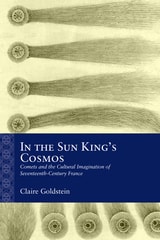
In the Sun King's Cosmos
Comets and the Cultural Imagination of Seventeenth-Century FranceClaire Goldstein
Northwestern University Press, 2025
Offering a new history of a formative cultural and political era through the cosmic phenomena that captured the public’s imagination
In the winters of 1664–65 and 1680–81, the French public was galvanized by two bright comets whose elliptical orbits could not be mapped with contemporary geometry and that thus seemed to appear in random and unpredictable locations. Bookending the period during which Louis XIV’s sun king mythology was created, these comets defied the heliocentric order to which French politics and culture aspired. As Claire Goldstein demonstrates, literary texts, cultural institutions, and architecture inspired by comets offer a different perspective on the relationship between sensory experience, ideology, and artistic form.
In the Sun King’s Cosmos: Comets and the Cultural Imagination of Seventeenth-Century France presents an alternative view of a formative era in cultural and political history, when distinctly modern forms of power and control were established through a regime of the spectacular. Goldstein shows how comets allow us to see the seventeenth century in ways that complicate the narrative of a race toward rationalization, classicism, and modernity, indexing instead a messy period in which the spectacular was sometimes also inscrutable.
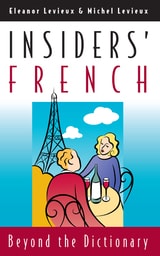
Insiders' French
Beyond the DictionaryEleanor Levieux and Michel Levieux
University of Chicago Press, 1999
This "new France" is a country poised to experience the European single currency but uncertain about being part of Europe. It is hooked on fast food but ambivalent about the country where it originated. France today has record unemployment and an increasingly controversial immigrant population. Clearly, given the rapidly changing conditions and lifestyles, conventional French dictionaries alone cannot completely inform readers and visitors. Insiders' French offers a solution to the incomprehension, a unique handbook in which you'll find the language of European union, the space program, abortion and women's rights, high-tech industries, and health care, among other topics. Entries proceed by association of ideas and related terms, with extensive cross-referencing, while still being alphabetized for easy reference like a standard dictionary. Cartoons from major French journals add to your understanding and enjoyment.
Insiders' French opens up the secret territory of French politics and culture that is often not understood by visitors or students, and it does so with wit and verve—qualities that remain in the French language despite its recent changes.
Intratextual Baudelaire
The Sequential Fabric of the Fleurs du mal and Spleen de ParisRandolph Paul Runyon
The Ohio State University Press, 2010
Involuntary Confessions of the Flesh in Early Modern France
Nora Martin Peterson
University of Delaware Press, 2017
Involuntary Confessions of the Flesh in Early Modern France was inspired by the observation that small slips of the flesh (involuntary confessions of the flesh) are omnipresent in early modern texts of many kinds. These slips (which bear similarities to what we would today call the Freudian slip) disrupt and destabilize readings of body, self, and text—three categories whose mutual boundaries this book seeks to soften—but also, in their very messiness, participate in defining them. Involuntary Confessions capitalizes on the uncertainty of such volatile moments, arguing that it is instability itself that provides the tools to navigate and understand the complexity of the early modern world. Rather than locate the body within any one discourse (Foucauldian, psychoanalytic), this book argues that slips of the flesh create a liminal space not exactly outside of discourse, but not necessarily subject to it, either. Involuntary confessions of the flesh reveal the perpetual and urgent challenge of early modern thinkers to textually confront and define the often tenuous relationship between the body and the self. By eluding and frustrating attempts to contain it, the early modern body reveals that truth is as much about surfaces as it is about interior depth, and that the self is fruitfully perpetuated by the conflict that proceeds from seemingly irreconcilable narratives.
Interdisciplinary in its scope, Involuntary Confessions of the Flesh in Early Modern France pairs major French literary works of the sixteenth and seventeenth centuries (by Marguerite de Navarre, Montaigne, Madame de Lafayette) with cultural documents (confession manuals, legal documents about the application of torture, and courtly handbooks). It is the first study of its kind to bring these discourses into thematic (rather than linear or chronological) dialog. In so doing, it emphasizes the shared struggle of many different early modern conversations to come to terms with the body’s volatility.
Published by University of Delaware Press. Distributed worldwide by Rutgers University Press.
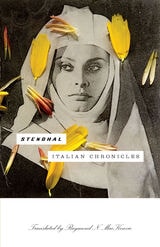
Italian Chronicles
Raymond N. Stendhal
University of Minnesota Press, 2017
Nineteenth-century French writer Marie-Henri Beyle, better known by his pen name Stendhal, is one of the earliest leading practitioners of realism, his stories filled with sharp analyses of his characters’ psychology. This translation of Stendhal’s Chroniques italiennes is a collection of nine tales written between 1829 and 1840, many of which were published only after his death. Together these collected tales reveal a great novelist working with highly dramatic subject matter to forge a vision of life lived at its most intense.
The setting for these tales is a romanticized Italy, a place Stendhal viewed as unpolluted by bourgeois inhibitions and conformism. From the hothouse atmosphere of aristocratic convents to the horrors of the Cenci family, the tales in Italian Chronicles all feature passionate, transgressive characters engaged in “la chasse au bonheur”—the quest for happiness. Most of the tragic, violent tales are based on historical events, with Stendhal using history to validate his characters’ extreme behaviors as they battle literal and figurative oppression and try to break through to freedom.
Complete with revenge, bloody daggers, poisonings, and thick-walled nunneries, this new translation of Italian Chronicles includes four never-before-translated stories and a fascinating introduction detailing the origins of the book. It is sure to gratify established Stendhal fans as well as readers new to the writer.