Results by title
252 books match the query 'Future' and 10 start with i

Illusions of a Future
Psychoanalysis and the Biopolitics of DesireKate Schechter
Duke University Press, 2014
A pioneering ethnography of psychoanalysis, Illusions of a Future explores the political economy of private therapeutic labor within industrialized medicine. Focusing on psychoanalysis in Chicago, a historically important location in the development and institutionalization of psychoanalysis in the United States, Kate Schechter examines the nexus of theory, practice, and institutional form in the original instituting of psychoanalysis, its normalization, and now its "crisis." She describes how contemporary analysts struggle to maintain conceptions of themselves as capable of deciding what psychoanalysis is and how to regulate it in order to prevail over market demands for the efficiency and standardization of mental health treatments.
In the process, Schechter shows how deeply imbricated the analyst-patient relationship is in this effort. Since the mid-twentieth century, the "real" relationship between analyst and patient is no longer the unremarked background of analysis but its very site. Psychoanalysts seek to validate the centrality of this relationship with theory and, through codified "standards," to claim it as a privileged technique. It has become the means by which psychoanalysts, in seeking to protect their disciplinary autonomy, have unwittingly bound themselves to a neoliberal discourse of regulation.
In the process, Schechter shows how deeply imbricated the analyst-patient relationship is in this effort. Since the mid-twentieth century, the "real" relationship between analyst and patient is no longer the unremarked background of analysis but its very site. Psychoanalysts seek to validate the centrality of this relationship with theory and, through codified "standards," to claim it as a privileged technique. It has become the means by which psychoanalysts, in seeking to protect their disciplinary autonomy, have unwittingly bound themselves to a neoliberal discourse of regulation.
[more]
Immigrants and Boomers
Forging a New Social Contract for the Future of AmericaDowell Myers
Russell Sage Foundation, 2007
"This story of hope for both immigrants and native-born Americans is a well-researched, insightful, and illuminating study that provides compelling evidence to support a policy of homegrown human investment as a new priority. A timely, valuable addition to demographic and immigration studies. Highly recommended." —Choice Virtually unnoticed in the contentious national debate over immigration is the significant demographic change about to occur as the first wave of the Baby Boom generation retires, slowly draining the workforce and straining the federal budget to the breaking point. In this forward-looking new book, noted demographer Dowell Myers proposes a new way of thinking about the influx of immigrants and the impending retirement of the Baby Boomers. Myers argues that each of these two powerful demographic shifts may hold the keys to resolving the problems presented by the other. Immigrants and Boomers looks to California as a bellwether state—where whites are no longer a majority of the population and represent just a third of residents under age twenty—to afford us a glimpse into the future impact of immigration on the rest of the nation. Myers opens with an examination of the roots of voter resistance to providing social services for immigrants. Drawing on detailed census data, Myers demonstrates that long-established immigrants have been far more successful than the public believes. Among the Latinos who make up the bulk of California's immigrant population, those who have lived in California for over a decade show high levels of social mobility and use of English, and 50 percent of Latino immigrants become homeowners after twenty years. The impressive progress made by immigrant families suggests they have the potential to pick up the slack from aging boomers over the next two decades. The mass retirement of the boomers will leave critical shortages in the educated workforce, while shrinking ranks of middle-class tax payers and driving up entitlement expenditures. In addition, as retirees sell off their housing assets, the prospect of a generational collapse in housing prices looms. Myers suggests that it is in the boomers' best interest to invest in the education and integration of immigrants and their children today in order to bolster the ranks of workers, taxpayers, and homeowners America they will depend on ten and twenty years from now. In this compelling, optimistic book, Myers calls for a new social contract between the older and younger generations, based on their mutual interests and the moral responsibility of each generation to provide for children and the elderly. Combining a rich scholarly perspective with keen insight into contemporary political dilemmas, Immigrants and Boomers creates a new framework for understanding the demographic challenges facing America and forging a national consensus to address them.
[more]
Imprisonment in America
Choosing the FutureMichael Sherman and Gordon J. Hawkins
University of Chicago Press, 1983
"For a few decades American prisons were the wonder of the world. [However] early hopes that a prison regime could be a powerful means of reforming most convicts have been abandoned, and prisons are seen even by some of those who think we need more of them as savage repositories, to be shunned or veiled rather than admired. This sad history is drawn with great insight and learning in [this] important new book about prisons and punishment in America by Michael Sherman and Gordon Hawkins. . . . The views of these professionals must be taken seriously."—Graham Hughes, New York Review of Books
"This is a serious and enlightened and concerned attempt to fuse liberal and conservative attitudes and values to achieve a breakthrough in American penal policy."—Congressional Staff Journal
"This is a serious and enlightened and concerned attempt to fuse liberal and conservative attitudes and values to achieve a breakthrough in American penal policy."—Congressional Staff Journal
[more]

In the Future of Yesterday
A Life of Stefan ZweigRüdiger Görner
Haus Publishing, 2025
A refreshing approach to the life and work of Austrian writer Stefan Zweig.
In the Future of Yesterday delves into Stefan Zweig’s considerable contribution to world literature, rooted in the Austro-Jewish tradition. His privileged social background saw him embrace European culture and cosmopolitanism. A world traveler from the outset, he liked to uproot himself, but whether he stayed in London, New York, or, eventually, in Brazil, his literary baggage continued to contain the flair of fin de siècle Vienna.
This biography re-examines Zweig’s influential time in England and offers new insights into his final years in the United States and Brazil. It discusses some of his prolific literary output in relation to his life and explores his political views on Europe, Zionism, and the world order in greater depth than previous appraisals of Zweig’s life.
The book also considers the many contradictions in Zweig’s views and attitudes, which included an initial, and surprising, leniency towards fascism. Most importantly, though, In the Future of Yesterday presents Zweig as a towering figure of a form of writing that was bursting with life and that was written in the knowledge that there can only be a future if we remain conscious of the past. In that sense, Zweig is a writer for our time.
[more]
Indigenizing Japan
Ainu Past, Present, and FutureJoe E. Watkins
University of Arizona Press, 2025
In Indigenizing Japan, archaeologist Joe E. Watkins provides a comprehensive look at the rich history and cultural resilience of the Ainu, the Indigenous people of Hokkaido, Japan, tracing their journey from ancient times to their contemporary struggles for recognition.
Relaying the deep history of the islands of Japan, Watkins tells the archaeological story from the earliest arrivals some 40,000 years ago to 16,000 years ago when local cultures began utilizing pottery and stone tools. About 2,300 years ago, another group of people immigrated from the Korean peninsula into the Japanese archipelago, bringing wet rice agriculture with them. They intermarried with the people who were there, forming the basis of the contemporary Japanese majority culture. As the Japanese state developed on the central Islands of Honshu, Ryukyu, and Shikoku, the people of Hokkaido continued developing along a different trajectory with minimal interaction with the mainland until colonization in the mid-nineteenth century, when the people known as the Ainu came under Japanese governmental policy.
Watkins’s insightful analysis highlights the Ainu’s enduring spirit and their resurgence as part of the global Indigenous movement. Key events such as the 1997 Nibutani Dam case and the 2007 recognition of the Ainu as Japan’s Indigenous people are explored in depth, showcasing the Ainu’s ongoing fight for cultural preservation and self-determination. By situating the Ainu’s experiences within broader global colonial histories, Indigenizing Japan underscores the shared struggles and resilience of Indigenous communities worldwide.
[more]
Inhuman Power
Artificial Intelligence and the Future of CapitalismNick Dyer-Witheford, Atle Mikkola Kjosen, and James Steinhoff
Pluto Press, 2019
The past several years have brought staggering advances in the field of Artificial Intelligence. And Marxist analysis has to keep up: while machines were always central to Marxist analysis, modern AI is a new kind of machine that Marx could not have anticipated.
Inhuman Power explores the relationship between Marxist theory and AI through three approaches, each using the lens of a different Marxist theoretical concept. While the idea of widespread AI tends to be celebrated as much as questioned, a deeper analysis of its reach and potential produces a more complex and disturbing picture than has been identified. Inhuman Power argues that on its current trajectory, AI is likely to render humanity obsolete and that the only way to prevent it is a communist revolution.
Inhuman Power explores the relationship between Marxist theory and AI through three approaches, each using the lens of a different Marxist theoretical concept. While the idea of widespread AI tends to be celebrated as much as questioned, a deeper analysis of its reach and potential produces a more complex and disturbing picture than has been identified. Inhuman Power argues that on its current trajectory, AI is likely to render humanity obsolete and that the only way to prevent it is a communist revolution.
[more]
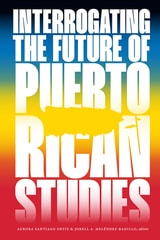
Interrogating the Future of Puerto Rican Studies
Aurora Santiago Ortiz and Jorell A. Meléndez-Badillo, editors
Duke University Press, 2026
Interrogating The Future of Puerto Rican Studies brings together emerging and established scholars from a wide range of disciplines to examine the disciplinary and epistemic transformations that have given way to new understandings of the field of Puerto Rican studies. Documenting the intellectual contours that have shaped the field of Puerto Rican Studies in the last decade, a diverse range of contributors survey the field with new lenses that are attentive to gender, queerness, disability, and Blackness among other things. A foreword by Yarimar Bonilla situates the volume in the context of the field’s shift, specifically in the aftermath of Hurricane Maria, while other sections, including “Queering Puerto Rican Studies,” “Centering Blackness,” and “Disaster Studies and Environmental Studies,” as well as “Puerto Rican Studies in Broader Fields of Knowledges,” “Prefigurative Politics and Social Movements,” and “Legal and Political Disruptions,” create a vibrant archive of conversations taking place within the field of Puerto Rican studies with the aim of interrogating its future.
Contributors. José Atiles, Bárbara Abadía Rexach, Yarimar Bonilla, daniela crespo-miró, Marie Cruz Soto, Yomaira Figueroa-Vásquez, Marcela Guerrero, Gustavo García López, Mónica Jiménez, Lawrence LaFountain Stokes, Marisol LeBrón, Pedro Lebrón Ortiz, Beatriz Llenín Figueroa, Jorell Meléndez-Badillo, Sarah Molinari, Marisel Moreno, Daniel Nevárez Araújo, Aurora Santiago Ortiz, Karrieann Soto Vega, Daniel Vázquez Sanabria, Roberto Vélez-Vélez, Joaquín Villanueva, Jacqueline Villarrubia-Mendoza
Contributors. José Atiles, Bárbara Abadía Rexach, Yarimar Bonilla, daniela crespo-miró, Marie Cruz Soto, Yomaira Figueroa-Vásquez, Marcela Guerrero, Gustavo García López, Mónica Jiménez, Lawrence LaFountain Stokes, Marisol LeBrón, Pedro Lebrón Ortiz, Beatriz Llenín Figueroa, Jorell Meléndez-Badillo, Sarah Molinari, Marisel Moreno, Daniel Nevárez Araújo, Aurora Santiago Ortiz, Karrieann Soto Vega, Daniel Vázquez Sanabria, Roberto Vélez-Vélez, Joaquín Villanueva, Jacqueline Villarrubia-Mendoza
[more]
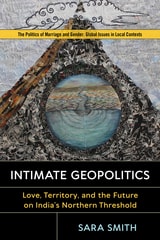
Intimate Geopolitics
Love, Territory, and the Future on India’s Northern ThresholdSara Smith
Rutgers University Press, 2020
Winner of the 2021 Julian Minghi Distinguished Book Award from the American Association of Geographers
2021 Foreword Indies Finalist - Politics and Social Sciences
Intimate Geopolitics begins with a love story set in the Himalayan region of Ladakh, in India’s Jammu and Kashmir State, but this is also a story about territory, and the ways that love, marriage, and young people are caught up in contemporary global processes. In Ladakh, children grow up to adopt a religious identity in part to be counted in the census, and to vote in elections. Religion, population, and voting blocs are implicitly tied to territorial sovereignty and marriage across religious boundaries becomes a geopolitical problem in an area that seeks to define insiders and outsiders in relation to borders and national identity. This book populates territory, a conventionally abstract rendering of space, with the stories of those who live through territorial struggle at marriage and birth ceremonies, in the kitchen and in the bazaar, in heartbreak and in joy. Intimate Geopolitics argues for the incorporation of the role of time–temporality–into our understanding of territory.
[more]
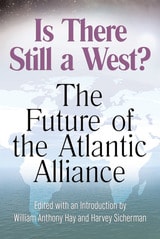
Is There Still a West?
The Future of the Atlantic AllianceEdited & Intro by William Anthony Hay & Harvey Sicherman
University of Missouri Press, 2007
The international response to the attacks of 9/11 promised a new sense of unity between the United States and its European allies, but subsequent disagreements over Iraq have made the Western alliance seem tentative at best. Is There Still a West? looks beyond recent events to put disagreements within NATO into historical perspective, exploring how cultural, demographic, economic, and military factors since the 1940s have affected future prospects for security cooperation.
As questions underlying the current rift persist, distinguished scholars—Stephen A. Schuker, Michael Radu, Jeremy Black, and others—consider whether that gathering of nations long known as “the West” remains a valid construct. Claiming that differences over Iraq are no greater than past conflicts over Suez, China, or other issues, they adopt a “realist” stance in international relations to offer an alternative to neoconservative and liberal viewpoints. They show what the major issues—and nonissues—really are, and which among them are the true time bombs.
These essays consider a range of relevant topics, from the impact of globalization to emerging differences in the political cultures of North Americans and Europeans to an analysis of headscarf issues among Muslim immigrants. They particularly address the consequences of demographic shifts as Western countries try to deal with growing Muslim communities that present a security and cultural challenge. In proposing possible counterterrorism strategies to define a shared Western security policy, this book considers whether a distinctive Western way of war in fact exists and what it might mean for the alliance.
These insightful essays look beyond transatlantic complaints to probe underlying difficulties, explore sources of conflict, assess prospects for economic divergence, and advocate a workable security policy. Together, they ask readers to consider whether “the West” is still a major force in international affairs or whether we face a new world of competing states and shifting alliances. By addressing these challenges, Is There Still a West? points toward the development of effective policies to ensure the ongoing unity of the West.
[more]

Islam and Secularity
The Future of Europe's Public SphereNilüfer Göle
Duke University Press, 2015
In Islam and Secularity Nilüfer Göle takes on two pressing issues: the transforming relationship between Islam and Western secular modernity and the impact of the Muslim presence in Europe. Göle shows how the visibility of Islamic practice in the European public sphere unsettles narratives of Western secularism. As mutually constitutive, Islam and secularism permeate each other, the effects of which play out in embodied and aesthetic practices and are accompanied by fear, anxiety, and violence. In this timely book, Göle illuminates the recent rethinking of secularism and religion, of modernity and resistance to it, of the public significance of sexuality, and of the shifting terrain of identity in contemporary Europe.
[more]