Results by title
86 books match the query 'Gerontology' and 5 start with i
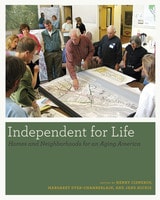
Independent for Life
Homes and Neighborhoods for an Aging AmericaEdited by Henry Cisneros, Margaret Dyer-Chamberlain, and Jane Hickie
University of Texas Press, 2012
Do you want to age independently in your own home and neighborhood? Staying home, aging in place, is most people's preference, but most American housing and communities are not adapted to the needs of older people. And with the fastest population growth among people over 65, finding solutions for successful aging is important not only for individual families, but for our whole society. In Independent for Life, former HUD Secretary Henry Cisneros and a team of experts on aging, architecture, construction, health, finance, and politics assess the current state of housing and present new possibilities that realistically address the interrelated issues of housing, communities, services, and financial concerns.
Independent for Life covers a wide range of smart solutions, including remodeling current housing and building new homes for accessibility and safety, retrofitting existing neighborhoods to connect needed services and amenities, and planning new communities that work well for people of all ages. Case studies show how the proposals can be implemented. The authors offer action plans for working with policy makers at local, state, and national levels to address the larger issues of aging in place, including family financial security, real estate markets, and the limitations of public support. Lists of essential resources, including a detailed "to do" list of aging in place priorities and an individual home assessment, complete the volume.
Inquiries in the Economics of Aging
Edited by David A. Wise
University of Chicago Press, 1998
Within the next twenty years, an unprecedented proportion of Americans will be over sixty-five. New research in the economics of aging is an essential element of understanding what the future holds for this aging population. Inquiries in the Economics of Aging presents both empirical papers that consider questions that are fundamental to public policy and more theoretical contributions that lay new groundwork for future research in the economics of aging.
Inquiries in the Economics of Aging provides a timely overview of some of the most important questions facing researchers on aging and outlines new techniques and models that may help to answer these questions. This important volume will be of great interest to specialists and policy makers as it paves the way for future analysis.
Issues in the Economics of Aging
Edited by David A. Wise
University of Chicago Press, 1990
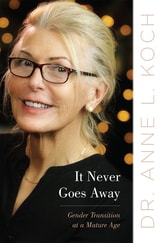
It Never Goes Away
Gender Transition at a Mature AgeAnne L. Koch, D.M.D.
Rutgers University Press, 2019
Ken Koch was one of those people. Married twice, a veteran, and a world traveler, a health scare when he was sixty-three prompted him to acknowledge the feelings that had plagued him since he was a small child. By undergoing a host of procedures, he radically changed his appearance and became Anne Koch. In the process though, Anne lost everything that Ken had accomplished. She had to remake herself from the ground up. Hoping to help other people in her age bracket who may be considering transitioning, Anne describes the step by step procedures that she underwent, and shares the cost to her personal life, in order to show seniors that although it is never too late to become the person you always knew you were, it is better to go into that new life prepared for some serious challenges. Both a fascinating memoir of a well-educated man growing up trans yet repressed in the mid-twentieth century, and a guidebook to navigating the tricky waters of gender reassignment as a senior, It Never Goes Away shows how what we see in the television world of Transparent translates in real life.
It Shouldn't Be This Way
The Failure of Long-Term CareRobert L. Kane
Vanderbilt University Press, 2005
Part memoir, part practical guide, part prescription for change, It Shouldn't Be This Way is a unique look at the problems of long-term care. Robert L. Kane, a highly experienced physician and gerontologist, and his sister, Joan C. West, tell the painful story of what happened to their mother after she suffered a debilitating stroke and spent the last years of her life in rehabilitation, assisted-living facilities, and finally a nursing home. Along the way, her adult children encountered some professionals who were kind and considerate but also many frustrations—inadequate care and the need to hire private duty aides, as well as poor communication and lack of coordination throughout the system. The situation, they found, proved far more difficult than it needed to be.
As the authors recount their mother's story, they impart various lessons they learned from each phase of the experience. They alert those who are confronting such situations for the first time about what they will likely face and how to approach the problems. Closing with a broader look at why long-term care is the way it is, they propose steps to make necessary reforms, including the development of national organizations to work for change. Their message to families, care professionals, and policy-makers could not be more urgent.