Results by title
383 books match the query 'Globalization' and 23 start with i
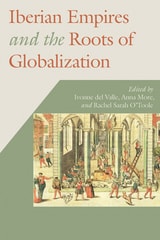
Iberian Empires and the Roots of Globalization
Ivonne del Valle
Vanderbilt University Press, 2019
Iberian Empires and the Roots of Globalization argues that Iberian empires cannot be viewed apart from early modern globalization. From research sites throughout the early modern Spanish and Portuguese territories and from distinct disciplinary approaches, the essays collected in this volume investigate the economic mechanisms, administrative hierarchies, and art forms that linked the early modern Americas, Africa, Asia, and Europe. Iberian Empires and the Roots of Globalization demonstrates that early globalization was structured through diverse networks and their mutual and conflictive interactions within overarching imperial projects. To this end, the essays explore how specific products, texts, and people bridged ideas and institutions to produce multiple centers within Iberian imperial geographies. Taken as a whole, the authors also argue that despite attempts to reproduce European models, early Iberian globalization depended on indigenous agency and the agency of people of African descent, which often undermined or changed these models.
The volume thus relays a nuanced theory of early modern globalization: the essays outline the Iberian imperial models that provided templates for future global designs and simultaneously detail the negotiated and conflictive forms of local interactions that characterized that early globalization. The essays here offer essential insights into historical continuities in regions colonized by Spanish and Portuguese monarchies.

Illness Is a Weapon
Indigenous Identity and Enduring AfflictionsEirik Saethre
Vanderbilt University Press, 2013
Rarely is disease and suffering understood as a form of protest, and in Illness Is a Weapon, Saethre confronts the stark reality of the current contest between all parties in this struggle. As Saethre explains, "Cursing at nurses, refusing to take medication, and accepting acute illness as unremarkable is simultaneously an act of defiance and a rejection of vulnerability."

Ilmatar's Inspirations
Nationalism, Globalization, and the Changing Soundscapes of Finnish Folk MusicTina K. Ramnarine
University of Chicago Press, 2003
Kalevala (the Finnish national epic). In Ilmatar's Inspirations, Tina K. Ramnarine explores creative processes and the critical role that music has played in Finnish nationalism by focusing on Finnish "new folk music" in the shifting spaces between the national imagination and the global marketplace.
Through extensive interviews and observations of performances, Ramnarine reveals how new folk musicians think and talk about past and present folk music practices, the role of folk music in the representation of national identity, and the interactions of Finnish folk musicians with performers from around the globe. She focuses especially on two internationally successful groups—JPP, a group that plays fiddle dance music, and Värttinä, an ensemble that highlights women's vocal traditions. Analyzing the multilayered processes—musical, institutional, political, and commercial—that have shaped and are shaped by new folk music in Finland, Ramnarine gives us an entirely new understanding of the connections between music, place, and identity.
Imagined Globalization
Néstor García Canclini
Duke University Press, 2014
García Canclini contrasts the imaginaries of previous migrants to the Americas with those who live in transnational circuits today. He integrates metaphor and narrative, working through philosophical, anthropological, and socioeconomically grounded interpretations of art, literature, crafts, media, and other forms of expression toward his conclusion that globalization is, in important ways, a collection of heterogeneous narratives. García Canclini advocates global imaginaries that generate new strategies for dealing with contingency and produce new forms of citizenship oriented toward multiple social configurations rather than homogenization. This edition of Imagined Globalization includes a significant new introduction by George Yúdice and an interview in which the cultural theorist Toby Miller and García Canclini touch on events including the Arab Spring and Occupy Wall Street.
Imagining Our Americas
Toward a Transnational FrameSandhya Shukla and Heidi Tinsman, eds.
Duke University Press, 2007
Scholars of literature, ethnic studies, and regional studies as well as of anthropology and history, the contributors focus on the Americas as a broadly conceived geographic, political, and cultural formation. Among the essays are explorations of the varied histories of African Americans’ presence in Mexican and Chicano communities, the different racial and class meanings that the Colombian musical genre cumbia assumes as it is absorbed across national borders, and the contrasting visions of anticolonial struggle embodied in the writings of two literary giants and national heroes: José Martí of Cuba and José Rizal of the Philippines. One contributor shows how a pidgin-language mixture of Japanese, Hawaiian, and English allowed second-generation Japanese immigrants to critique Hawaii’s plantation labor system as well as Japanese hierarchies of gender, generation, and race. Another examines the troubled history of U.S. gay and lesbian solidarity with the Cuban Revolution. Building on and moving beyond previous scholarship, this collection illuminates the productive intellectual and political lines of inquiry opened by a focus on the Americas.
Contributors. Rachel Adams, Victor Bascara, John D. Blanco, Alyosha Goldstein, Héctor Fernández L’Hoeste, Ian Lekus, Caroline F. Levander, Susan Y. Najita, Rebecca Schreiber, Sandhya Shukla, Harilaos Stecopoulos, Michelle Stephens, Heidi Tinsman, Nick Turse, Rob Wilson
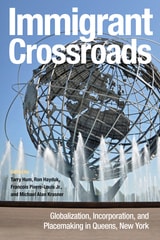
Immigrant Crossroads
Globalization, Incorporation, and Placemaking in Queens, New YorkEdited by Tarry Hum, Ron Hayduk, Francois Pierre-Louis Jr., and Michael Alan Krasner
Temple University Press, 2021
Nearly half the 2.3 million residents of Queens, New York are foreign-born. Immigrants in Queens hail from more than 120 countries and speak more than 135 languages. As an epicenter of immigrant diversity, Queens is an urban gateway that exemplifies opportunities and challenges in shaping a multi-racial democracy.
The editors and contributors to Immigrant Crossroads examine the social, spatial, economic, and political dynamics that stem from this fast-growing urbanization. The interdisciplinary chapters examine residential patterns and neighborhood identities, immigrant incorporation and mobilizations, and community building and activism.
Essays combine qualitative and quantitative research methods to address globalization and the unprecedented racial and ethnic diversity as a result of international migration. Chapters on incorporation focus on immigrant participation and representation in electoral politics, and advocacy for immigrant inclusion in urban governance and service provision. A section of Immigrant Crossroads concerns placemaking, focusing on the production of neighborhood spaces and identities as well as immigrant activism and community development and control.
Based on engaged and robust analysis, Immigrant Crossroads highlights the dynamics of this urban gateway.
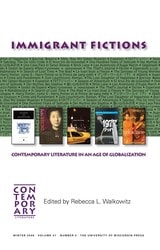
Immigrant Fictions
Contemporary Literature in an Age of GlobalizationRebecca L. Walkowitz
University of Wisconsin Press, 2007
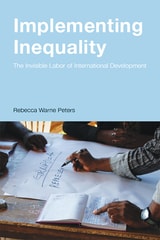
Implementing Inequality
The Invisible Labor of International DevelopmentRebecca Warne Peters
Rutgers University Press, 2020

In a Wounded Land
Conservation, Extraction, and Human Well-Being in Coastal TanzaniaVinay R. Kamat
University of Arizona Press, 2024
Focusing on the human element of marine conservation and the extractive industry in Tanzania, this volume illuminates what happens when impoverished people living in underdeveloped regions of Africa are suddenly subjected to state-directed conservation and natural resource extraction projects, implemented in their landscapes of subsistence. In a Wounded Land draws on ethnographically rich case studies and vignettes collected over a ten-year period in several coastal villages on Tanzania’s southeastern border with Mozambique. In seven chapters, the book demonstrates how state power, processes of displacement and dispossession, forms of local resistance and acquiescence, environmental and social justice, and human well-being become interconnected.
Written in lucid, accessible language, this is the first book that reveals the social implications of the co-presence of a marine park and a gas project at a time when internationally funded conservation initiatives and extraction projects among rural African populations are engendering rapid social transformation.

In the Space of Theory
Postfoundational Geographies of the Nation-StateMatthew Sparke
University of Minnesota Press, 2005
In the Space of Theory details the territorial implications of the Iraq war, NAFTA, welfare reform, constitutional reform, cross-border regional development, and the legal battles of First Nations. In using antiessentialist arguments to elucidate the complexity of these developments, Sparke seeks to ground and critique postfoundational theory itself. He shows how the postfoundational arguments of Homi Bhabha, Arjun Appadurai, Timothy Mitchell, Ernesto Laclau, Chantal Mouffe, Michael Hardt, and Antonio Negri obscure politically important processes of reterritorialization at the same time they deterritorialize diverse theoretical assumptions about the nation-state. Engaged with theory and grounded in close study of cultural, political, and economic change, In the Space of Theory explores the geographies of struggle that at once underlie and undermine the hyphen in contemporary nation-states.
Matthew Sparke is associate professor of geography and international studies at the University of Washington.
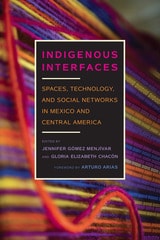
Indigenous Interfaces
Spaces, Technology, and Social Networks in Mexico and Central AmericaEdited by Jennifer Gómez Menjívar and Gloria Elizabeth Chacón; Foreword by Arturo Arias
University of Arizona Press, 2019
Indigenous Interfaces provides the first thorough examination of indigeneity at the interface of cyberspace. Correspondingly, it examines the impact of new media on the struggles for self-determination that Indigenous peoples undergo in Mexico and Central America. The volume’s contributors highlight the fresh approaches that Mesoamerica’s Indigenous peoples have given to new media—from YouTubing Maya rock music to hashtagging in Zapotec. Together, they argue that these cyberspatial activities both maintain tradition and ensure its continuity. Without considering the implications of new technologies, Indigenous Interfaces argues, twenty-first-century indigeneity in Mexico and Central America cannot be successfully documented, evaluated, and comprehended.
Indigenous Interfaces rejects the myth that indigeneity and information technology are incompatible through its compelling analysis of the relationships between Indigenous peoples and new media. The volume illustrates how Indigenous peoples are selectively and strategically choosing to interface with cybertechnology, highlights Indigenous interpretations of new media, and brings to center Indigenous communities who are resetting modes of communication and redirecting the flow of information. It convincingly argues that interfacing with traditional technologies simultaneously with new media gives Indigenous peoples an edge on the claim to autonomous and sovereign ways of being Indigenous in the twenty-first century.
Contributors
Arturo Arias
Debra A. Castillo
Gloria Elizabeth Chacón
Adam W. Coon
Emiliana Cruz
Tajëëw Díaz Robles
Mauricio Espinoza
Alicia Ivonne Estrada
Jennifer Gómez Menjívar
Sue P. Haglund
Brook Danielle Lillehaugen
Paul Joseph López Oro
Rita M. Palacios
Gabriela Spears-Rico
Paul Worley

Inequality and the Global Economic Crisis
Douglas Dowd
Pluto Press, 2009
Inequality, per se, has been with us for millennia. With the creation, growth and deepening of Capitalism across the globe, inequalities take on new dimensions, unknown in previous eras. As Capitalism has spread its wings across the globe over the last 200 or so years, so inequalities have deepened and widened, both inside Nation Sates, between nation States. These inequalities are of income, wealth and of power.
This book, written by the widely respected economic historian Douglas Dowd at the age of 90, is notable for his own experience and vivid memory, of the 1929-31 recession. Since the 1980s, and the predominance of the present neo-liberal ideology, all of the inequalities that the book presents have grown rapidly. Written as a critique of the counter-productivity of growing economic inequality and vindicated by the present world banking crisis, Dowd presents a strong argument against capitalist expansion, exploitation and oligarchic rule.
Dowd's conclusions, that the globalization and growth of the financial sector will impact painfully upon hundreds of millions of people, unknown to most of us in our lifetime, Dowd's book deals with these issues from the unique perspective of inequality. Presenting both a history of the current crisis and an overview of it's, Inequality will appeal to both a broad general readership, and provides an extremely useful reference point for students of political economy, economic history, contemporary economics and global politics.
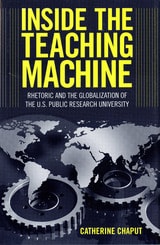
Inside the Teaching Machine
Rhetoric and the Globalization of the U.S. Public Research UniversityCatherine Chaput
University of Alabama Press, 2008
An incisive critique of the corporatized university, tracing the entanglement of academic missions with economic, political, and cultural systems.
Advocates of higher education have long contended that universities should operate above the crude material negotiations of economics and politics. Such arguments, ignore the historical reality that the American university system emerged through, and in service to, a capitalist political economy that unevenly combines corporate, state, and civil interests.
As the corporatization of U.S. universities becomes nearly impossible to deny, the common response from many academics has been a superior stand against the contamination of the professional ideal by tainted corporate interests. Inside the Teaching Machine proposes a correction to this view through the lens of historical materialism.
Chaput argues that the U.S. public research university has always been a vital component of the capitalist political economy. While conventional narratives of public higher education emphasize civic preparation and upward mobility, Chaput demonstrates that supposedly egalitarian policies like the Morrill Land-Grant Act and the G.I. Bill served the changing interests of capitalism much as education, creating a professional class that supports the capitalist political economy. Chaput also focuses on the relationship between American universities and globalization, showing how the trend toward professionalization contributes to the production of surplus value, and the ways that the American university model circulates outside the United States. Chaput concludes by advocating rhetorical strategies for the professional who opposes the capitalist logic of the global university system, proposing concrete options for engaging and redirecting globalization within the university system.
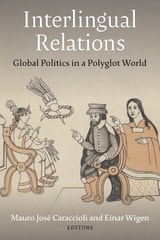
Interlingual Relations
Global Politics in a Polyglot WorldMauro J. Caraccioli and Einar Wigen, Editors.
University of Michigan Press, 2026
International politics is often conducted in two languages or more, and since no two languages are exactly the same, what is possible to say in one language may be impossible to say in another. Translation is at the heart of global politics, and interlingual relations traverse time, space, culture, and state borders. Interlingual Relations builds on emergent literature on translation in International Relations (IR) to propose a unique research agenda for scholars of global politics, offering multiple directions and sets of principles for sustained study.
The contributors use various methodologies to explore these interfaces and encounters in different sites, bringing together multiple subfields, approaches, and disciplinary paradigms across IR’s history. Together they offer a more truly global perspective on international affairs, going beyond the hegemony of English to demonstrate the interconnectedness between “high” politics and everyday life. They show the role of translation in global politics as one of world-making, whereby social roles, rules, and responsibilities establish the semblance of order despite not sounding or meaning the same to all actors. In establishing Interlingual Relations as a foundational part of IR, the book offers another key to studying global interactions and the high political stakes in the theories, methods, and ethics of translation.
International Dimensions of Monetary Policy
Edited by Jordi Galí and Mark Gertler
University of Chicago Press, 2010
United States monetary policy has traditionally been modeled under the assumption that the domestic economy is immune to international factors and exogenous shocks. Such an assumption is increasingly unrealistic in the age of integrated capital markets, tightened links between national economies, and reduced trading costs. International Dimensions of Monetary Policy brings together fresh research to address the repercussions of the continuing evolution toward globalization for the conduct of monetary policy.
In this comprehensive book, the authors examine the real and potential effects of increased openness and exposure to international economic dynamics from a variety of perspectives. Their findings reveal that central banks continue to influence decisively domestic economic outcomes—even inflation—suggesting that international factors may have a limited role in national performance. International Dimensions of Monetary Policy will lead the way in analyzing monetary policy measures in complex economies.

International Financial Markets
The Challenge of GlobalizationEdited by Leonardo Auernheimer
University of Chicago Press, 2003
After a guided tour by the editor and a historical exploration, some of the world's leading theorists and policy analysts examine the benefits and pitfalls of capital movements and controls. In the second portion, papers examine the recent experiences of Argentina and Mexico, with Charles Calomiris—whose proposals for a new world financial architecture have elicited wide attention—contributing a response. The volume concludes with a roundtable discussion of the report of the International Financial Institutions Advisory Commission, in which the chair of the commission, Allan H. Meltzer, both comments on the report and responds to questions about it.
The material presented here will become a standard reference for analysts, policymakers, and the interested general public.
Contributors:
Leonardo Auernheimer, Matthew Bishop, Michael D. Bordo, Charles Calomiris, Guillermo A. Calvo, Augustin Carstens, Michael P. Dooley, Pablo E. Guidotti, T. Britton Harris, John P. Lipsky, Guillermo Ortiz Martinez, Allan H. Meltzer, Andrew Powell, Rene Stulz, Carl E. Walsh
International Trade in Services and Intangibles in the Era of Globalization
Edited by Marshall B. Reinsdorf and Matthew J. Slaughter
University of Chicago Press, 2009
Quantitative measures of international exchange have historically focused on trade in tangible products or capital. However, services have recently become a larger portion of developed economies and international trade, and will only increase in the future. In International Trade in Services and Intangibles in the Era of Globalization, Marshall Reinsdorf and Matthew J. Slaughter examine new and emerging patterns of trade, especially the growing importance of transactions involving services or intangible assets such as intellectual property.
A distinguished team of contributors analyzes the challenges involved in measuring trade in intangibles, the comparative advantages enjoyed by United States service industries, and the heightened international competition for jobs, capital investment, economic growth, and tax revenue that results from trade in services. This comprehensive volume will be necessary reading for scholars seeking to understand the rapidly changing global economy.

Interwoven Rosewood
Collaborative Ecologies, Colonial Entanglements, and Indigenous ResistanceJulie Velásquez Runk, the Wounaan National Congress, and the Wounaan Local Congress of Majé
University of Arizona Press, 2026
Interwoven Rosewood is a collaborative exploration of the global rosewood trade and its entanglements with Indigenous lifeways, colonial histories, and environmental crises. Co-authored by Julie Velásquez Runk and members of the Wounaan National Congress and its Local Congress of the Majé community, this book traces the story of cocobolo rosewood from Wounaan lands in Panama to international markets, revealing how centuries of settler colonialism and extractive capitalism continue to shape landscapes, livelihoods, and relationships. At its heart, the book is a meditation on well-being and belonging—how people live in relation to land, each other, and the more-than-human world.
Drawing on more than a decade of community-based research and six collaborative book workshops, the authors weave together first-person narratives, ecological analysis, historical context, and Indigenous knowledge. The result is a richly textured account that challenges dominant narratives of environmental degradation by centering Wounaan experiences of joy, resistance, and conviviality. The book’s structure reflects its method: interwoven chapters authored or spoken by Wounaan colleagues, grounded in consent protocols and shaped by ancestral storytelling traditions.
Accessibly written, Interwoven Rosewood is ideal for courses in environmental conservation, Indigenous studies, anthropology, Latin American studies, and political ecology. With its interdisciplinary reach and classroom-ready discussion questions, the book invites readers to reflect on the global forces behind environmental catastrophe—and the enduring power of Indigenous ways of knowing, being, and becoming.
Invested Interests
Capital, Culture, and the World BankBret Benjamin
University of Minnesota Press, 2007
Despite the World Bank’s profound impact on economic, political, and social conditions during the post–World War II era, cultural critics who rigorously theorize other institutions of colonialism and globalization have largely ignored the institution. Working to correct this blind spot, Bret Benjamin’s Invested Interests presents the first extended cultural analysis of the World Bank.
In Invested Interests, Benjamin contends that the World Bank has, from its inception, trafficked in culture. From the political context in which the Bank was chartered to its evolution into an interventionist development agency with vast, unchecked powers, Benjamin explores the Bank’s central role in the global dissemination of Fordist-Keynesianism, its conflicted support for nationalism and the nation-state, and its emerging awareness of the relationships between economics and culture. Benjamin argues that the Bank shapes, and is in turn shaped by, historical pressures of the age—most significantly the rise of third world national liberation movements. Reading a broad array of midcentury archival materials, Benjamin examines not only the Bank’s own growing attentiveness to cultural work but also its prominent place in the thinking of such anti-imperialist intellectuals as Aimé Césaire, Frantz Fanon, and Richard Wright.
Benjamin maps the Bank’s contemporary rhetorical maneuvering in the wake of ever-intensifying protests, offering close readings of the World Bank’s corporate literature, the activities of the antiglobalization World Social Forum, and the writings of prominent Bank critic Arundhati Roy, including her novel The God of Small Things.
Deftly investigating the World Bank’s ideological struggles over six decades, Invested Interests develops a conceptually and politically nuanced critique of the Bank as a cultural institution deeply enmeshed in the last century’s historical transformations of imperial power and anti-imperial struggle.
Bret Benjamin is associate professor of English and director of undergraduate studies at the University of Albany, SUNY.

Iranian Cinema and Globalization
National, Transnational, and Islamic DimensionsShahab Esfandiary
Intellect Books, 2012
Despite critical acclaim and a recent surge of popularity with Western audiences, Iranian cinema has been the subject of lamentably few academic studies—and those have by and large been limited to the films and filmmakers most visible on the international film circuit. Iranian Cinema and Globalization seeks to broaden readers’ exposure to other dimensions of Iranian cinema, including the works of the many prolific filmmakers whose films have received little outside attention despite being widely popular within Iran. Combining theories of globalization and national cinema with in-depth, interdisciplinary analyses of individual films, this volume expands the current literature on Iranian cinema with insights into the social, and religious political contexts involved.

Irish Families and Globalization
Conversations about Belonging and Identity across Space and Time: Groves Monographs on Marriage and Family (Volume 3)Christine A. Readdick
Michigan Publishing Services, 0
Groves Monographs on Marriage and Family is an edited book series based on the annual meetings of the Groves Conference on Marriage and Family, an interdisciplinary, interprofessional organization of limited invited membership founded in 1934. Groves Monographs publishes work on the leading edges of theory development and empirical research in the field of family studies. Individual volumes are edited by the chairs of the annual Groves Conferences and include peer-reviewed chapters by the conference presenters and invited authors. Topics are timely and provocative with diverse themes.
Isle of Rum
Havana Club, Cultural Mediation, and the Fight for Cuban AuthenticityChristopher Chávez
Rutgers University Press, 2024
Rather than laying claim to authentic Cuban culture, Chávez explores which aspects of Cuban culture are deemed most compelling and, therefore, most profitable by corporate marketers. As a joint venture between the Cuban state and Pernod Ricard, a global spirits marketer based in Paris, Havana Club embodies the larger process of economic reform, which was meant to reintegrate Cuba into global markets during Cuba’s Special Period in a Time of Peace.

It's Legal but It Ain't Right
Harmful Social Consequences of Legal IndustriesNikos Passas and Neva Goodwin
University of Michigan Press, 2005
--William S. Laufer, Professor, The Wharton School of Business
"This delightful and serious book involves a matter I have long felt of first importance. That is our tendency to make social truth and acceptance conform to personal or larger corporate interests. On this I have written , but gladly yield to this persuasive parallel. No one concerned with literate, informed, and relevant---as distinct from self-serving---truth should miss It's Legal but It Ain't Right."
--John Kenneth Galbraith
"This absorbing and well-written book of essays on the harmful consequences of legal industries skillfully illuminates the ways in which some corporate harms fail to be transformed into criminal law-making and enforcement, and offers cogent suggestions for better regulation in the public interest."
--Dr. Michael Levi, Professor of Criminology, Cardiff University
Many U.S. corporations and the goods they produce negatively impact our society without breaking any laws. We are all too familiar with the tobacco industry's effect on public health and health care costs for smokers and nonsmokers, as well as the role of profit in the pharmaceutical industry's research priorities. It's Legal but It Ain't Right tackles these issues, plus the ethical ambiguities of legalized gambling, the firearms trade, the fast food industry, the pesticide industry, private security companies, and more. Aiming to identify industries and goods that undermine our societal values and to hold them accountable for their actions, this collection makes a valuable contribution to the ongoing discussion of ethics in our time.
This accessible exploration of corporate legitimacy and crime will be important reading for advocates, journalists, students, and anyone interested in the dichotomy between law and legitimacy.