Results by title
406 books match the query 'Greece' and 11 start with i
Iliad, Book 1
Homer
University of Michigan Press, 2002
Image and Myth
A History of Pictorial Narration in Greek ArtLuca Giuliani
University of Chicago Press, 2013
Imports and Immigrants
Near Eastern Contacts with Iron Age CreteGail L. Hoffman
University of Michigan Press, 1998
Drawing together all the evidence and arguments for Near Eastern immigrants in Crete, Hoffman demonstrates there are basic problems with the accepted interpretations. Evidence of continued technical expertise casts doubt on the necessity of reintroduction, while careful scrutiny of the evidence supporting immigrant craftsmen reveals many inadequacies in the currently accepted analyses.
Imports and Immigrants identifies the need for reassessing all dimensions of the question of artistic relationships between ancient Greece and other regions of the Aegean basin and suggests new avenues of inquiry in this important debate. The volume also reassesses arguments made for the presence of Near Eastern immigrants in Crete. This book includes a catalogue indispensable for future work on these issues and illustrations of most of the known imports to Crete.
Gail L. Hoffman is Associate Professor of Greek Art and Archaeology, Department of Classics, Yale University.
Indo-European Sacred Space
Vedic and Roman CultRoger D. Woodard
University of Illinois Press, 2006
Looking closely at the organization of Roman religious activity, especially as regards sacrifices, festivals, and the hierarchy of priests, Woodard sheds new light on issues including the presence of the god Terminus in Jupiter's Capitoline temple, the nature of the Roman suovetaurilia, the Ambarvalia and its relationship to the rites of the Fratres Arvales, and the identification of the "Sabine" god Semo Sancus. Perhaps most significantly, this work also presents a novel and persuasive resolution to the long standing problem of "agrarian Mars."
Information Gathering in Classical Greece
Frank S. Russell
University of Michigan Press, 2000
Insults in Classical Athens
Deborah Kamen
University of Wisconsin Press, 2022
While the classical city celebrated the democratic equality of "autochthonous" citizens, it counted a large population of noncitizens as inhabitants, so that ancient Athenians developed a preoccupation with negotiating, affirming, and restricting citizenship. Kamen raises key questions about what it meant to be a citizen in democratic Athens and demonstrates how insults were deployed to police the boundaries of acceptable behavior. In doing so, she illuminates surprising differences between antiquity and today and sheds light on the ways a democratic society valuing "free speech" can nonetheless curb language considered damaging to the community as a whole.
Intimate Commerce
Exchange, Gender, and Subjectivity in Greek TragedyBy Victoria Wohl
University of Texas Press, 1997
Exchanges of women between men occur regularly in Greek tragedy—and almost always with catastrophic results. Instead of cementing bonds between men, such exchanges rend them. They allow women, who should be silent objects, to become monstrous subjects, while men often end up as lifeless corpses. But why do the tragedies always represent the transferal of women as disastrous?
Victoria Wohl offers an illuminating analysis of the exchange of women in Sophocles' Trachiniae, Aeschylus' Agamemnon, and Euripides' Alcestis. She shows how the attempts of women in these plays to become active subjects rather than passive objects of exchange inevitably fail. While these failures seem to validate male hegemony, the women's actions, however futile, blur the distinction between male subject and female object, calling into question the very nature of the tragic self. What the tragedies thus present, Wohl asserts, is not only an affirmation of Athens' reigning ideologies (including its gender hierarchy) but also the possibility of resistance to them and the imagination of alternatives.
Inventing Paradise
The Greek Journey, 1937-47Edmund Keeley
Northwestern University Press, 2002

Ireland and the Classical World
By Philip Freeman
University of Texas Press, 2000
On the boundary of what the ancient Greeks and Romans considered the habitable world, Ireland was a land of myth and mystery in classical times. Classical authors frequently portrayed its people as savages—even as cannibals and devotees of incest—and evinced occasional uncertainty as to the island's shape, size, and actual location. Unlike neighboring Britain, Ireland never knew Roman occupation, yet literary and archaeological evidence prove that Iuverna was more than simply terra incognita in classical antiquity.
In this book, Philip Freeman explores the relations between ancient Ireland and the classical world through a comprehensive survey of all Greek and Latin literary sources that mention Ireland. He analyzes passages (given in both the original language and English) from over thirty authors, including Julius Caesar, Strabo, Tacitus, Ptolemy, and St. Jerome. To amplify the literary sources, he also briefly reviews the archaeological and linguistic evidence for contact between Ireland and the Mediterranean world.
Freeman's analysis of all these sources reveals that Ireland was known to the Greeks and Romans for hundreds of years and that Mediterranean goods and even travelers found their way to Ireland, while the Irish at least occasionally visited, traded, and raided in Roman lands. Everyone interested in ancient Irish history or Classics, whether scholar or enthusiast, will learn much from this pioneering book.
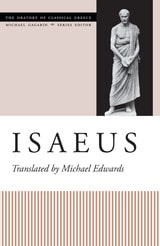
Isaeus
Translated with an introduction by Michael Edwards
University of Texas Press, 2007
This is the eleventh volume in the Oratory of Classical Greece. This series presents all of the surviving speeches from the late fifth and fourth centuries BC in new translations prepared by classical scholars who are at the forefront of the discipline. These translations are especially designed for the needs and interests of today's undergraduates, Greekless scholars in other disciplines, and the general public.
Classical oratory is an invaluable resource for the study of ancient Greek life and culture. The speeches offer evidence on Greek moral views, social and economic conditions, political and social ideology, law and legal procedure, and other aspects of Athenian culture that have recently been attracting particular interest: women and family life, slavery, and religion, to name just a few.
The orator Isaeus lived during the fourth century BC and was said to be the teacher of Demosthenes, Athens' most famous orator. Of the fifty or more speeches he is believed to have written, eleven survive in whole, one as a large fragment, and others as smaller fragments. This volume presents all the surviving works of Isaeus. The speeches mainly deal with inheritances and are a vital source of information regarding Greek law in this important area. In addition to translating the speeches, Michael Edwards provides a general introduction to Isaeus and Athenian inheritance law, as well as specific introductions and notes for each speech.
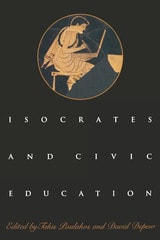
Isocrates and Civic Education
Edited by Takis Poulakos and David Depew
University of Texas Press, 2004
Civic virtue and the type of education that produces publicly minded citizens became a topic of debate in American political discourse of the 1980s, as it once was among the intelligentsia of Classical Athens. Conservatives such as former National Endowment for the Humanities chairman William Bennett and his successor Lynn Cheney held up the Greek philosopher Aristotle as the model of a public-spirited, virtue-centered civic educator. But according to the contributors in this volume, a truer model, both in his own time and for ours, is Isocrates, one of the preeminent intellectual figures in Greece during the fourth century B.C.
In this volume, ten leading scholars of Classics, rhetoric, and philosophy offer a pathfinding interdisciplinary study of Isocrates as a civic educator. Their essays are grouped into sections that investigate Isocrates' program in civic education in general (J. Ober, T. Poulakos) and in comparison to the Sophists (J. Poulakos, E. Haskins), Plato (D. Konstan, K. Morgan), Aristotle (D. Depew, E. Garver), and contemporary views about civic education (R. Hariman, M. Leff). The contributors show that Isocrates' rhetorical innovations carved out a deliberative process that attached moral choices to political questions and addressed ethical concerns as they could be realized concretely. His notions of civic education thus created perspectives that, unlike the elitism of Aristotle, could be used to strengthen democracy.