Results by title
218 books match the query 'Handbooks, manuals, etc' and 12 start with i
Indexes
A Chapter from The Chicago Manual of Style, 15th EditionUniversity of Chicago Press Staff
University of Chicago Press, 2003
Indexes
A Chapter from The Chicago Manual of Style, 16th ed.University of Chicago Press Staff
University of Chicago Press, 2010
Indexes
A Chapter from The Chicago Manual of Style, Seventeenth EditionThe University of Chicago Press Editorial Staff
University of Chicago Press, 2017
Instructor Guide for Speechcraft
Discourse Pronunciation for Academic CommunicationWayne B. Dickerson
University of Michigan Press, 2027
Instructor Guide for Speechcraft helps shoulder time-consuming, non-teaching tasks so that instructors can focus on working directly with their students. Four-part lesson plans are adaptable for instructors who want to insert critical pronunciation topics into a non-pronunciation ESL/EFL course. To aid in professional development, each lesson plan includes a commentary on the order of topics in the syllabus and common student questions. Appendices provide pre- and post-tests to make sure that instructors have the resources they need to teach confidently. In addition to the 232 audio recordings for the textbook, instructors can access 37 additional recordings that can be used for class preparation or for in-class progress checks. With the Instructor Guide for Speechcraft, teachers will be able to help their students achieve the clear, intelligible speech they need to pursue their studies in their chosen discipline, to serve as international teaching assistants, and to interact well in their chosen professions.

Intellectual Freedom Manual
Trina Magi
American Library Association, 2015
Intellectual Freedom Manual
Trina Magi
American Library Association, 2021
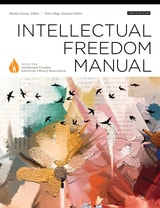
The newest edition of the Intellectual Freedom Manual is more than simply an update of a foundational text that has served as a crucial resource for more than four decades. It is a living document that serves as the authoritative reference for day-to-day guidance on maintaining free and equal access to information for all people. Whether you’re developing or revising policies, on-boarding new staff or trustees, responding to challenges and controversies, or studying librarianship, you’ll find this an indispensable resource, with features such as
- ALA policy statements, approved by committees and Council, articulating core intellectual freedom principles and best practices;
- 8 new interpretations of the Library Bill of Rights, which address urgent issues like internet filtering, public performances, political activity, religion, and equity, diversity, and inclusion;
- “Issues at a Glance” sidebars which present key concepts, points of law, tips, and questions for reflection;
- expanded content about developing library policies that support intellectual freedom;
- updated information on censorship of library programs, displays, and databases;
- “Advocacy and Assistance,” a section offering concrete guidance when you’re called on to talk to the media or meet with legislators;
- Deeper Look essays which examine the laws related to library operations;
- advice on when to call the police, when not to, and how to handle personally identifiable information when they arrive; and
- an expanded glossary.
Intellectual Freedom Manual
American Library Association, 2006
Intellectual Freedom Manual
American Library Association, 2010
Intellectual Freedom Manual, Eleventh Edition
Erin Office for Intellectual Freedom
American Library Association, 2026
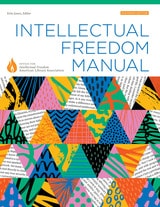
When someone faces a difficult intellectual freedom (IF) issue, they usually don’t have time to wade through dense text to find the answers they need. Designed as a real-world reference, OIF’s Intellectual Freedom Manual provides trusted, comprehensive guidance for every library worker, from the volunteer to the director, in plain language. Whether you’re developing or reviewing policies, on-boarding new staff or trustees, responding to challenges and controversies, or studying librarianship, you’ll find this a vital tool, with features such as
- contributions that center the voices of Black, Indigenous, and other People of Color (BIPOC) and LGBTQIA+ people, who are often targeted by censorship efforts;
- chapters that begin with an overview explaining the big ideas and offering reflection questions;
- an introduction to IF and why it matters, drawing on ALA's core IF documents and supported with adaptable policy worksheets;
- information and best practice guidance on key topics such as access, children and youth, censorship and internet filtering, collection development and management, copyright, meeting rooms and exhibit spaces, library programming, politics and religion, privacy, and visits and requests from law enforcement;
- stories from real people whose lives have been impacted by IF, showing how library policies shape culture, protect staff and users, and affect real people;
- concise breakdowns of IF issues from legal experts, helping you understand the laws and how they apply in real situations;
- practical advice on advocating for IF, getting help when challenges arise, lobbying, and working with your elected officials;
- a thorough index to help you quickly find the information you need; and
- a helpful glossary and selected bibliography of additional resources.
Interlibrary Loan Practices Handbook
Cherié L. Weible
American Library Association, 2011
Interlibrary Loan Practices Handbook
American Library Association, 1997
Internships in the Private Sector
How You Can Find, Prepare for, and Thrive in ThemCharles A. Fishkin
University of Chicago Press, 2026
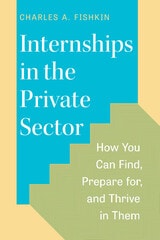
Every year, college students across the country seek internships to build experience in their chosen fields. In this highly competitive job market, students and recent graduates need to seek out every possible opportunity to differentiate themselves and demonstrate that they are ready to roll up their sleeves and get to work. One important way to do so is an internship in the private sector, which can lead to a full-time job with a well-regarded organization. Yet the process of finding an internship can appear challenging. This book can make it easier.
For more than a decade, finance professional Charles Fishkin has been preparing students to thrive in internship programs. In this book, he shares his advice for those who are seeking a private-sector internship. With insights relevant to a variety of fields—from finance to the tech sector—he covers the process from start to finish, beginning with exploring the range of internship opportunities available. Several chapters offer advice on best practices for crafting effective resumes, networking, and interviewing to get the position. Fishkin offers checklists, action items, real-life scenarios, and practical suggestions, each arising from the experiences of former interns and hiring managers. The heart of the book focuses on the nine to twelve weeks of the internship itself, with tips on how to interact with supervisors and colleagues, how to learn and apply new skills, and how to solve problems and address challenges that arise.
Internships in the Private Sector is the first full-length guide to securing and making the most of an internship. This book will help level the playing field, providing students with the tools and support they need to perform to the fullest extent of their abilities and lay the foundation for a strong start to their careers.