Results by title
184 books match the query 'Hispanic Americans' and 7 start with i
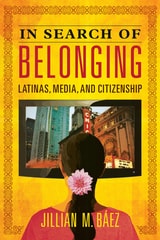
In Search of Belonging
Latinas, Media, and CitizenshipJillian M Baez
University of Illinois Press, 2018
Innovative and informed by a wealth of new evidence, In Search of Belonging answers important questions about the ways Latinas perform citizenship in today’s America.
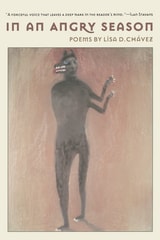
In an Angry Season
Lisa D. Chávez
University of Arizona Press, 2001
A white woman navigates her fear and uncertainty to learn the ways of the people she called savages, until she begins to dream “in Dakota, syllables sliding / on my tongue like tender pieces of meat.” An African man, on display as a cannibal at the World’s Columbian Exposition in 1893, sees into the future: “humiliations heaped up / as on overfilled plates . . . / . . . a country that casually / consumes its own.” A woman holds the gray-blue barrel of a gun in her mouth, “the taste familiar / as her own blood.”
With an unexcelled command of narrative verse, Lisa Chávez tells the stories of American lives across more than a century. Whether retelling nineteenth-century captivity narratives or depicting contemporary American women confronting addiction and despair, Chávez investigates issues of identity and self-definition in the face of an often harsh and unremitting history.
Her story-poems explore the ways in which people have been made captive—whether to racism or national policy, to bad marriages or alcoholism, to poverty or emotion—from the Inuit woman birthing a son among strangers to the wife now deranged by desire for another man: “He’s the smoky slow-burn of chipotle on the tongue. My golden idol. My gospel revival. He’s hashish sweet and languorous—my body’s one desire.”
In the end, Chávez shows us a New World of promise in which an alchemist’s assistant summons stories from stones by calling their names with “clicks of her tongue, / syllables of silver, turquoise, and jade,” and a Native woman discovers her true power in an Alaskan bar. Passionate and political, In an Angry Season is a work of startling depth and breadth—an American history in poetry—that asks us what it means to be civilized.
In the Barrios
Latinos and the Underclass DebateJoan Moore
Russell Sage Foundation, 1993
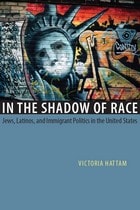
In the Shadow of Race
Jews, Latinos, and Immigrant Politics in the United StatesVictoria Hattam
University of Chicago Press, 2007
Victoria Hattam locates the origins of ethnicity in the New York Zionist movement of the early 1900s. In a major revision of widely held assumptions, she argues that Jewish activists identified as ethnics not as a means of assimilating and becoming white, but rather as a way of defending immigrant difference as distinct from race—rooted in culture rather than body and blood. Eventually, Hattam shows, the Immigration and Naturalization Service and the Census Bureau institutionalized this distinction by classifying Latinos as an ethnic group and not a race. But immigration and the resulting population shifts of the last half century have created a political opening for reimagining the relationship between immigration and race. How to do so is the question at hand.
In the Shadow of Race concludes by examining the recent New York and Los Angeles elections and the 2006 immigrant rallies across the country to assess the possibilities of forging a more robust alliance between immigrants and African Americans. Such an alliance is needed, Hattam argues, to more effectively redress the persistent inequalities in American life.
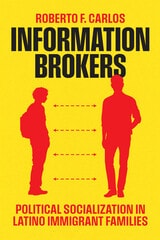
Information Brokers
Political Socialization in Latino Immigrant FamiliesRoberto F. Carlos
University of Chicago Press, 2026
An insightful rethinking of political socialization within Latino immigrant households.
Conventional wisdom tells us that children are passive recipients of political lessons from their parents, with caregivers being the ones who mold the developing behavior and beliefs of the children under their roof. Roberto F. Carlos challenges this preconception by revealing how Latino children, especially those with immigrant parents, often become key sources of political information and guidance in their families. As migrant parents navigate unfamiliar institutions and customs in the United States, they often turn to their children to broker information about everything from daily life to civic engagement. These roles not only place unique responsibilities on children but also create new pathways for them to shape the political behavior of their parents. Moreover, by taking on these roles, children learn the skills that can make them effective advocates later in life, even as they face resource disadvantages that normally correlate with reduced political participation and sense of political efficacy.
Drawing on six original surveys, multiple experiments, and in-depth interviews, including the accounts of youth helping protect their families from deportation, InformationBrokers shows how these dynamics influence both immigrant parents and their children in politically consequential ways. With the Latino population now over 64 million, Information Brokers offers vital insight into the political incorporation of America’s largest ethnic group.
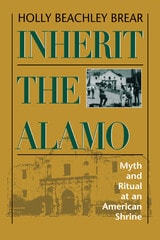
Inherit the Alamo
Myth and Ritual at an American ShrineBy Holly Beachley Brear
University of Texas Press, 1994
Long overshadowed by the towering buildings of downtown San Antonio, the modest little Alamo still evokes tremendous feeling among Texans and, indeed, many other Americans. For Anglo Texans, the Alamo is the "Cradle of Texas Liberty" and a symbolic confirmation of Manifest Destiny. For Hispanic Texans, however, the Alamo has increasingly become a stolen symbol, its origin as a Spanish mission forgotten, its famous defeat used to exclude Hispanics from an honorable place in Texas history.
In this important new book, Holly Beachley Brear explores in fascinating detail what the Alamo means to the numerous groups that lay claim to its heritage. She shows how Alamo myths often diverge from the historical facts—and why. She decodes the agendas of various groups, including the Daughters of the Republic of Texas (who maintain the Alamo buildings and grounds), the Order of the Alamo, the Texas Cavaliers, and LULAC. And she probes attempts by individuals and groups to rewrite the Alamo myth to include more positive roles for themselves, as she explains the value in laying claim to the Alamo's past.
With new perspectives on all the sacred icons of the Alamo and the Fiesta that celebrates (one version of) its history each year, Inherit the Alamo is guaranteed to challenge stereotypes and offer new understanding of the Alamo's ongoing role in shaping Texas and American history and mythology. It will be of interest to a wide popular and scholarly audience.

Intimacy Across Borders
Race, Religion, and Migration in the U.S. MidwestJane Juffer
Temple University Press, 2013
Examining how encounters produced by migration lead to intimacies-ranging from sexual, spiritual, and neighborly to hateful and violent, Jane Juffer considers the significant changes that have occurred in small towns following an influx of Latinos to the Midwest.
Intimacy across Borders situates the story of the Dutch Reformed Church in Iowa and South Africa within a larger analysis of race, religion, and globalization. Drawing on personal narrative, ethnography, and sociopolitical critique, Juffer shows how migration to rural areas can disrupt even the most thoroughly entrenched religious beliefs and transform the schools, churches, and businesses that form the heart of small-town America. Conversely, such face-to-face encounters can also generate hatred, as illustrated in the increasing number of hate crimes against Latinos and the passage of numerous anti-immigrant ordinances.
Juffer demonstrates how Latino migration to new areas of the U.S. threatens certain groups because it creates the potential for new kinds of families—mixed race, mixed legal status, and transnational—that challenge the conservative definition of community based on the racially homogeneous, coupled, citizen family.