Results by title
2646 books match the query 'History & Criticism' and 81 start with i

I Am a Fugitive From a Chain Gang
Edited, with an introduction by John E. O'Connor; Tino T. Balio, Series Editor
University of Wisconsin Press, 1981
Since its release in 1932, I Am a Fugitive From a Chain Gang had earned a reputation as one of the few Hollywood products that can be associated directly with social change. Film historians attribute the reform of the southern chain gang system to the public outrage generated by this movie, which depicts a true story.
In addition to being an important social document, the film remains a gripping experience for filmgoers today because of its unusual dramatic conception, its hauntingly inconclusive ending, and Paul Muni's performance as the good boy forced to go wrong.
This book includes the complete screenplay.

I Believe I'll Go Back Home
Roots and Revival in New England Folk MusicThomas S. Curren
University of Massachusetts Press, 2021
Fueled by interviews with key players from the folk music scene, I Believe I'll Go Back Home traces a direct line from Yankee revolutionaries, up-country dancers, and nineteenth-century pacifists to the emergence of blues and rock 'n' roll, ultimately landing at the period of the folk revival. Thomas S. Curren presents the richness and diversity of the New England folk tradition, which continues to provide perspective, inspiration, and healing in the present day.
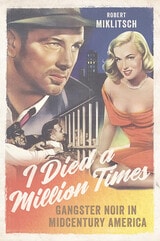
I Died a Million Times
Gangster Noir in Midcentury AmericaRobert Miklitsch
University of Illinois Press, 2020
With the Senate's organized crime hearings and the brighter-than-bright myth of the American Dream as a backdrop, Miklitsch examines the style and history, and the production and cultural politics, of classic pictures from The Big Heat and The Asphalt Jungle to lesser-known gems like 711 Ocean Drive and post-Fifties movies like Ocean’s Eleven. Miklitsch pays particular attention to trademark leitmotifs including the individual versus the collective, the family as a locus of dissension and rapport, the real-world roots of the heist picture, and the syndicate as an octopus with its tentacles deep into law enforcement, corporate America, and government. If the memes of gangster noir remain prototypically dark, the look of the films becomes lighter and flatter, reflecting the influence of television and the realization that, under the cover of respectability, crime had moved from the underworld into the mainstream of contemporary everyday life.

I Hid It under the Sheets
Growing Up with RadioGerald Eskenazi
University of Missouri Press, 2005
Imagine that there was a time in America when a child sat next to a radio and simply listened. But didn’t just listen, was enthralled and knew that this time was his alone, that he was part of the vortex of drama unfolding inside the radio’s innards. . . . I never saw a punch thrown, or a glass shatter, or a blood-smeared shirt as I listened to the radio. Nor did I know Barbara Stanwyck’s hairstyle as she overacted in Sorry, Wrong Number on the Lux Radio Theatre. And I had no idea how corpulent Happy Felton was as he dropped ten silver dollars that jangled into a Sheffield’s Milk bottle on Guess Who. (Yes, ten bucks was what you won on that show.) Instead, I imagined it all.
I Hid It under the Sheets captures a bygone era—the late 1930s, 1940s, and early 1950s—through the reminiscences of award-winning New York Times reporter Gerald Eskenazi. This first-person recollection shows radio’s broad impact on his generation and explains how and why it became such a major factor in shaping America and Americans.
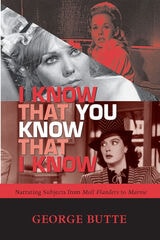
I KNOW THAT YOU KNOW THAT I KNOW
NARRATING SUBJECTS FROM MOLL FLANDERS TO MARNIEGeorge Butte
The Ohio State University Press, 2004
In I Know That You Know That I Know, Butte explores how stories narrate human consciousness. Butte locates a historical shift in the representation of webs of consciousnesses in narrative—what he calls “deep intersubjectivity”—and examines the effect this shift has since had on Western literature and culture. The author studies narrative practices in two ways: one pairing eighteenth-and nineteenth-century British novels (Moll Flanders and Great Expectations, for example), and the other studying genre practices—comedy, anti-comedy and masquerade—in written and film narratives (Jane Austen and His Girl Friday, for example, and Hitchcock’s Cary Grant films).
Butte’s second major claim argues for new ways to read representations of human consciousness, whether or not they take the form of deep intersubjectivity. Phenomenological criticism has lost its credibility in recent years, but this book identifies better reading strategies arising out of what the author calls poststructuralist phenomenology, grounded largely in the work of the French philosopher Merleau-Ponty. Butte criticizes the extreme of transcendental idealism (first-wave phenomenological criticism) and cultural materialism (when it rules out the study of consciousness). He also criticizes the dominant Lacanian framework of much academic film criticism.
I Know You Are, but What Am I?
On Pee-wee HermanCait McKinney
University of Minnesota Press, 2024
How Pee-wee and his playhouse help us reimagine our relationships to technology
I Know You Are, but What Am I? explores the cultural legacy of Pee-wee Herman, the cult television star of Pee-wee’s Playhouse. This children’s show—that was also for adults—ran on network TV from 1986 to 1990 and starred comedian Paul Reubens as Herman, a queer man-boy whose playhouse, the set for the show, was tricked out with a profusion of animate computational toys and technologies.
Cait McKinney shows how three defining scenes from the show inform, and even foretell and challenge, our present moment: the playhouse as an alternative precursor to networked smart homes that foregrounds caring and ethical relationships between humans and technologies; a reparative retelling of Reubens’s career-wrecking 1991 arrest for indecent exposure inside a Florida adult film theater as part of an AIDS-phobic, antigay sting operation; and worn-out, Talking Pee-wee dolls and their broken afterlives on eBay and YouTube.
McKinney looks at how queer people who were children in the 1980s remember and relate to Pee-wee now, showing that the moral panic about sexuality, gender, and children from the past can help us refute anti-trans and anti-queer political movements organized today.

I Wonder U
How Prince Went beyond Race and BackAdilifu Nama
Rutgers University Press, 2020
In 1993, Prince infamously changed his name to a unique, unpronounceable symbol. Yet this was only one of a long string of self-reinventions orchestrated by Prince as he refused to be typecast by the music industry’s limiting definitions of masculinity and femininity, of straightness and queerness, of authenticity and artifice, or of black music and white music.
Revealing how he continually subverted cultural expectations, I Wonder U examines the entirety of Prince’s diverse career as a singer, multi-instrumentalist, songwriter, producer, record label mogul, movie star, and director. It shows how, by blending elements of R&B, rock, and new wave into an extremely videogenic package, Prince was able to overcome the color barrier that kept black artists off of MTV. Yet even at his greatest crossover success, he still worked hard to retain his credibility among black music fans. In this way, Adilifu Nama suggests, Prince was able to assert a distinctly black political sensibility while still being perceived as a unique musical genius whose appeal transcended racial boundaries.

I'd Fight the World
A Political History of Old-Time, Hillbilly, and Country MusicPeter La Chapelle
University of Chicago Press, 2019
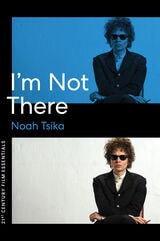
I'm Not There
Noah Tsika
University of Texas Press, 2023
An examination of director Todd Haynes and his Bob Dylan biopic.
As the first and only Bob Dylan “biopic,” I’m Not There caused a stir when released in 2007. Offering a surreal retelling of moments from Dylan’s life and career, the film is perhaps best known for its distinctive approach to casting, including Cate Blanchett and Marcus Carl Franklin, a Black child actor, as versions of Dylan though none of the characters bear his name. Greenlit by Bob Dylan himself, the film uses Dylan’s music as a score, a triumph for famed queer filmmaker Todd Haynes after encountering issues with copyright in previous projects.
Noah Tsika eloquently characterizes all the ways that Dylan and Haynes harmonize in their methods and sensibilities, interpreting the rule-breaking film as a biography that refuses chronology, disdains factual accuracy, flirts with libel, and cannibalizes Western cinema. Fitting the film’s inspiration, creation, and reception alongside its continuing afterlife, Tsika examines Dylan’s music in the film through the context of intellectual property, raising questions about who owns artistic material and artistic identities and how such material can be reused and repurposed. Tsika’s adventurous analysis touches on gender, race, queerness, celebrity, popular culture, and the law, while offering much to Haynes and Dylan fans alike.

Ibsen Apocalypse
Vegard Vinge and Ida Müller’s Six-Hundred-Year Mission to Raise the Ghosts of ModernityAndrew Friedman
Northwestern University Press, 2026
Presenting a groundbreaking account of an audacious theatrical undertaking
Created by the Norwegian/German duo of Vegard Vinge and Ida Müller, the Ibsen-Saga (2006–present) is a six-hundred-year project to restage Henrik Ibsen’s entire oeuvre. Andrew Friedman presents a groundbreaking historical narrative of this project’s development and dramaturgy, through the theories and practices of modernism’s most influential and controversial artists, including Henrik Ibsen, Richard Wagner, F. T. Marinetti, Erwin Piscator, and Jackson Pollock. Vinge and Müller treat Ibsen’s plays as the urtexts of a mythical struggle between artistic vision and material limits, which they explore through analogous narratives ranging from Hamlet to World Cup soccer matches, all unified by a singular aesthetic that juxtaposes totalizing fiction and extreme reality. As Friedman shows, they mythologize Ibsen’s themes of artistic ambition to resurrect and test modernism’s fantasies of artistic autonomy, totality, creative license, and provocation.
By reading Vinge and Müller’s project through its modernist inspirations, Friedman demonstrates the material and ethical limits of modernist ideals in current theatrical practice, providing new perspectives on the legacy of these pioneering figures. Ibsen Apocalypse is a bold, cross-disciplinary reappraisal of the persistent power of modernity in contemporary performance.
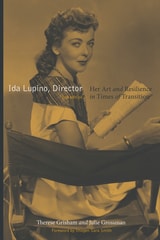
Ida Lupino, Director, 2nd edition
Her Art and Resilience in Times of TransitionTherese Grisham
Rutgers University Press, 2026
The updated edition of Ida Lupino, Director: Her Art and Resilience in Times of Transition, an in-depth exploration of Lupino’s film and television directing work, provides close readings of the films and TV episodes Lupino directed and accounts for the history of Lupino’s reception, continuing into the mid-2020s, in media and film scholarship. The book gives readers a fuller understanding of Lupino’s major contribution to the history of American cinema and media. The revisions update this book, the first on Lupino’s directing, to address recent scholarship on Lupino’s work and reinforce her abiding relevance for cinephiles and film scholars. It incorporates scholarly and popular culture references to Lupino in the last seven years. Updates include a foreword by writer and film critic Imogen Sara Smith, whose work in film scholarship and the public arena has drawn attention to Lupino and the importance of gender to film noir. Authors Therese Grisham and Julie Grossman have added a complete list of the TV episodes Lupino directed in the 1950s and '60s, as well as an updated epilogue.
This new edition addresses how our views of Lupino’s innovative cinema and her prodigious contributions to classic television have been taken up by others, proving that Lupino, whose reputation has waxed and waned since the middle of the twentieth century, is here to stay as a major figure in the history of American media.
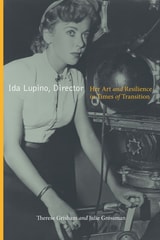
Ida Lupino, Director
Her Art and Resilience in Times of TransitionGrisham, Therese
Rutgers University Press, 2017
The first in-depth study devoted to Lupino’s directorial work, this book makes a strong case for her as a trailblazing feminist auteur, a filmmaker with a clear signature style and an abiding interest in depicting the plights of postwar American women. Ida Lupino, Director not only examines her work as a cinematic auteur, but also offers a serious consideration of her diverse and long-ranging career, getting her start in Hollywood as an actress in her teens and twenties, directing her first films in her early thirties, and later working as an acclaimed director of television westerns, sitcoms, and suspense dramas. It also demonstrates how Lupino fused generic elements of film noir and the social problem film to create a distinctive directorial style that was both highly expressionistic and grittily realistic. Ida Lupino, Director thus shines a long-awaited spotlight on one of our greatest filmmakers.

Ideal Beauty
The Life and Times of Greta GarboLois W. Banner
Rutgers University Press, 2023
Ideal Beauty reveals the woman behind the mystique, a woman who overcame an impoverished childhood to become a student at the Swedish Royal Dramatic Academy, an actress in European films, and ultimately a Hollywood star. Chronicling her tough negotiations with Louis B. Mayer at MGM, it shows how Garbo carved out enough power in Hollywood to craft a distinctly new feminist screen presence in films like Queen Christina. Banner draws on over ten years of in-depth archival research in Sweden, Germany, France, and the United States to demonstrate how, away from the camera’s glare, Garbo’s life was even more intriguing. Ideal Beauty takes a fresh look at an icon who helped to define female beauty in the twentieth century and provides answers to much-debated questions about Garbo’s childhood, sexuality, career, illnesses and breakdowns, and spiritual awakening.
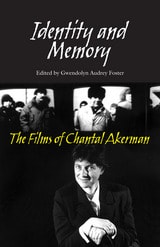
Identity And Memory
The Films of Chantal AkermanEdited by Gwendolyn Audrey Foster
Southern Illinois University Press, 2003
Considered to be one of the most influential auteurs in French cinema today, Chantal Akerman has had a profound impact on both feminist filmmaking discourse and avant-garde film. She has shown herself to be an uncompromising and dedicated practitioner of the cinematic arts in works such as I…You…He…She (Je tu il elle,1974); Jeanne Dielman, 23 quai du Commerce, 1080 Bruxelles (1975); Meetings with Anna (Les Rendez-vous d’Anna,1978); American Stories/Food, Family, and Philosophy (Histoires d’Amérique,1989); and From the East (D’Est,1993). Akerman has continued to create new and unexpected films that explore ideas about image, gaze, space, performance, and narration.
This collection of essays edited by Gwendolyn Audrey Foster assesses Akerman’s wide-ranging oeuvre, particularly her exploration of identity and memory, and considers her development as an artist and as a social force. Along with a detailed filmography and bibliography, both compiled by Foster, ten of the key figures in contemporary feminist moving-image discourse explore the themes with which Akerman is preoccupied: sexuality and lesbian identity, subjectivity, alterity, quotidian reality, the mother-daughter relationship, and Jewish diasporic identity.
The contributors include Maureen Turim, Sandy Flitterman-Lewis, Jennifer M. Barker, Ivone Margulies, Catherine Fowler, Janet Bergstrom, Ginette Vincendeau, Gwendolyn Audrey Foster, Judith Mayne, and Kristine Butler.
Originally published in the United Kingdom by Flicks Books, this marks the first United States edition of Identity and Memory: The Films of Chantal Akerman.

Identity, Place, and Subversion in Contemporary Mizrahi Cinema in Israel
Yaron Shemer
University of Michigan Press, 2013
In Identity, Place, and Subversion in Contemporary Mizrahi Cinema in Israel, Yaron Shemer presents the most comprehensive and systematic study to date of Mizrahi (Oriental-Jewish or Arab-Jewish) films produced in Israel in the last several decades. Through an analysis of dozens of films the book illustrates how narratives, characters, and space have been employed to give expression to Mizrahi ethnic identity and to situate the Mizrahi within the broader context of the Israeli societal fabric. The struggle over identity and the effort to redraw ethnic boundaries have taken place against the backdrop of a long-standing Zionist view of the Mizrahi as an inferior other whose “Levantine” culture posed a threat to the Western-oriented Zionist enterprise.
In its examination of the nature and dynamics of Mizrahi cinema (defined by subject-matter), the book engages the sensitive topic of Mizrahi ethnicity head-on, confronting the conventional notion of Israeli society as a melting pot and the widespread dismissal of ethnic divisions in the country. Shemer explores the continuous marginalization of the Mizrahi in contemporary Israeli cinema and the challenge some Mizrahi films offer to the subjugation of this ethnic group. He also studies the role cultural policies and institutional power in Israel have played in shaping Mizrahi cinema and the creation of a Mizrahi niche in cinema. In a broader sense, this pioneering work is a probing exploration of Israeli culture and society through the prism of film and cinematic expression. It sheds light on the play of ethnicity, class, gender, and religion in contemporary Israel, and on the heated debates surrounding Zionist ideology and identity politics. By charting a new territory of academic inquiry grounded in an interdisciplinary theoretical framework, the study contributes to the formation of “Mizrahi Cinema” as a recognized and vibrant scholarly field.
If Beale Street Could Talk
Music, Community, CultureRobert Cantwell
University of Illinois Press, 2008
Illuminating Childhood
Portraits in Fiction, Film, and DramaEllen Handler Spitz
University of Michigan Press, 2012
"A brilliant and daring book on how art reveals life, how it illuminates childhood beyond what the sciences of development can tell us."
---Jerome Bruner, University Professor, New York University
"Combining the surgical precision of a psychoanalytically informed critic with the oracular eloquence of a brilliant close reader, Ellen Handler Spitz reads our cultural fortunes about childhood and parenting through works of art. Moving us (in both senses of the term) from the serene plenitude of Piero della Francesca's Madonna of Childbirth to the unsparing horror of Lessing's Fifth Child, she reveals just how powerfully art puts us in touch with the pulsing energies of real life."
---Maria Tatar, John L. Loeb Professor of Germanic Languages and Literatures, Harvard University
"Illuminating Childhood is a wonderfully well-written and researched interdisciplinary study of childhood in various media and mediums as well as through ethnicity, race, gender, cultures, and time."
---T. Denean Sharpley-Whiting, Distinguished Professor of French and Director of African American and Diaspora Studies, Vanderbilt University
While literature and the arts are rarely considered primary sources for knowledge about human motivation and behavior, people read novels, attend movies, watch television, and go to the theater not solely to be entertained but also to learn about one another and about themselves. Illuminating Childhood formalizes this quest for psychological knowledge in the domain of the arts.
Starting with the premise that a gifted writer, artist, or filmmaker has the ability to teach us as much in one scene as a theorist can in a treatise or a therapist in a session, the author shares her intimate experience of eight thematically linked works in film and literature from the second half of the twentieth century, touching on issues central to parent-child relations, including toxic intrafamilial secrets, the disjunction between love and understanding, and the lasting impact of deceased parents on their children. While the canon of literature about children and parent-child relations includes books that identify problems, propose solutions, and present statistical data, Illuminating Childhood offers a living out of experience via the arts, written for a general audience---parents, teachers, mental health professionals, those who engage with their students via the arts of literature and film, and others.
Ellen Handler Spitz holds the Honors College Professorship of Visual Arts at the University of Maryland. She is the author of a number of books on art, psychology, and imagery, including The Brightening Glance: Imagination and Childhood. Her abiding research interests are the cultural lives of young people; the relations between aesthetics and psychology; and the interconnections among literature, music, dance, and the visual arts.
Jacket photo: Courtesy of PhotoFest
Illusive Utopia
Theater, Film, and Everyday Performance in North KoreaSuk-Young Kim
University of Michigan Press, 2010
"North Korea is not just a security or human rights problem (although it is those things) but a real society. This book gets us closer to understanding North Korea beyond the usual headlines, and does so in a richly detailed, well-researched, and theoretically contextualized way."
---Charles K. Armstrong, Director, Center for Korean Research, Columbia University
"One of this book's strengths is how it deals at the same time with historical, geographical, political, artistic, and cultural materials. Film and theatre are not the only arts Kim studies---she also offers an excellent analysis of paintings, fashion, and what she calls 'everyday performance.' Her analysis is brilliant, her insights amazing, and her discoveries and conclusions always illuminating."
---Patrice Pavis, University of Kent, Canterbury
No nation stages massive parades and collective performances on the scale of North Korea. Even amid a series of intense political/economic crises and international conflicts, the financially troubled country continues to invest massive amounts of resources to sponsor unflinching displays of patriotism, glorifying its leaders and revolutionary history through state rituals that can involve hundreds of thousands of performers. Author Suk-Young Kim explores how sixty years of state-sponsored propaganda performances---including public spectacles, theater, film, and other visual media such as posters---shape everyday practice such as education, the mobilization of labor, the gendering of social interactions, the organization of national space, tourism, and transnational human rights. Equal parts fascinating and disturbing, Illusive Utopia shows how the country's visual culture and performing arts set the course for the illusionary formation of a distinctive national identity and state legitimacy, illuminating deep-rooted cultural explanations as to why socialism has survived in North Korea despite the fall of the Berlin Wall, the collapse of the Soviet Union, and China's continuing march toward economic prosperity. With over fifty striking color illustrations, Illusive Utopia captures the spectacular illusion within a country where the arts are not only a means of entertainment but also a forceful institution used to regulate, educate, and mobilize the population.
Suk-Young Kim is Associate Professor in the Department of Theater and Dance at the University of California, Santa Barbara, and coauthor with Kim Yong of Long Road Home: A Testimony of a North Korean Camp Survivor.
Imagining Politics
Interpretations in Political Science and Political TelevisionStephen Benedict Dyson
University of Michigan Press, 2019
Imagining Politics critically examines two interpretations of government. The first comes from pop culture fictions about politics, the second from academic political science. Stephen Benedict Dyson argues that televised political fictions and political science theories are attempts at meaning-making, reflecting and shaping how a society thinks about its politics.
By taking fiction seriously, and by arguing that political science theory is homologous to fiction, the book offers a fresh perspective on both, using fictions such as The West Wing, House of Cards, Borgen, Black Mirror, and Scandal to challenge the assumptions that construct the discipline of political science itself.
Imagining Politics is also about a political moment in the West. Two great political shocks—Brexit and the election of Donald Trump—are set in a new context here. Dyson traces how Brexit and Trump campaigned against our image of politics as usual, and won.
Imagining the Method
Reception, Identity, and American Screen PerformanceJustin Owen Rawlins
University of Texas Press, 2024
A revisionist history of Method acting that connects the popular reception of “methodness” to entrenched understandings of screen performance still dominating American film discourse today.
Only one performance style has dominated the lexicon of the casual moviegoer: “Method acting.” The first reception-based analysis of film acting, Imagining the Method investigates how popular understandings of the so-called Method—what its author Justin Rawlins calls "methodness"—created an exclusive brand for white, male actors while associating such actors with rebellion and marginalization. Drawing on extensive archival research, the book maps the forces giving shape to methodness and policing its boundaries.
Imagining the Method traces the primordial conditions under which the Method was conceived. It explores John Garfield's tenuous relationship with methodness due to his identity. It considers the links between John Wayne's reliance on "anti-Method" stardom and Marlon Brando and James Dean's ascribed embodiment of Method features. It dissects contemporary emphases on transformation and considers the implications of methodness in the encoding of AI performers. Altogether, Justin Rawlins offers a revisionist history of the Method that shines a light on the cultural politics of methodness and the still-dominant assumptions about race, gender, and screen actors and acting that inform how we talk about performance and performers.
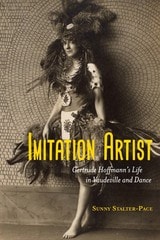
Imitation Artist
Gertrude Hoffmann’s Life in Vaudeville and DanceSunny Stalter-Pace
Northwestern University Press, 2020
Gertrude Hoffmann made her name in the early twentieth century as an imitator, copying highbrow performances staged in Europe and popularizing them for a broader American audience. Born in San Francisco, Hoffmann started working as a ballet girl in pantomime spectacles during the Gay Nineties. She performed through the heyday of vaudeville and later taught dancers and choreographed nightclub revues. After her career ended, she reflected on how vaudeville’s history was represented in film and television.
Drawn from extensive archival research, Imitation Artist shows how Hoffmann’s life intersected with those of central figures in twentieth-century popular culture and dance, including Florenz Ziegfeld, George M. Cohan, Isadora Duncan, and Ruth St. Denis. Sunny Stalter-Pace discusses the ways in which Hoffmann navigated the complexities of performing gender, race, and national identity at the dawn of contemporary celebrity culture. This book is essential reading for those interested in the history of theater and dance, modernism, women’s history, and copyright.
Imitation of Life
Douglas Sirk, DirectorFischer, Lucy
Rutgers University Press, 1991
Because of the special stamp he put on his melodramas, Sirk's best works transcend the constraints of their genre. In them, he both exemplified and critiqued postwar, conservative, materialistic life and its false value systems. There is much in Sirk, particularly in Imitation of Life, that is of interest to us today. The time seems to be right for a new look at the film, its reception amidst scandal over the affairs of its star—Lana Turner—the relationships between its mothers and daughters, the tensions between its men and its women, the friendships between its black and white women, and the ambiguous, controversial approach of Sirk to his material.
This volume includes the complete continuity script of the film, critical commentary and published reviews, interviews with the director, and a filmography and bibliography. It also includes an excellent introduction by Lucy Fischer.
Immediations
The Humanitarian Impulse in DocumentaryPooja Rangan
Duke University Press, 2017
Imperial Affects
Sensational Melodrama and the Attractions of American CinemaEagle, Jonna
Rutgers University Press, 2017
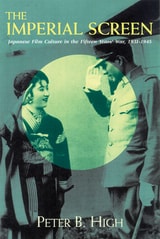
Imperial Screen
Japanese Film Culture In The Fifteen Years War,Peter B. High
University of Wisconsin Press, 2003
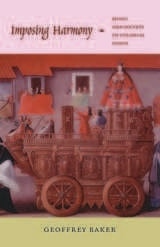
Imposing Harmony
Music and Society in Colonial CuzcoGeoffrey Baker
Duke University Press, 2008
Building on recent scholarship by social historians and urban musicologists and drawing on extensive archival research, Baker highlights European music as a significant vehicle for reproducing and contesting power relations in Cuzco. He examines how Andean communities embraced European music, creating an extraordinary cultural florescence, at the same time that Spanish missionaries used the music as a mechanism of colonialization and control. Uncovering a musical life of considerable and unexpected richness throughout the diocese of Cuzco, Baker describes a musical culture sustained by both Hispanic institutional patrons and the upper strata of indigenous society. Mastery of European music enabled elite Andeans to consolidate their position within the colonial social hierarchy. Indigenous professional musicians distinguished themselves by fulfilling important functions in colonial society, acting as educators, religious leaders, and mediators between the Catholic Church and indigenous communities.
Improvisation and Social Aesthetics
Georgina Born, Eric Lewis, and Will Straw, editors
Duke University Press, 2017

In Concert
Performing Musical PersonaPhillip Auslander
University of Michigan Press, 2021
The conventional way of understanding what musicians do as performers is to treat them as producers of sound; some even argue that it is unnecessary to see musicians in performance as long as one can hear them. But musical performance, counters Philip Auslander, is also a social interaction between musicians and their audiences, appealing as much to the eye as to the ear. In Concert: Performing Musical Persona he addresses not only the visual means by which musicians engage their audiences through costume and physical gesture, but also spectacular aspects of performance such as light shows.
Although musicians do not usually enact fictional characters on stage, they nevertheless present themselves to audiences in ways specific to the performance situation. Auslander’s term to denote the musician’s presence before the audience is musical persona. While presence of a musical persona may be most obvious within rock and pop music, the book’s analysis extends to classical music, jazz, blues, country, electronic music, laptop performance, and music made with experimental digital interfaces. The eclectic group of performers discussed include the Beatles, Miles Davis, Keith Urban, Lady Gaga, Nicki Minaj, Frank Zappa, B. B. King, Jefferson Airplane, Virgil Fox, Keith Jarrett, Glenn Gould, and Laurie Anderson.
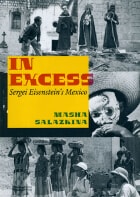
In Excess
Sergei Eisenstein's MexicoMasha Salazkina
University of Chicago Press, 2009
During the 1920s and ’30s, Mexico attracted an international roster of artists and intellectuals—including Orson Welles, Katherine Anne Porter, and Leon Trotsky—who were drawn to the heady tumult engendered by battling cultural ideologies in an emerging center for the avant-garde. Against the backdrop of this cosmopolitan milieu, In Excess reconstructs the years that the renowned Soviet director Sergei Eisenstein spent in the country to work on his controversial film ¡Que Viva Mexico!
Illuminating the inextricability of Eisenstein’s oeuvre from the global cultures of modernity and film, Masha Salazkina situates this unfinished project within the twin contexts of postrevolutionary Mexico and the ideas of such contemporaneous thinkers as Walter Benjamin. In doing so, Salazkina explains how Eisenstein’s engagement with Mexican mythology, politics, and art deeply influenced his ideas, particularly about sexuality. She also uncovers the role Eisenstein’s bisexuality played in his creative thinking and identifies his use of the baroque as an important turn toward excess and hybrid forms. Beautifully illustrated with rare photographs, In Excess provides the most complete genealogy available of major shifts in this modern master’s theories and aesthetics.
In Her Own Words
Conversations with Composers in the United StatesJennifer Kelly
University of Illinois Press, 2014
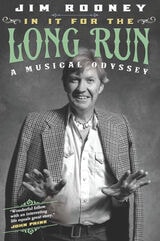
In It for the Long Run
A Musical OdysseyJim Rooney
University of Illinois Press, 2014
Inspired by the Hank Williams and Leadbelly recordings he heard as a teenager growing up outside of Boston, Jim Rooney began a musical journey that intersected with some of the biggest names in American music including Bob Dylan, James Taylor, Bill Monroe, Muddy Waters, and Alison Krauss. In It for the Long Run: A Musical Odyssey is Rooney's kaleidoscopic first-hand account of more than five decades of success as a performer, concert promoter, songwriter, music publisher, engineer, and record producer.
As witness to and participant in over a half century of music history, Rooney provides a sophisticated window into American vernacular music. Following his stint as a "Hayloft Jamboree" hillbilly singer in the mid-1950s, Rooney managed Cambridge's Club 47, a catalyst of the ‘60’s folk music boom. He soon moved to the Newport Folk Festival as talent coordinator and director where he had a front row seat to Dylan "going electric."
In the 1970s Rooney's odyssey continued in Nashville where he began engineering and producing records. His work helped alternative country music gain a foothold in Music City and culminated in Grammy nominations for singer-songwriters John Prine, Iris Dement, and Nanci Griffith. Later in his career he was a key link connecting Nashville to Ireland's folk music scene.
Writing songs or writing his memoir, Jim Rooney is the consummate storyteller. In It for the Long Run: A Musical Odyssey is his singular chronicle from the heart of Americana.
In Search of Our Warrior Mothers
Women Dramatists of the Black Arts MovementLa Donna L. Forsgren
Northwestern University Press, 2018
The Black Arts Movement (1965–76) consisted of artists across the United States deeply concerned with the relationship between politics and the black aesthetic. In Search of Our Warrior Mothers examines the ways in which black women playwrights in the movement advanced feminist and womanist perspectives from within black nationalist discourses. La Donna L. Forsgren recuperates the careers, artistic theories, and dramatic contributions of four leading playwrights: Martie Evans-Charles, J.e. Franklin, Sonia Sanchez, and Barbara Ann Teer. Using original interviews, production recordings, playbills, and unpublished manuscripts, she investigates how these women, despite operating within a context that equated the collective well-being of black people with black male agency, created works that validated black women's aspirations for autonomy and explored women's roles in the struggle for black liberation.
In Search of Our Warrior Mothers demonstrates the powerful contributions of women to the creation, interpretation, and dissemination of black aesthetic theory, thus opening an interdisciplinary conversation at the intersections of theater, performance, feminist, and African American studies and identifying and critiquing the gaps and silences within these fields.

In Search of the True Russia
The Provinces in Contemporary Nationalist DiscourseLyudmila Parts
University of Wisconsin Press, 2020
Surveying a largely unexplored body of Russian journalism, literature, and film from the late twentieth and early twenty-first centuries, Parts finds that the harshest portrayals of the provinces arise within "high" culture. Popular culture, however, has increasingly turned from the newly prosperous, multiethnic, and westernized Moscow to celebrate the hinterlands as repositories of national traditions and moral strength. This change, she argues, has directed debate about Russia's identity away from its loss of imperial might and global prestige and toward a hermetic national identity based on the opposition of "us vs. us" rather than "us vs. them." She offers an intriguing analysis of the contemporary debate over what it means to be Russian and where "true" Russians reside.
In and Out of Phase
An Episodic History of Art and Music in the 1960sMichael Maizels
University of Michigan Press, 2020
In and Out of Phase is the first sustained look at the creative interactions between artists and musicians of this era, looking at four pairs of creators who used process-oriented ideas and techniques in their music and art: Dan Flavin and La Monte Young; Sol LeWitt and Milton Babbitt; Richard Serra and Steve Reich; and Bruce Nauman and Meredith Monk. Maizels uncovers not just the social and intellectual connections between these two groups of creators, but illuminates how the focus on repetitive actions, pattern and process, and an emphasis on “surface” created mutual influence—and stylistic change—between music and art during this period. The book’s concluding chapter briefly addresses the enduring influence of the innovations of the 1960s on more recent works.
In the Lurch
Verbatim Theater and the Crisis of Democratic DeliberationRyan Claycomb
University of Michigan Press, 2023
But this is not just a disinterested history—Claycomb reflects on his own participation in that political fantasy, including earlier scholarly writing that articulated with breathless hopefulness the potential of verbatim theater, and on his own theatrical attendance, imbued with a belief that witnessing this idealized public sphere was a substitute for actual public participation. In the Lurch also recounts the bumpy path towards its completion, two years marked by presidential impeachments, an insurrection, a national reckoning with racism, and a global pandemic. At the heart of the book is a central question: is verbatim theater any longer an effective cultural response to what can look like the possible end of democracy?

In the Mood for Texture
The Revival of Bangkok as a Chinese CityArnika Fuhrmann
Duke University Press, 2026
Incarceration Games
A History of Role-Play in Psychology, Prisons, and PerformanceStephen Scott-Bottoms
University of Michigan Press, 2024
Incongruous Entertainment
Camp, Cultural Value, and the MGM MusicalSteven Cohan
Duke University Press, 2005
In addition to examining the spectatorship of the mgm musical, Cohan investigates the genre’s production and marketing, paying particular attention to the studio’s employment of a largely gay workforce of artists and craftspeople. He reflects on the role of the female stars—including Judy Garland, Debbie Reynolds, Esther Williams, and Lena Horne—and he explores the complex relationship between Gene Kelley’s dancing and his masculine persona. Cohan looks at how, in the decades since the 1950s, the marketing and reception of the mgm musical have negotiated the more publicly recognized camp value attached to the films. He considers the status of Singin’ in the Rain as perhaps the first film to be widely embraced as camp; the repackaging of the musicals as nostalgia and camp in the That’s Entertainment! series as well as on home video and cable; and the debates about Garland’s legendary gay appeal among her fans on the Internet. By establishing camp as central to the genre, Incongruous Entertainment provides a new way of looking at the musical.
Incorporations
Race, Nation, and the Body Politics of CapitalEva Cherniavsky
University of Minnesota Press, 2006
An exploration of race, Hollywood, and the commodification of the body
Incorporations offers a new way of thinking about issues of race, bodies, and commodity culture. Moving beyond the study of identity and difference in media, Eva Cherniavsky asserts that race can be understood as a sign of the body’s relation to capital.
In Incorporations, Cherniavsky interrogates the interplay of nationalism, colonialism, and capitalism in the production of racial embodiment. Testing the links between race and capital, Incorporations examines how media culture transmutes white bodies into commodity-images in such films as Blonde Venus, A Touch of Evil, and Fargo, in the television series The Simpsons, and in the fiction of Octavia Butler and Leslie Marmon Silko. Cherniavsky posits an innovative approach to whiteness studies that does not focus on the emancipatory possibilities of cross-racial identification.Working with the tools of critical race theory as well as postcolonial and cultural studies, Cherniavsky demonstrates how representations of racial embodiment have evolved, and suggests that “race” is the condition of exchangeable bodies under capital.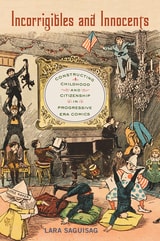
Incorrigibles and Innocents
Constructing Childhood and Citizenship in Progressive Era ComicsSaguisag, Lara
Rutgers University Press, 2019
Histories and criticism of comics note that comic strips published in the Progressive Era were dynamic spaces in which anxieties about race, ethnicity, class, and gender were expressed, perpetuated, and alleviated. The proliferation of comic strip children—white and nonwhite, middle-class and lower class, male and female—suggests that childhood was a subject that fascinated and preoccupied Americans at the turn of the century. Many of these strips, including R.F. Outcault’s Hogan’s Alley and Buster Brown, Rudolph Dirks’s The Katzenjammer Kids and Winsor McCay’s Little Nemo in Slumberland were headlined by child characters. Yet no major study has explored the significance of these verbal-visual representations of childhood. Incorrigibles and Innocents addresses this gap in scholarship, examining the ways childhood was depicted and theorized in late nineteenth- and early twentieth-century comic strips. Drawing from and building on histories and theories of childhood, comics, and Progressive Era conceptualizations of citizenship and nationhood, Lara Saguisag demonstrates that child characters in comic strips expressed and complicated contemporary notions of who had a right to claim membership in a modernizing, expanding nation.
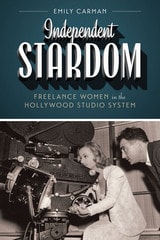
Independent Stardom
Freelance Women in the Hollywood Studio SystemBy Emily Carman
University of Texas Press, 2015
Bringing to light an often-ignored aspect of Hollywood studio system history, this book focuses on female stars who broke the mold of a male-dominated, often manipulative industry to dictate the path of their own careers through freelancing.
Runner-up, Richard Wall Memorial Award, Theatre Library Association, 2016
During the heyday of Hollywood’s studio system, stars were carefully cultivated and promoted, but at the price of their independence. This familiar narrative of Hollywood stardom receives a long-overdue shakeup in Emily Carman’s new book. Far from passive victims of coercive seven-year contracts, a number of classic Hollywood’s best-known actresses worked on a freelance basis within the restrictive studio system. In leveraging their stardom to play an active role in shaping their careers, female stars including Irene Dunne, Janet Gaynor, Miriam Hopkins, Carole Lombard, and Barbara Stanwyck challenged Hollywood’s patriarchal structure.
Through extensive, original archival research, Independent Stardom uncovers this hidden history of women’s labor and celebrity in studio-era Hollywood. Carman weaves a compelling narrative that reveals the risks these women took in deciding to work autonomously. Additionally, she looks at actresses of color, such as Anna May Wong and Lupe Vélez, whose careers suffered from the enforced independence that resulted from being denied long-term studio contracts. Tracing the freelance phenomenon among American motion picture talent in the 1930s, Independent Stardom rethinks standard histories of Hollywood to recognize female stars as creative artists, sophisticated businesswomen, and active players in the then (as now) male-dominated film industry.

Indian Stereotypes in TV Science Fiction
First Nations' Voices Speak OutBy Sierra S. Adare
University of Texas Press, 2005
According to an early 1990s study, 95 percent of what college students know about Native Americans was acquired through the media, leading to widespread misunderstandings of First Nations peoples. Sierra Adare contends that negative "Indian" stereotypes do physical, mental, emotional, and financial harm to First Nations individuals.
At its core, this book is a social study whose purpose is to explore the responses of First Nations peoples to representative "Indian" stereotypes portrayed within the TV science fiction genre. Participants in Adare's study viewed episodes from My Favorite Martian, Star Trek, Star Trek: Voyager, Quantum Leap, The Adventures of Superman, and Star Trek: The Next Generation. Reactions by viewers range from optimism to a deep-rooted sadness. The strongest responses came after viewing a Superman episode's depiction of an "evil medicine man" who uses a ceremonial pipe to kill a warrior. The significance of First Nations peoples' responses and reactions are both surprising and profound. After publication of "Indian" Stereotypes in TV Science Fiction, ignorance can no longer be used as an excuse for Hollywood's irresponsible depiction of First Nations peoples' culture, traditions, elders, religious beliefs, and sacred objects.

Indie Cinema Online
Sarah E.S. Sinwell
Rutgers University Press, 2020
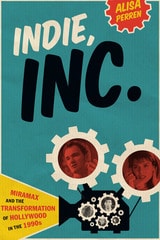
Indie, Inc.
Miramax and the Transformation of Hollywood in the 1990sBy Alisa Perren
University of Texas Press, 2012
During the 1990s, films such as sex, lies, and videotape, The Crying Game, Pulp Fiction, Good Will Hunting, and Shakespeare in Love earned substantial sums at the box office along with extensive critical acclaim. A disproportionate number of these hits came from one company: Miramax. Indie, Inc. surveys Miramax’s evolution from independent producer-distributor to studio subsidiary, chronicling how one company transformed not just the independent film world but the film and media industries more broadly. As Alisa Perren illustrates, Miramax’s activities had an impact on everything from film festival practices to marketing strategies, talent development to awards campaigning.
Case studies of key films, including The Piano, Kids, Scream, The English Patient, and Life Is Beautiful, reveal how Miramax went beyond influencing Hollywood business practices and motion picture aesthetics to shaping popular and critical discourses about cinema during the 1990s. Indie, Inc. does what other books about contemporary low-budget cinema have not—it transcends discussions of “American indies” to look at the range of Miramax-released genre films, foreign-language films, and English-language imports released over the course of the decade. The book illustrates that what both the press and scholars have typically represented as the “rise of the American independent” was in fact part of a larger reconfiguration of the media industries toward niche-oriented products.
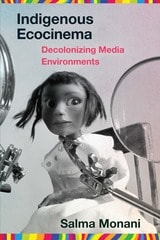
Indigenous Ecocinema
Decolonizing Media EnvironmentsSalma Monani
West Virginia University Press, 2024
This absorbing text is the first book-length exploration foregrounding the environmental dimensions of cinema made by Indigenous peoples, including a particularly fascinating discussion on how Indigenous cinema’s ecological entanglements are a crucial and complementary aspect of its agenda of decolonialism.

Indigenous Pop
Native American Music from Jazz to Hip HopEdited by Jeff Berglund, Jan Johnson, and Kimberli Lee
University of Arizona Press, 2016
From Joe Shunatona and the United States Indian Reservation Orchestra to Jim Pepper, from Buffy Saint-Marie to Robbie Robertson, from Joy Harjo to Lila Downs, Indigenous Pop vividly addresses the importance of Native musicians and popular musical genres, establishing their origins and discussing what they represent.
Arranged both chronologically and according to popular generic forms, the book gives Indigenous pop a broad new meaning. In addition to examining the transitive influences of popular music on Indigenous expressive forms, the contributors also show ways that various genres have been shaped by what some have called the “Red Roots” of American-originated musical styles. This recognition of mutual influence extends into the ways of understanding how music provides methodologies for living and survival.
Each in-depth essay in the volume zeros in on a single genre and in so doing exposes the extraordinary whole of Native music. This book showcases the range of musical genres to which Native musicians have contributed and the unique ways in which their engagement advances the struggle for justice and continues age-old traditions of creative expression.

Indirect Subjects
Nollywood's Local AddressMatthew H. Brown
Duke University Press, 2021
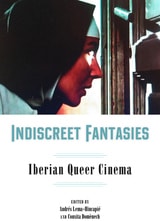
Indiscreet Fantasies
Iberian Queer CinemaAndrés Lema-Hincapié
Bucknell University Press, 2021
Published by Bucknell University Press. Distributed worldwide by Rutgers University Press.

Industrial Strength Bluegrass
Southwestern Ohio's Musical LegacyEdited by Fred Bartenstein and Curtis W. Ellison
University of Illinois Press, 2021
Revelatory and multifaceted, Industrial Strength Bluegrass shares the inspiring story of a bluegrass hotbed and the people who created it.
Contributors: Fred Bartenstein, Curtis W. Ellison, Jon Hartley Fox, Rick Good, Lily Isaacs, Ben Krakauer, Mac McDivitt, Nathan McGee, Daniel Mullins, Joe Mullins, Larry Nager, Phillip J. Obermiller, Bobby Osborne, and Neil V. Rosenberg.
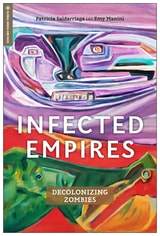
Infected Empires
Decolonizing ZombiesPatricia Saldarriaga
Rutgers University Press, 2022
Studying films from around the world, including Latin America, Asia, Africa, the US, and Europe, Infected Empires presents a vision of a global zombie that points toward a posthuman and feminist future.
Given the current moment—polarized populations, increasing climate fears, and decline of supranational institutions in favor of a rising tide of nationalisms—it is easy to understand the proliferation of apocalyptic and dystopian elements in popular culture. Infected Empires examines one of the most popular figures in contemporary apocalyptic film: the zombie. This harbinger of apocalypse reveals bloody truths about the human condition, the wounds of history, and methods of contending with them.
Infected Empires considers parallels in the zombie genre to historical and current events on different political, theological and philosophical levels, and proposes that the zombie can be read as a figure of decolonization and an allegory of resistance to oppressive structures that racialize, marginalize, disable, and dispose of bodies.