95 books match the query 'History & Culture' and 4 start with i

cover of Imprints, Voiceprints, and Footprints of Memory

Imprints, Voiceprints, and Footprints of Memory

Werner H. Kelber

SBL Press, 2013

Jesus and his followers defined their allegiances and expressed their identities in a communications culture that manifested itself in voice and chirographic practices, in oral-scribal interfaces, and in performative activities rooted in memory. In the sixteen essays gathered in Imprints, Voiceprints, and Footprints of Memory, Werner Kelber explores the verbal arts of early Christian word processing operative in a media world that was separated by two millennia from our contemporary media history. The title articulates the fact that the ancient culture of voiced texts, hand-copying, and remembering is chiefly accessible to us in print format and predominantly assimilated from print perspectives. The oral-scribal-memorial-performative paradigm developed in these essays challenges the reigning historical-critical model in biblical scholarship. Notions of tradition, the fixation on the single original saying, the dominant methodology of form criticism, and the heroic labors of the Quest—stalwart features of the historical, documentary paradigm—are all subject to a critical review. A number of essays reach beyond New Testament texts, ranging from the pre-Socratic Gorgias through medieval manuscript culture on to print’s triumphant apotheosis in Gutenberg’s Vulgate, product of the high tech of the fifteenth century, all the way to conflicting commemorations of Auschwitz—taking tentative steps toward a history of media technologies, culture, and cognition of the Christian tradition in the West.
[more]
cover of Impurity and Purification in Early Judaism and the Jesus Tradition

Impurity and Purification in Early Judaism and the Jesus Tradition

Thomas Kazen

SBL Press, 2021
This collection of essays by Thomas Kazen focuses on issues of purity and purification in early Judaism and the Jesus tradition. During the late Second Temple period, Jewish purity practices became more prominent than before and underwent substantial developments. These essays advance the ongoing conversation and debate about a number of key issues in the field, such as the relationship between ritual and morality, the role and function of metaphor, and the use of evolutionary and embodied perspectives. Kazen's research stands in constant dialogue with the major currents and main figures in purity research, including both historical (origin, development, practice) and cognitive (evolutionary, emotional, conceptual) approaches.
[more]
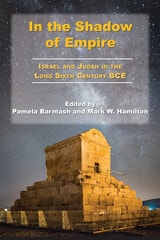
cover of In the Shadow of Empire: Israel and Judah in the Long Sixth Century BCE

In the Shadow of Empire

Israel and Judah in the Long Sixth Century BCE

Pamela Barmash

SBL Press, 2021

Empires Come and Go, Homelands Never

Readers of the Hebrew Bible know the basic story line: during the early sixth century BCE the Babylonian ruler Nebuchadnezzar sacked Jerusalem, deported a portion of the population to Mesopotamia, and triggered a crisis of faith in the minds of prophets, priests, and liturgists that still echoes through the centuries. Though many Judahites chose to make their way home under Persian imperial control, the straightforward biblical story of exile and return masks many complex issues of evidence and fact. Unlike previous studies that focused narrowly on the Babylonian exile of the Judahite elites, this volume widens the geographical and temporal scope to include the Assyrian, Babylonian, and Persian Empires. Improved access to and understanding of relevant texts, iconography, and material culture provide an opportunity for scholars to reappraise methods of imperial control and the responses of those in exile and under occupation. Contributors Pamela Barmash, Ryan P. Bonfiglio, Caralie Cooke, Lisbeth S. Fried, Martien A. Halvorson-Taylor, Mark W. Hamilton, Matt Waters, and Ian D. Wilson lay a firm foundation for future work on the long sixth century.
[more]
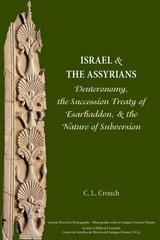
cover of Israel and the Assyrians: Deuteronomy, the Succession Treaty of Esarhaddon, and the Nature of Subvers

Israel and the Assyrians

Deuteronomy, the Succession Treaty of Esarhaddon, and the Nature of Subvers

C. L. Crouch

SBL Press, 2014

Was Deuteronomy created to be a subversive text based on Assyian treaties?

In this new book Crouch focuses on Deuteronomy’s subversive intent, asking what would be required in order for Deuteronomy to successfully subvert either a specific Assyrian source or Assyrian ideology more generally. The book reconsiders the nature of the relationship between Deuteronomy and Assyria, Deuteronomy’s relationship to ancient Near Eastern and biblical treaty and loyalty oath traditions, and the relevance of Deuteronomy’s treaty affinities to discussions of its date.

Features:

  • A thorough investigation of the nature and requirements of subversion
  • A focused examination of the context in which Deuteronomy would have functioned
  • An appendix focused on redactional questions related to Deuteronoy 13 and 28
[more]