Results by title
395 books match the query 'How' and 5 start with i
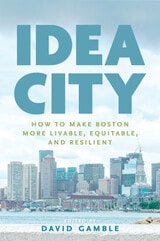
Idea City
How to Make Boston More Livable, Equitable, and ResilientEdited by David Gamble, Foreword by Renée Loth
University of Massachusetts Press, 2023
Racial strife, increased social and economic discrimination, amplified political friction, and growing uncertainty around the impacts of the COVID-19 pandemic and climate change have laid bare many inequalities within the city of Boston. How will these disruptions and inequities influence the city’s future, especially as Boston celebrates its quadricentennial in 2030?
This collection of original essays addresses the many challenges Boston contends with in the twenty-first century and considers ways to improve the city for everyone. Presenting a range of perspectives written by area experts—academics, reflective practitioners, and policymakers—these essays tackle issues of resiliency, mobility, affordable housing, health outcomes, social equity, economic equality, zoning, regionalism, and more. Reflecting the diversity of the city and the challenges and opportunities Boston currently faces, Idea City will help readers think differently about their own areas of expertise and draw conclusions from urban regeneration work in other fields.
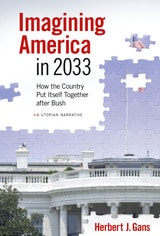
Imagining America in 2033
How the Country Put Itself Together after BushHerbert J. Gans
University of Michigan Press, 2008
At the heart of Herbert J. Gans's utopian narrative is the vision of progress with fairness on which the best of American idealism has been built. Part utopia, part realism, Imagining America in 2033 is also a liberal's dream of life after Bush and a set of progressive yet practical guidelines for restoring sanity and intelligence to nearly every aspect of public and political life post-Bush.
Herbert J. Gans, one of the most influential and prolific sociologists and social commentators of our time, achieves a realistic utopia set mostly in the second and third decades of the century. In Gans's imagined future, elected officials, policymakers, activists, and citizens have transformed America into a much more humane and effective democracy. The book features three Democratic presidents; the major new domestic, foreign, and social policies their administrations pursue; and the political battles they fight.
Gans provides chapters on an exhaustive list of social, political, and economic policy issues: jobs; war; tax reform; global warming; economic, racial, gender, and religious equality; family policies; the creation of affordable housing and energy saving communities; education reform; and more. While hopeful and idealistic, many of Gans's proposals---such as the concept of the nurse-doctor, in which nurses increasingly take on tasks previously handled only by medical doctors within a framework of national health care---are ideas innovative enough that they should be taken seriously by actual policymakers.
Imagining America in 2033 is lively and accessible, with an appeal for general readers, policy hounds, and the politically savvy alike.

Implementing Cost-Effective Assistive Computer Technology
A How-To-Do-It Manual for LibrariansJane Vincent
American Library Association, 2012
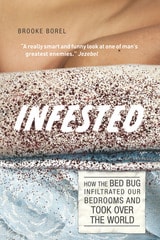
Infested
How the Bed Bug Infiltrated Our Bedrooms and Took Over the WorldBrooke Borel
University of Chicago Press, 2015
In Infested, Borel introduces readers to the biological and cultural histories of these amazingly adaptive insects, and the myriad ways in which humans have responded to them. She travels to meet with scientists who are rearing bed bug colonies—even by feeding them with their own blood (ouch!)—and to the stages of musicals performed in honor of the pests. She explores the history of bed bugs and their apparent disappearance in the 1950s after the introduction of DDT, charting how current infestations have flourished in direct response to human chemical use as well as the ease of global travel. She also introduces us to the economics of bed bug infestations, from hotels to homes to office buildings, and the expansive industry that has arisen to combat them.
Hiding during the day in the nooks and seams of mattresses, box springs, bed frames, headboards, dresser tables, wallpaper, or any clutter around a bed, bed bugs are thriving and eager for their next victim. By providing fascinating details on bed bug science and behavior as well as a captivating look into the lives of those devoted to researching or eradicating them, Infested is sure to inspire at least a nibble of respect for these tenacious creatures—while also ensuring that you will peek beneath the sheets with prickly apprehension.
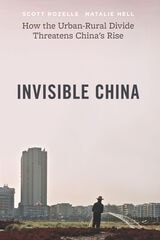
Invisible China
How the Urban-Rural Divide Threatens China’s RiseScott Rozelle and Natalie Hell
University of Chicago Press, 2020
As the glittering skyline in Shanghai seemingly attests, China has quickly transformed itself from a place of stark poverty into a modern, urban, technologically savvy economic powerhouse. But as Scott Rozelle and Natalie Hell show in Invisible China, the truth is much more complicated and might be a serious cause for concern.
China’s growth has relied heavily on unskilled labor. Most of the workers who have fueled the country’s rise come from rural villages and have never been to high school. While this national growth strategy has been effective for three decades, the unskilled wage rate is finally rising, inducing companies inside China to automate at an unprecedented rate and triggering an exodus of companies seeking cheaper labor in other countries. Ten years ago, almost every product for sale in an American Walmart was made in China. Today, that is no longer the case. With the changing demand for labor, China seems to have no good back-up plan. For all of its investment in physical infrastructure, for decades China failed to invest enough in its people. Recent progress may come too late. Drawing on extensive surveys on the ground in China, Rozelle and Hell reveal that while China may be the second-largest economy in the world, its labor force has one of the lowest levels of education of any comparable country. Over half of China’s population—as well as a vast majority of its children—are from rural areas. Their low levels of basic education may leave many unable to find work in the formal workplace as China’s economy changes and manufacturing jobs move elsewhere.
In Invisible China, Rozelle and Hell speak not only to an urgent humanitarian concern but also a potential economic crisis that could upend economies and foreign relations around the globe. If too many are left structurally unemployable, the implications both inside and outside of China could be serious. Understanding the situation in China today is essential if we are to avoid a potential crisis of international proportions. This book is an urgent and timely call to action that should be read by economists, policymakers, the business community, and general readers alike.