Results by title
71 books match the query 'Human beings' and 2 start with i

In the Shadow of Tungurahua
Disaster Politics in Highland EcuadorA.J. Faas
Rutgers University Press, 2023
In the Shadow of Tungurahua relates the stories of the people of Penipe, Ecuador living in and between several villages around the volcano Tungurahua and two resettlement communities built for people displaced by government operations following volcanic eruptions in 1999 and 2006. The stories take shape in ways that influence prevailing ideas about how disasters are produced and reproduced, in this case by shifting assemblages of the state first formed during Spanish colonialism attempting to settle (make “legible”) and govern Indigenous and campesino populations and places. The disasters unfolding around Tungurahua at the turn of the 21st century also provide lessons in the humanitarian politics of disaster—questions of deservingness, reproducing inequality, and the reproduction of bare life. But this is also a story of how people responded to confront hardships and craft new futures, about forms of cooperation to cope with and adapt to disaster, and the potential for locally derived disaster recovery projects and politics.
[more]
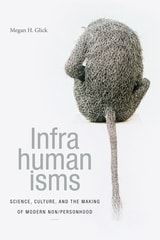
Infrahumanisms
Science, Culture, and the Making of Modern Non/personhoodMegan H. Glick
Duke University Press, 2018
In Infrahumanisms Megan H. Glick considers how conversations surrounding nonhuman life have impacted a broad range of attitudes toward forms of human difference such as race, sexuality, and health. She examines the history of human and nonhuman subjectivity as told through twentieth-century scientific and cultural discourses that include pediatrics, primatology, eugenics, exobiology, and obesity research. Outlining how the category of the human is continuously redefined in relation to the infrahuman—a liminal position of speciation existing between the human and the nonhuman—Glick reads a number of phenomena, from early twentieth-century efforts to define children and higher order primates as liminally human and the postwar cultural fascination with extraterrestrial life to anxieties over AIDS, SARS, and other cross-species diseases. In these cases the efforts to define a universal humanity create the means with which to reinforce notions of human difference and maintain human-nonhuman hierarchies. In foregrounding how evolving definitions of the human reflect shifting attitudes about social inequality, Glick shows how the consideration of nonhuman subjectivities demands a rethinking of long-held truths about biological meaning and difference.
[more]