Results by title
78 books match the query 'Humanism' and 4 start with i
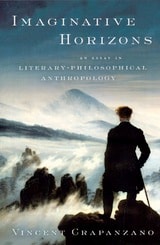
Imaginative Horizons
An Essay in Literary-Philosophical AnthropologyVincent Crapanzano
University of Chicago Press, 2003
How do people make sense of their experiences? How do they understand possibility? How do they limit possibility? These questions are central to all the human sciences. Here, Vincent Crapanzano offers a powerfully creative new way to think about human experience: the notion of imaginative horizons. For Crapanzano, imaginative horizons are the blurry boundaries that separate the here and now from what lies beyond, in time and space. These horizons, he argues, deeply influence both how we experience our lives and how we interpret those experiences, and here sets himself the task of exploring the roles that creativity and imagination play in our experience of the world.
[more]
In Reasonable Hope
Philosophical Reflections on Ultimate MeaningPatrick Masterson
Catholic University of America Press, 2021
In Reasonable Hope considers three foundational responses to this quest for some understanding of the existence, meaning, and value of everything. Other approaches can be considered as combinations or variations of these. Firstly, there is the approach which claims that it is our humanity, exercising its unique intelligent subjectivity, that is the source and measure of all possible meaning and value. Nothing can be thought of as existing, meaningful or of value apart from a thinking human subject. This is a broadly Humanist approach to ultimate meaning. Man is the measure of all things. Secondly, there is the approach of Scientism. This claims that an ultimate understanding of the world and ourselves must be sought, less anthropocentrically, in terms of the findings of basic empirical sciences such as physics and chemistry. We live in a world ever-increasingly dominated by the autonomous system of science and technology. Such Scientism implies an explicitly reductionist and materialist conception of the meaning and value of everything. Thirdly, there is the approach of Theism which maintains that, in the final analysis, the meaning and value of everything, insofar as this can be known, is to be explained in terms of a transcendent infinitely perfect personal being we call God.
The first two approaches are carefully considered. However, it is the third to which most attention is devoted. Consideration is given to the traditional impersonal metaphysical approach to questions about the existence and nature of God. The alternative approaches of linguistic philosophy and phenomenology, which reject such metaphysical speculation are also discussed. These various approaches are judged to be complementary rather than strict alternatives.
In the latter half of the book is devoted to a more personal and self-involving discussion of the relevance of an affirmation of the existence of God. It explores the implications of a rational commitment to live one's life in accordance with the requirements of values which transcend explanation in purely physical terms, such as truth, goodness, beauty, and especially love. It provides a personal and existential development of the rational hope that such values are ultimately more objectively real and dependable than the eventual universal material chaos predicted by empirical science. It argues that the existence of God as the infinite expression and source of these values is the necessary and sufficient condition of this rational hope in their enduring significance. Finally, there is an account of how the Christian Revelation illuminates and transforms our rational hope in the enduring significance of love of God and neighbor.
[more]
Intention, Plans and Practical Reason
Michael E. Bratman
CSLI, 1987
Michael E. Bratman develops a planning theory of intention. Intentions are treated as elements of partial plans of action. These plans play basic roles in practical reasoning, roles that support the organization of our activities over time and socially. Bratman explores the impact of this approach on a wide range of issues, including the relation between intention and intentional action, and the distinction between intended and expected effects of what one intends.
[more]
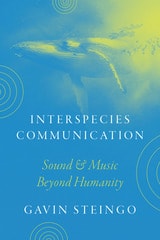
Interspecies Communication
Sound and Music beyond HumanityGavin Steingo
University of Chicago Press, 2024
A surprising study reveals a plethora of attempts to communicate with non-humans in the modern era.
In Interspecies Communication, music scholar Gavin Steingo examines significant cases of attempted communication beyond the human—cases in which the dualistic relationship of human to non-human is dramatically challenged. From singing whales to Sun Ra to searching for alien life, Steingo charts the many ways we have attempted to think about, and indeed to reach, beings that are very unlike ourselves.
Steingo focuses on the second half of the twentieth century, when scientists developed new ways of listening to oceans and cosmic space—two realms previously inaccessible to the senses and to empirical investigation. As quintessential frontiers of the postwar period, the outer space of the cosmos and the inner space of oceans were conceptualized as parallel realities, laid bare by newly technologized “ears.” Deeply engaging, Interspecies Communication explores our attempts to cross the border between the human and non-human, to connect with non-humans in the depths of the oceans, the far reaches of the universe, or right under our own noses.
[more]