Results by title
69 books match the query 'Images' and 20 start with i

Images Of Animals
Eileen Crist
Temple University Press, 2000
Images of Animals examines the literature of behavioral science, revealing how works with the common aim of documenting animal lives, habits, and instincts describe "realities that are worlds apart." Whether the writer affirms the Cartesian verdict of an unbridgeable chasm between animals and humans or the Darwinian panorama of evolutionary continuity, the question of animal mind is ever present and problematic in behavioral thought. Comparing the naturalist writings of Charles Darwin, Jean Henri Fabre, and George and Elizabeth Peckham to works of classical ethology by Konrad Lorenz and Nikolaas Tinbergen and of contemporary sociobiology, Crist demonstrates how words matter. She does not attempt to defend any of these constructions as a faithful representation of animal existence, but to show how each internally coherent view molds the reader's understanding of animals. Rejecting the notion that "a neutral language exists, or can be constructed, which yields incontestably objective accounts of animal behavior," Crist argues that "language is not instrumental in the depiction of animals and, in particular, it is never impartial with respect to the question of animal mind."

Images and Conversations
Mexican Americans Recall a Southwestern PastText by Patricia Preciado Martin; Photographs by Louis Carlos Bernal
University of Arizona Press, 1983

Images and Identity
Educating Citizenship through Visual ArtsEdited by Rachel Mason and Carl-Peter Buschkuehle
Intellect Books, 2013
Images and Translations
The Etruscans AbroadLarissa Bonfante
University of Michigan Press, 2023
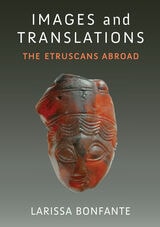
Professor Larissa Bonfante’s great gift was the ability to evoke, in a fresh, immediate, and convincing way, the experiences, beliefs, and thoughts of people living more than two thousand years ago. Her final publication, Images and Translations: The Etruscans Abroad, communicates the sensations of other times and places, from the day-to-day to the solemnly ritualistic.
The world of the Etruscans, sophisticated and pleasure-loving, radiated throughout a vast area of the ancient world – a world very different from our own. Relying on a wealth of creative works, Images and Translations examines the expertise and productions of the artists who made them, the tastes of those who used them, and the sometimes surprising results of the exchanges between creators and buyers. Just as the French demand for Chinese ceramics in the seventeenth century gave birth to the unprecedented famille colors, so the production of Greek ceramics for the Etruscan market produced singularly expressive depictions. Humorous, pious, or erotic to the buyers, they could be shocking to the culture that made them.
Images and Translations explores areas in much closer economic and cultural contact than is usually recognized. The volume finds threads of connection not only between Italy and Greece, but between Italy and northern Europe—today’s France and Germany—as well as between Italy and the Near East. Etruscan influence runs through Western history, into the Renaissance, and emerges in imagery still evocative today.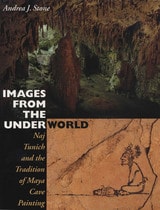
Images from the Underworld
Naj Tunich and the Tradition of Maya Cave PaintingBy Andrea J. Stone
University of Texas Press, 1995
In 1979, a Kekchi Maya Indian accidentally discovered the entrance to Naj Tunich, a deep cave in the Maya Mountains of El Peten, Guatemala. One of the world's few deep caves that contain rock art, Naj Tunich features figural images and hieroglyphic inscriptions that have helped to revolutionize our understanding of ancient Maya art and ritual.
In this book, Andrea Stone takes a comprehensive look at Maya cave painting from Preconquest times to the Colonial period. After surveying Mesoamerican cave and rock painting sites and discussing all twenty-five known painted caves in the Maya area, she focuses extensively on Naj Tunich. Her text analyzes the images and inscriptions, while photographs and line drawings provide a complete visual catalog of the cave art, some of which has been subsequently destroyed by vandals.
This important new body of images and texts enlarges our understanding of the Maya view of sacred landscape and the role of caves in ritual. It will be important reading for all students of the Maya, as well as for others interested in cave art and in human relationships with the natural environment.

Images in Spite of All
Four Photographs from AuschwitzGeorges Didi-Huberman
University of Chicago Press, 2008
Available today because they were smuggled out of the camp and into the hands of Polish resistance fighters, the photographs show a group of naked women being herded into the gas chambers and the cremation of corpses that have just been pulled out. Georges Didi-Huberman’s relentless consideration of these harrowing scenes demonstrates how Holocaust testimony can shift from texts and imaginations to irrefutable images that attempt to speak the unspeakable. Including a powerful response to those who have criticized his interest in these images as voyeuristic, Didi-Huberman’s eloquent reflections constitute an invaluable contribution to debates over the representability of the Holocaust and the status of archival photographs in an image-saturated world.
Images of Black Modernism
Verbal and Visual Strategies of the Harlem RenaissanceMiriam Thaggert
University of Massachusetts Press, 2010
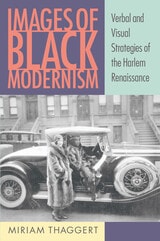
Focusing on the years from 1922 to 1938, this book revisits an important moment in black cultural history to explore how visual elements were used in poems, novels, and photography to undermine existing stereotypes. Miriam Thaggert identifies and analyzes an early form of black American modernism characterized by a heightened level of experimentation with visual and verbal techniques for narrating and representing blackness. The work of the writers and artists under discussion reflects the creative tension between the intangibility of some forms of black expression, such as spirituals, and the materiality of the body evoked by other representations of blackness, such as “Negro” dialect.
By paying special attention to the contributions of photographers and other visual artists who have not been discussed in previous accounts of black modernism, Thaggert expands the scope of our understanding of the Harlem Renaissance and contributes to a growing recognition of the importance of visual culture as a distinct element within, and not separate from, black literary studies.
Thaggert trains her critical eye on the work of James Weldon Johnson, Nella Larsen, George Schuyler, Carl Van Vechten, James Van Der Zee, and Aaron Siskind—artists who experimented with narrative and photographic techniques in order to alter the perception of black images and to question and reshape how one reads and sees the black body. Examining some of the more problematic authors and artists of black modernism, she challenges entrenched assumptions about black literary and visual representations of the early to mid twentieth century.
Thaggert concludes her study with a close look at the ways in which Harlem and the Harlem Renaissance were reimagined and memorialized in two notable texts—Wallace Thurman's 1932 satire Infants of the Spring and the Metropolitan Museum of Art's controversial 1969 exhibition “Harlem on My Mind: The Cultural Capital of Black America, 1900–1968.”
Images of Bliss
Ejaculation, Masculinity, MeaningMurat Aydemir
University of Minnesota Press, 2007
Aristotle believed semen to be the purest of all bodily secretions, a vehicle for the spirit or psyche that gives form to substance. For Proust’s narrator in Swann’s Way, waking to find he has experienced a nocturnal emission, it is the product of “some misplacing of my thigh.” The heavy metal band Metallica used it to adorn an album cover. Beyond its biological function, semen has been applied with surprising frequency to metaphorical and narratological purposes.
In Images of Bliss, Murat Aydemir undertakes an original and extensive analysis of images of male orgasm and semen. In a series of detailed case studies—Aristotle’s On the Generation of Animals; Andres Serrano’s use of bodily fluids in his art; paintings by Holbein and Leonardo; Proust’s In Search of Lost Time; hard-core pornography (both straight and gay); and key texts from the poststructuralist canon, including Lacan on the phallus, Bataille on expenditure, Barthes on bliss, and Derrida on dissemination—Aydemir traces the complex and often contradictory possibilities for imagination, description, and cognition that both the idea and the reality of semen make available. In particular, he foregrounds the significance of male ejaculation for masculine subjectivity. More often than not, Aydemir argues, the event or object of ejaculation emerges as the instance through which identity, meaning, and gender are not so much affirmed as they are relentlessly and productively questioned, complicated, and displaced.
Combining close readings of diverse works with subtle theoretical elaboration and a keen eye for the cultural ideals and anxieties attached to sexuality, Images of Bliss offers a convincing and long overdue critical exploration of ejaculation in Western culture.
Murat Aydemir is assistant professor of comparative literature at the University of Amsterdam.

Images of Contemporary Iceland
Everyday Lives and Global ContextsGisli Palsson
University of Iowa Press, 1996
The Anthropology of Iceland presents the first perspectives on Icelandic anthropology from both Icelandic and foreign anthropologists. The thirteen essays in this volume are divided into four themes: ideology and action; kinship and gender; culture, class, and ethnicity; and the Commonwealth period of circa 930 to 1220, which saw the flowering of sagas. Insider and outsider viewpoints on such topics as the Icelandic women's movement, the transformation of the fishing industry, the idea of mystical power in modern Iceland, and archaeological research in Iceland merge to form an international, comparative discourse.
Individually and collectively, by bringing the insights of anthropology to bear on Iceland, the native and foreign authors of this volume carry Iceland into the realm of modern anthropology, advancing our understanding of the island's people and the practice of anthropology.

Images of English
A Cultural History of the LanguageRichard W. Bailey
University of Michigan Press, 1992

Images of Germany in American Literature
Waldemar Zacharasiewicz
University of Iowa Press, 2007
Starting with the notion of Germany as the ideal site for academic study and travel in the nineteenth century and concluding with the twentieth-century image of Germany as an aggressive country, this innovative work examines the ever-changing image of Germans and Germany in the writings of Louisa May Alcott, Samuel Clemens, Henry James, William James, George Santayana, W. E. B. Du Bois, John Dewey, H. L. Mencken, Katherine Anne Porter, Kay Boyle, Thomas Wolfe, Upton Sinclair, Gertrude Stein, Kurt Vonnegut, Thomas Pynchon, William Styron, Walker Percy, and John Hawkes, among others.

Images of History
19th and Early 20th Century Latin American Photographs as DocumentsRobert M. Levine
Duke University Press, 1990
Levine has woven together an account of the development of photographic equipment and processes, with the artists and entrepreneurs who actually took the pictures, and places the emergence of photography firmly in the historical context of Latin American societies.
Treating the photographs themselves—some 225 in all—Levine develops criteria for questions we can ask of the photographs in an attempt to extract emotional, psychological, and personal information, as well as the more obvious material evidence. This is an often subjective process, one that can lead to differing results, and observers may well come to conclusions departing radically from those of the author. But this may well be one of the most important functions of an innovative work, the creation of controversy that stimulates forward motion in a discipline.

Images of Kin
NEW AND SELECTED POEMSMichael S. Harper
University of Illinois Press, 1977
"It is Mr. Harper's achievement to have projected his most difficult and complex insights and feelings through the epical manner, yet at the same time carried us along to identify with him." -- New York Times Book Review
Images of Public Wealth or the Anatomy of Well-Being in Indigenous Amazonia
Edited by Fernando Santos-Granero
University of Arizona Press, 2015
Mindful of the widespread discontent generated by the ongoing economic crisis in postindustrial societies as well as the renewed attempts by social scientists to measure more effectively what we consider to be “development” and “economic success,” the contributors to this volume contend that the study of public wealth in indigenous Amazonia provides not only an exceptional opportunity to apprehend native notions of wealth, poverty, and the good life, but also to engage in a critical revision of capitalist constructions of living well.
Through ethnographic analysis and thought-provoking new approaches to contemporary and historical cases, the book’s contributors reveal how indigenous views of wealth—based on the abundance of intangibles such as vitality, good health, biopower, and convivial relations—are linked to the creation of strong, productive, and moral individuals and collectivities, differing substantially from those in capitalist societies more inclined toward the avid accumulation and consumption of material goods.

Images of Science
Essays on Realism and EmpiricismEdited by Paul M. Churchland and Clifford A. Hooker
University of Chicago Press, 1985
Images of Women in Peace and War
Cross-cultural and Historical PerspectivesSharon Macdonald
University of Wisconsin Press, 1988
As warriors, freedom fighters and victims, as mothers, wives and prostitutes, and as creators and members of peace movements, women are inevitably caught up in the net of war. Yet women’s participation in warfare and peace campaigns has often been underestimated or ignored.
Images of Women in Peace and War explores women’s relationships to war, peace, and revolution, from the Amazons, Inka and Boadicea, to women soldiers in South Africa, Mau Mau freedom fighters and the protestors at Greenham Common. The contributors consider not only the reality of women’s participation but also look at how their actions have been perceived and represented across cultures and through history. They examine how sexual imagery is constructed, how it is used to delineate women’s relation to warfare and how these images have sometimes been subverted in order to challenge the status quo. The book raises important questions about whether women have a special prerogative to promote peace and considers whether the experience of motherhood leads to a distinctive women’s position on war. The authors find that their analyses lead them to deal with arguments on the basic nature of the sexes and to reevaluate our concepts of “peace,” “war,” and “gender.”

Images of a Free Press
Lee C. Bollinger
University of Chicago Press, 1991
"Images of a Free Press is the natural sequel to Lee Bollinger's first book, The Tolerant Society, and is destined to become a standard in first amendment scholarship."—Rodney A. Smolla, Constitutional Commentary
"Revisiting themes he first explored some fifteen years ago, Bollinger now adds further to our understanding of the complex relationship among the First Amendment, the Supreme Court, the public, the press and the democratic process. This is a work of insight, sensitivity, and power. Bollinger has a profound knowledge of and a deep affection for his subject, and it shows."—Geoffrey R. Stone, Michigan Law Review
"This thoughtful, understated book remains a call to come join the town meeting and hammer out some new rules of order. Scholars and citizens alike could do well to read Bollinger's book and accept his challenge."—Yale Law Review
"For a number of years, Lee Bollinger has argued that the First Amendment has been applied differently to the print media than it has been to the broadcast media. In his new book, Images of a Free Press, Bollinger provides a concise, persuasive account of why this is so—and why it ought to be so."—Columbia Law Review

Images of the Canton Factories 1760–1822
Reading History in ArtPaul A. Van Dyke and Maria Kar-wing Mok
Hong Kong University Press, 2015

Images of the Child
Harry Eiss
University of Wisconsin Press, 1994
This collection of articles on images of the child offers an excellent range of perspectives on an equally wide range of concerns, including advertising, girls' book series, rap music, realistic fiction, games, dolls, violence, and movies. Taken together as a book, this collection confirms the complexity of the world of childhood, and demonstrates how strongly images of the child reflect the entire culture.

In a Persian Mirror
Images of the West and Westerners in Iranian FictionBy M. R. Ghanoonparvar
University of Texas Press, 1993
The extreme anti-Western actions and attitudes of Iranians in the 1980s astonished and dismayed the West, which has characterized the Iranian positions as irrational and inexplicable. In this groundbreaking study of images of the West in Iranian literature, however, M. R. Ghanoonparvar reveals that these attitudes did not develop suddenly or inexplicably but rather evolved over more than two centuries of Persian-Western contact.
Notable among the authors whose works Ghanoonparvar discusses are Sadeq Hedayat, M. A. Jamalzadeh, Hushang Golshiri, Gholamhoseyn Sa'edi, Simin Daneshvar, Moniru Ravanipur, Sadeq Chubak, and Jalal Al-e Ahmad. This survey significantly illuminates the sources of Iranian attitudes toward the West and offers many surprising discoveries for Western readers, not least of which is the fact that Iranians have often found Westerners to be as enigmatic and incomprehensible as we have believed them to be.