Results by title
54 books match the query 'Indians in literature' and 3 start with i
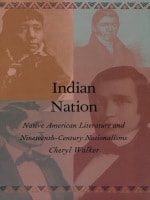
Indian Nation
Native American Literature and Nineteenth-Century NationalismsCheryl Walker
Duke University Press, 1997
Indian Nation documents the contributions of Native Americans to the notion of American nationhood and to concepts of American identity at a crucial, defining time in U.S. history. Departing from previous scholarship, Cheryl Walker turns the "usual" questions on their heads, asking not how whites experienced indigenous peoples, but how Native Americans envisioned the United States as a nation. This project unfolds a narrative of participatory resistance in which Indians themselves sought to transform the discourse of nationhood.
Walker examines the rhetoric and writings of nineteenth-century Native Americans, including William Apess, Black Hawk, George Copway, John Rollin Ridge, and Sarah Winnemucca. Demonstrating with unique detail how these authors worked to transform venerable myths and icons of American identity, Indian Nation chronicles Native American participation in the forming of an American nationalism in both published texts and speeches that were delivered throughout the United States. Pottawattomie Chief Simon Pokagon’s "The Red Man’s Rebuke," an important document of Indian oratory, is published here in its entirety for the first time since 1893.
By looking at this writing through the lens of the best theoretical work on nationality, postcoloniality, and the subaltern, Walker creates a new and encompassing picture of the relationship between Native Americans and whites. She shows that, contrary to previous studies, America in the nineteenth century was intercultural in significant ways.
[more]
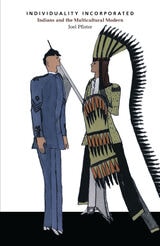
Individuality Incorporated
Indians and the Multicultural ModernJoel Pfister
Duke University Press, 2004
Spanning the 1870s to the present, Individuality Incorporated demonstrates how crucial a knowledge of Native American-White history is to rethinking key issues in American studies, cultural studies, and the history of subjectivity. Joel Pfister proposes an ingenious critical and historical reinterpretation of constructions of “Indians” and “individuals.” Native Americans have long contemplated the irony that the government used its schools to coerce children from diverse tribes to view themselves first as “Indians”—encoded as the evolutionary problem—and then as “individuals”—defined as the civilized industrial solution. As Luther Standing Bear, Charles Eastman, and Black Elk attest, tribal cultures had their own complex ways of imagining, enhancing, motivating, and performing the self that did not conform to federal blueprints labeled “individuality.” Enlarging the scope of this history of “individuality,” Pfister elaborates the implications of state, corporate, and aesthetic experiments that moved beyond the tactics of an older melting pot hegemony to impose a modern protomulticultural rule on Natives. The argument focuses on the famous Carlisle Indian School; assimilationist novels; Native literature and cultural critique from Zitkala-Sa to Leslie Marmon Silko; Taos and Santa Fe bohemians (Mabel Dodge Luhan, D. H. Lawrence, Mary Austin); multicultural modernisms (Fred Kabotie, Oliver La Farge, John Sloan, D’Arcy McNickle); the Southwestern tourism industry’s development of corporate multiculturalism; the diversity management schemes that John Collier implemented as head of the Indian New Deal; and early formulations of ethnic studies. Pfister’s unique analysis moves from Gilded Age incorporations of individuality to postmodern incorporations of multicultural reworkings of individuality to unpack what is at stake in producing subjectivity in World America.
[more]
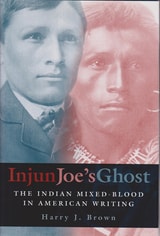
Injun Joe's Ghost
The Indian Mixed-Blood in American WritingHarry J. Brown
University of Missouri Press, 2004
What does it mean to be a “mixed-blood,” and how has our understanding of this term changed over the last two centuries? What processes have shaped American thinking on racial blending? Why has the figure of the mixed-blood, thought too offensive for polite conversation in the nineteenth century, become a major representative of twentieth-century native consciousness?
In Injun Joe’s Ghost, Harry J. Brown addresses these questions within the interrelated contexts of anthropology, U.S. Indian policy, and popular fiction by white and mixed-blood writers, mapping the evolution of “hybridity” from a biological to a cultural category. Brown traces the processes that once mandated the mixed-blood’s exile as a grotesque or criminal outcast and that have recently brought about his ascendance as a cultural hero in contemporary Native American writing.
Because the myth of the demise of the Indian and the ascendance of the Anglo-Saxon is traditionally tied to America’s national idea, nationalist literature depicts Indian-white hybrids in images of degeneracy, atavism, madness, and even criminality. A competing tradition of popular writing, however, often created by mixed-blood writers themselves, contests these images of the outcast half-breed by envisioning “hybrid vigor,” both biologically and linguistically, as a model for a culturally heterogeneous nation.
Injun Joe’s Ghost focuses on a significant figure in American history and culture that has, until now, remained on the periphery of academic discourse. Brown offers an in-depth discussion of many texts, including dime novels and Depression-era magazine fiction, that have been almost entirely neglected by scholars. This volume also covers texts such as the historical romances of the 1820s and the novels of the twentieth-century “Native American Renaissance” from a fresh perspective. Investigating a broad range of genres and subject over two hundred year of American writing, Injun Joe’s Ghost will be useful to students and professionals in the fields of American literature, popular culture, and native studies.
[more]