Results by title
129 books match the query 'Individual Philosophers' and 6 start with i
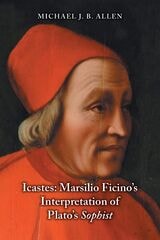
Icastes
Marsilio Ficino's Interpretation of Plato's SophistMichael J. B. Allen
Arizona Center for Medieval and Renaissance Studies, 2016
New 2016 paperback edition of the original 1989 printing (out-of-print).
Michael Allen's latest work on the profoundly influential Florentine thinker of the fifteenth century, Marsilio Ficino, will be welcomed by philosophers, literary scholars, and historians of the Renaissance, as well as by classicists. Ficino was responsible for inaugurating, shaping, and disseminating the wide-ranging philosophico-cultural movement known as Renaissance Platonism, and his views on the Sophist, which he saw as Plato's preeminent ontological dialogue, are of signal interest. This dialogue also served Ficino as a vehicle for exploring a number of other humanist, philosophical, and magical preoccupations, including the theme of man the artist and creator.
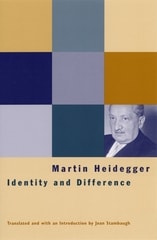
Identity and Difference
Martin Heidegger
University of Chicago Press, 2002
Two essential works by Heidegger on the nature of identity
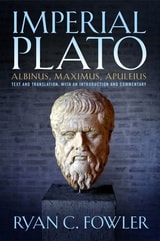
Imperial Plato
Albinus, Maximus, Apuleius: Text and Translation, with an Introduction and CommentaryRyan C. Fowler
Parmenides Publishing, 2016
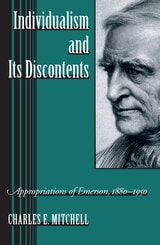
Individualism and Its Discontents
Appropriations of Emerson, 1880-1950Charles E. Mitchell
University of Massachusetts Press, 1997
The work of Ralph Waldo Emerson has long been synonymous with the American ideals of self-reliance and individualism. Like those ideals, it has come to mean different things, at different times, to different people. Emerson has been identified as the source of both the best and worst in the American intellectual tradition, his authority invoked by back-to-the-landers and industrial capitalists, the philosopher Nietzsche, as well as the promoters of Nike footwear.
This book explores the intertwined history of Emerson and individualism. Charles E. Mitchell begins by examining those who regarded Emersonian individualism with ambivalence or hostility, focusing on the comments of such diverse figures as Henry James, Sr., Oliver Wendell Holmes, Van Wyck Brooks, and H.L. Mencken. He then offers an alternative view as reflected in the work of William James, John Dewey, W.E.B. Du Bois, and William Carlos Williams. Each of these figures embraced Emerson’s claim for the sanctity of the individual and wove it into a social vision that sought to reconcile the paradox at the heart of American life: a simultaneous devotion to the community and the individual, tradition and innovation, order and freedom.
While indirectly answering Emerson’s more fervent critics, James, Dewey, Du Bois, and Williams also constructed a vibrant tradition of their own, one that offers guidance as Americans continue to struggle with these competing claims.
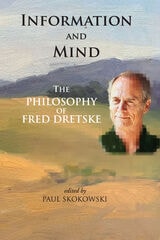
Information and Mind
The Philosophy of Fred DretskeEdited by Paul G. Skokowski
CSLI, 2020

Investigations into the Literary Use of Language
Course Notes from the Collège de France, 1953Maurice Merleau-Ponty, Bryan Smyth
Northwestern University Press, 2026
A closely annotated translation of Merleau-Ponty’s lecture notes on literary language
Investigations into the Literary Use of Language presents an annotated translation of Maurice Merleau-Ponty’s lecture notes from one of the two courses that he gave during his inaugural year teaching at the Collège de France. In his notes from the concurrent course, The Sensible World and the World of Expression, Merleau-Ponty contends that our embodied perceptual engagement with the sensible world already involves the same spontaneity that underlies cultural expression. Approaching it from the other side, he revisits here the analysis of language that he had undertaken in the unfinished manuscript The Prose of the World.
Focusing on the work of Paul Valéry (1871–1945) and Stendhal (Marie-Henri Beyle, 1783–1842), Merleau-Ponty explores how the spontaneity of literary language sheds light on the relation between lived experience and language more broadly, and how cultural expression remains grounded in embodied perceptual experience in a way that is homologous yet irreducible to it. Specifically, Merleau-Ponty shows how Stendhal had already overcome Valéry’s skepticism concerning literary sincerity by effectively incorporating what the latter called the linguistic “implex”—in effect, language as institution—and thus achieving a “total style” of improvisational spontaneity in which the “conquering function” characteristic of the literary use of language gives shape to an immanent model of political engagement.