Results by title
92 books match the query 'Information literacy' and 13 start with i

I Found It on the Internet
Coming of Age OnlineFrances Jacobson Harris
American Library Association, 2011
Information Literacy Assessment
Standards-Based Tools and AssignmentsTeresa Y. Neely
American Library Association, 2006

Information Literacy Instruction Handbook
Christopher N. Cox
Assoc of College & Research Libraries, 2008
Information Literacy Instruction that Works
A Guide to Teaching by Discipline and Student PopulationPatrick Ragains
American Library Association, 2013
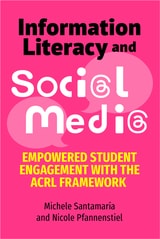
Information Literacy and Social Media
Empowered Student Engagement with the ACRL FrameworkMichele Santamaria
Assoc of College & Research Libraries, 2024
Information Literacy and Social Media: Empowered Student Engagement with the ACRL Framework provides librarians and non-librarian practitioners with ways to teach and learn with social media. It addresses how to broadly conceptualize information literacy teaching with social media and allay any student reluctance to using social media for academic purposes. It proposes how to map some of the ACRL threshold concepts onto specific social media platforms, including Facebook, X, Instagram, and TikTok, while providing general guidance for if and when those platforms change. There are eight concrete, cross-disciplinary lesson plans that factor in design, assessment, and student engagement. Finally, the book considers how up-and-coming platforms might empower students to be critical content creators and encourage librarians and faculty to support and create new information literacy initiatives on their campuses.
Information Literacy and Social Media demonstrates how to engage students with and through social media platforms and teach them to embrace their role as information creators through engagement with the ACRL Framework for Information Literacy for Higher Education. This is the step that they must take to truly be metaliterate in the creative and ethical ways that make information literacy an essential college competency.
Information Literacy
Research and Collaboration across DisciplinesBarbara d'Angelo
University Press of Colorado, 2017
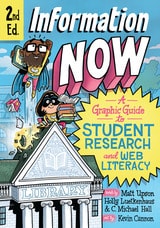
Information Now, Second Edition
A Graphic Guide to Student Research and Web LiteracyMatt Upson, Holly Luetkenhaus, C. Michael Hall, and Kevin Cannon
University of Chicago Press, 2021
This second edition of the popular guide incorporates critical analysis of information systems, asking students to think about the biases and problems in how databases and search engines are designed and used. It also addresses how different populations of people are disproportionately affected by the algorithmic biases built into information systems. And it includes revised critical thinking exercises in every chapter.
Written and revised by library professionals, Information Now is a fun and insightful tool for high school and college students, writers, and anyone wanting to improve their research skills.
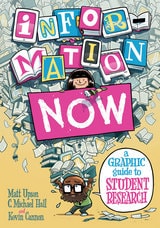
Information Now
A Graphic Guide to Student ResearchMatt Upson, C. Michael Hall, and Kevin Cannon
University of Chicago Press, 2015
Information Now is an innovative approach to information literacy that will reinvent the way college students think about research. Instead of the typical textbook format, it uses illustrations, humor, and reflective exercises to teach students how to become savvy researchers. Students will learn how to evaluate information, to incorporate it into their existing knowledge base, to wield it effectively, and to understand the ethical issues surrounding its use. Written by two library professionals, it incorporates concepts and skills drawn from the Association of College and Research Libraries’ Information Literacy Competency Standards for Higher Education and their Framework for Information Literacy for Higher Education. Thoroughly researched and highly engaging, Information Now offers the tools that students need to become powerful consumers and creators of information.
Whether used by a high school student tackling a big paper, an undergrad facing the newness of a university library, or a writer wanting to go beyond Google, Information Now is a powerful tool for any researcher’s arsenal.
Instructional Design for Librarians and Information Professionals
American Library Association, 2011
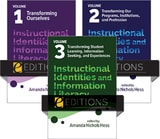
Instructional Identities and Information Literacy
Three Volume SetAmanda Nichols Hess
Assoc of College & Research Libraries, 2023
Grappling with this potentially unexpected identity comes amid a time of significant transition for higher education itself. Academic librarians must figure out how to counter mis-, dis-, and malinformation, address shrinking funding for collections while costs increase, and establish meaningful partnerships in diverse, data-driven environments. And writ large, librarianship as a profession continues to grapple with its responsibility to challenge information illiteracy across contexts, its support of systemic systems of oppression under the guise of neutrality, and its value to a society flooded with information.
In three volumes, Instructional Identities and Information Literacy uses transformative learning theory—a way of understanding adult learning and ourselves—to explore the ways librarians can meaningfully advance how we think about our identities, instructional work, and learning as transformation. Three volumes explore:
- Transforming Ourselves
- Transforming Our Programs, Institutions, and Profession
- Transforming Student Learning, Information Seeking, and Experiences
Instructional Identities and Information Literacy
Volume 1: Transforming OurselvesAmanda Nichols Hess
Assoc of College & Research Libraries, 2023
Grappling with this potentially unexpected identity comes amid a time of significant transition for higher education itself. Academic librarians must figure out how to counter mis-, dis-, and malinformation, address shrinking funding for collections while costs increase, and establish meaningful partnerships in diverse, data-driven environments. And writ large, librarianship as a profession continues to grapple with its responsibility to challenge information illiteracy across contexts, its support of systemic systems of oppression under the guise of neutrality, and its value to a society flooded with information.
In three volumes, Instructional Identities and Information Literacy uses transformative learning theory—a way of understanding adult learning and ourselves—to explore the ways librarians can meaningfully advance how we think about our identities, instructional work, and learning as transformation. Three volumes explore:
- Transforming Ourselves
- Transforming Our Programs, Institutions, and Profession
- Transforming Student Learning, Information Seeking, and Experiences
Instructional Identities and Information Literacy
Volume 2: Transforming Our Programs, Institutions, and ProfessionAmanda Nichols Hess
Assoc of College & Research Libraries, 2023
Grappling with this potentially unexpected identity comes amid a time of significant transition for higher education itself. Academic librarians must figure out how to counter mis-, dis-, and malinformation, address shrinking funding for collections while costs increase, and establish meaningful partnerships in diverse, data-driven environments. And writ large, librarianship as a profession continues to grapple with its responsibility to challenge information illiteracy across contexts, its support of systemic systems of oppression under the guise of neutrality, and its value to a society flooded with information.
In three volumes, Instructional Identities and Information Literacy uses transformative learning theory—a way of understanding adult learning and ourselves—to explore the ways librarians can meaningfully advance how we think about our identities, instructional work, and learning as transformation. Three volumes explore:
- Transforming Ourselves
- Transforming Our Programs, Institutions, and Profession
- Transforming Student Learning, Information Seeking, and Experiences
Instructional Identities and Information Literacy
Volume 3: Transforming Student Learning, Information Seeking, and ExperiencesAmanda Nichols Hess
Assoc of College & Research Libraries, 2023
Grappling with this potentially unexpected identity comes amid a time of significant transition for higher education itself. Academic librarians must figure out how to counter mis-, dis-, and malinformation, address shrinking funding for collections while costs increase, and establish meaningful partnerships in diverse, data-driven environments. And writ large, librarianship as a profession continues to grapple with its responsibility to challenge information illiteracy across contexts, its support of systemic systems of oppression under the guise of neutrality, and its value to a society flooded with information.
In three volumes, Instructional Identities and Information Literacy uses transformative learning theory—a way of understanding adult learning and ourselves—to explore the ways librarians can meaningfully advance how we think about our identities, instructional work, and learning as transformation. Three volumes explore:
- Transforming Ourselves
- Transforming Our Programs, Institutions, and Profession
- Transforming Student Learning, Information Seeking, and Experiences