Results by title
124 books match the query 'Information technology' and 5 start with i

I Found It on the Internet
Coming of Age OnlineFrances Jacobson Harris
American Library Association, 2011
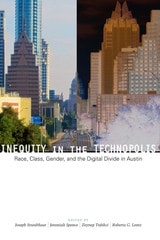
Inequity in the Technopolis
Race, Class, Gender, and the Digital Divide in AustinEdited by Joseph Straubhaar, Jeremiah Spence, Zeynep Tufekci, and Roberta G. Lentz
University of Texas Press, 2012
Over the past few decades, Austin, Texas, has made a concerted effort to develop into a “technopolis,” becoming home to companies such as Dell and numerous start-ups in the 1990s. It has been a model for other cities across the nation that wish to become high-tech centers while still retaining the livability to attract residents. Nevertheless, this expansion and boom left poorer residents behind, many of them African American or Latino, despite local and federal efforts to increase lower-income and minority access to technology.
This book was born of a ten-year longitudinal study of the digital divide in Austin—a study that gradually evolved into a broader inquiry into Austin’s history as a segregated city, its turn toward becoming a technopolis, what the city and various groups did to address the digital divide, and how the most disadvantaged groups and individuals were affected by those programs.
The editors examine the impact of national and statewide digital inclusion programs created in the 1990s, as well as what happened when those programs were gradually cut back by conservative administrations after 2000. They also examine how the city of Austin persisted in its own efforts for digital inclusion by working with its public libraries and a number of local nonprofits, and the positive impact those programs had.
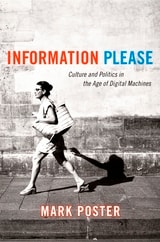
Information Please
Culture and Politics in the Age of Digital MachinesMark Poster
Duke University Press, 2006
Poster’s critique develops through a series of lively studies. Analyzing the appearance of Sesame Street’s Bert next to Osama Bin Laden in a New York Times news photo, he examines the political repercussions of this Internet “hoax” as well as the unlimited opportunities that Internet technology presents for the appropriation and alteration of information. He considers the implications of open-source licensing agreements, online personas, the sudden rise of and interest in identity theft, peer-to-peer file sharing, and more. Focusing explicitly on theory, he reflects on the limitations of critical concepts developed before the emergence of new media, particularly globally networked digital communications, and he argues that, contrary to the assertions of Michael Hardt and Antonio Negri, new media do not necessarily reproduce neoimperialisms. Urging a rethinking of assumptions ingrained during the dominance of broadcast media, Poster charts new directions for work on politics and digital culture.
Information and Communication Technologies for Humanitarian Services
Muhammad Nazrul Islam
The Institution of Engineering and Technology, 2020
Institutional Literacies
Engaging Academic IT Contexts for Writing and CommunicationStuart A. Selber
University of Chicago Press, 2020
Institutional Literacies argues that writing and communication teachers and program directors should collaborate more closely and engage more deeply with IT staff as technology projects are planned, implemented, and expanded. Teachers need to both analyze how their institutions approach information technologies and intervene in productive ways as active university citizens with relevant expertise. To help them do so, the book offers a three-part heuristic, reflecting the reality that academic IT units are complex and multilayered, with historical, spatial, and textual dimensions. It discusses six ways teachers can intervene in the academic IT work of their own institutions: maintaining awareness, using systems and services, mediating for audiences, participating as user advocates, working as designers, and partnering as researchers. With these strategies in hand, educators can be proactive in helping institutional IT approaches align with the professional values and practices of writing and communication programs.