89 books match the query 'Interpersonal relations' and 4 start with i

cover of I Saw Her in My Dreams

I Saw Her in My Dreams

Huda Hamed, translated by Nadine Sinno & William Taggart

University of Texas Press, 2022

I Saw Her in My Dreams is a powerful novel about interpersonal and systemic violence, examined through the lens of a relationship between Zahiyya, an anxious middle-class Omani artist, and Faneesh, the Ethiopian domestic worker she hires. When Zahiyya’s husband Amer, a novelist, leaves for Zanzibar in search of his biological mother, Zahiyya is left to confront her anxieties and prejudices. Both Zahiyya and Faneesh begin to suffer a recurring nightmare, prompting Zahiyya to read Fanheesh’s diaries in search of answers. Alone and afraid, Zahiyya reads excerpts from Amer’s novel, written from his father’s diaries about living in Zanzibar, where he fell in love with Amer’s mother, a Zanzibari woman whose absence still haunts him. Weaving between multiple perspectives and stories within stories, the novel explores honestly—but without sensationalizing or self-Orientalizing—the anti-Blackness that has endured in the Arab world and elsewhere.
[more]
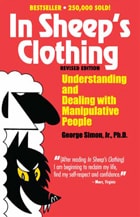
cover of In Sheep's Clothing: Understanding and Dealing with Manipulative People

In Sheep's Clothing

Understanding and Dealing with Manipulative People

George K. Simon, Ph.D.

Parkhurst Brothers, Inc., 2010

Dr. George Simon knows how people push your buttons.  Your children--especially teens--are expert at it, as is your mate.  A co-worker may quietly undermine your efforts while professing to be helpful, or your boss may prey on your weaknesses.  Manipulative people have two goals: to win and to look good doing it.  Often those they abuse are only vaguely aware of what is happening to them.  In this eye-opening book, you'll also discover...

* 4 reasons why victims have a hard time leaving abusive relationships

* Power tactics manipulators use to push their own agendas and justify their behavior

*Ways to redefine the rules of engagement between you and an abuser

* How to spot potential weaknesses in your character that can set you up for manipulation.

* 12 tools for personal empowerment to help you maintain greater strength in all relationships

[more]
cover of Intimate Inequalities: Millennials' Romantic Relationships in Contemporary Times

Intimate Inequalities

Millennials' Romantic Relationships in Contemporary Times

Cristen Dalessandro

Rutgers University Press, 2021

When it comes to the topic of romantic and sexual intimacy, social observers are often quick to throw criticisms at millennials. However, we know little about millennials’ own hopes, fears, struggles, and triumphs in their relationships from the perspectives of millennials themselves. Intimate Inequalities uses millennials’ own stories to explore how they navigate gender, race, social class, sexuality, and age identities and expectations in their relationships. Situating millennials’ lives within contemporary social and cultural conditions in the United States, Intimate Inequalities takes an intersectional approach to examining how millennials challenge—or rather, uphold—social inequalities in their lives as they come into their own as full adults. Intimate Inequalities provides an in-depth look into the intimate lives of one group of millennials living in the United States, demystifying what actually goes on behind closed doors, and arguing that millennials’ private lives can reveal much about their ability to navigate inequalities in their lives more broadly.
 
[more]
cover of Inventing the Ties That Bind: Imagined Relationships in Moral and Political Life

Inventing the Ties That Bind

Imagined Relationships in Moral and Political Life

Francesca Polletta

University of Chicago Press, 2020

At a time of deep political divisions, leaders have called on ordinary Americans to talk to one another: to share their stories, listen empathetically, and focus on what they have in common, not what makes them different. In Inventing the Ties that Bind, Francesca Polletta questions this popular solution for healing our rifts. Talking the way that friends do is not the same as equality, she points out. And initiatives that bring strangers together for friendly dialogue may provide fleeting experiences of intimacy, but do not supply the enduring ties that solidarity requires. But Polletta also studies how Americans cooperate outside such initiatives, in social movements, churches, unions, government, and in their everyday lives. She shows that they often act on behalf of people they see as neighbors, not friends, as allies, not intimates, and people with whom they have an imagined relationship, not a real one. To repair our fractured civic landscape, she argues, we should draw on the rich language of solidarity that Americans already have.
[more]