Results by title
173 books match the query 'Ireland' and 16 start with i
I Am of Ireland
Women of the North Speak OutElizabeth Shannon
University of Massachusetts Press, 1997
In the Footsteps of Joseph Dalton Hooker
Seamus O'Brien
Royal Botanic Gardens, Kew, 2018

Inside the Celtic Tiger
Denis O'Hearn
Pluto Press, 1998

Ireland and Irish Cultural Studies, Volume 95
John Paul Waters
Duke University Press, 0
The recent advent of postcolonial theory in the Irish academy, which sparked this special issue of SAQ, has had a profound effect on the Irish conversation and the turn it is taking today. As the island writes back, a rising faction in Irish studies is resisting what some see as yet another colonization, insisting that theory accommodate and respond to Ireland’s concerns and questions.
Contributors. Guinn Batten, Joe Cleary, Luke Dodd, Luke Gibbons, Dillon Johnston, David Kellogg, Declan Keberd, Aine O’Brien, Lance Pettitt, Lawrence J. Taylor, John Paul Waters, Clair Wills
Ireland and the Classical World
By Philip Freeman
University of Texas Press, 2000
On the boundary of what the ancient Greeks and Romans considered the habitable world, Ireland was a land of myth and mystery in classical times. Classical authors frequently portrayed its people as savages—even as cannibals and devotees of incest—and evinced occasional uncertainty as to the island's shape, size, and actual location. Unlike neighboring Britain, Ireland never knew Roman occupation, yet literary and archaeological evidence prove that Iuverna was more than simply terra incognita in classical antiquity.
In this book, Philip Freeman explores the relations between ancient Ireland and the classical world through a comprehensive survey of all Greek and Latin literary sources that mention Ireland. He analyzes passages (given in both the original language and English) from over thirty authors, including Julius Caesar, Strabo, Tacitus, Ptolemy, and St. Jerome. To amplify the literary sources, he also briefly reviews the archaeological and linguistic evidence for contact between Ireland and the Mediterranean world.
Freeman's analysis of all these sources reveals that Ireland was known to the Greeks and Romans for hundreds of years and that Mediterranean goods and even travelers found their way to Ireland, while the Irish at least occasionally visited, traded, and raided in Roman lands. Everyone interested in ancient Irish history or Classics, whether scholar or enthusiast, will learn much from this pioneering book.
Ireland at the Polls 1981, 1982, and 1987
A Study of Four General ElectionsHoward R. Penniman and Brian Farrell, eds.
Duke University Press, 1987
Ireland in the World Order
A History of Uneven DevelopmentMaurice Coakley
Pluto Press, 2012
Ireland in the World Order examines Ireland’s development from the medieval to the modern era, comparing its unique trajectory with that of England, Scotland and Wales.
Maurice Coakley focuses on key elements that contributed to Ireland’s development, examining its bloody and violent incorporation into the British state, its refusal to embrace the Protestant Reformation and failure to industrialise in the 19th century. Coakley considers the crucial question of why Ireland’s national identity has come to rest on a mass movement for independence.
Cutting through many of the myths – imperialist and nationalist – which have obscured the real reasons for Ireland's course of development, Ireland in the World Order provides a new perspective for students and academics of Irish history.
Ireland's Economic History
Crisis and Development in the North and SouthGerard McCann
Pluto Press, 2011
With clarity and depth, Gerard McCann explores the complex developments that have shaped Ireland’s economic development, north and south, and led to recurring crises and instability.
The Irish economy has been traditionally portrayed as a product of its political divisions and the colonial legacy, divided and analysed in terms of the hegemonic tensions that exist on the island. Influenced by these divisions, academics have tended to look at a two-region approach to economic development, without adequately acknowledging the interactive nature of the island economy as a source of the crises or as a solution to systemic divergence.
McCann's definitive and dynamic history of the Irish economy circumvents conventional analyses and investigates the economic development of the island economy as a whole, highlighting where aggressive differentiation has been divisive and destabilising. He concludes by considering an alternative integrated and cohesive process of economic development.
Ireland's Farthest Shores
Mobility, Migration, and Settlement in the Pacific WorldMalcolm Campbell
University of Wisconsin Press, 2022
Malcolm Campbell examines the rich history of Irish experiences on land and at sea, offering new perspectives on migration and mobility in the Pacific world and of the Irish role in the establishment and maintenance of the British Empire. This volume investigates the extensive transnational connections that developed among Irish immigrants and their descendants across this vast and unique oceanic space, ties that illuminate how the Irish participated in the making of the Pacific world and how the Pacific world made them.
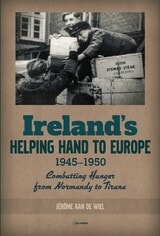
Ireland's Helping Hand to Europe
Combatting Hunger from Normandy to Tirana, 1945–1950Jérôme aan de Wiel
Central European University Press, 2021
Post-war Marshall Plan aid to Europe and indeed Ireland is well documented, but practically nothing is known about simultaneous Irish aid to Europe. This book provides a full record of the aid – mainly food but also clothes, blankets, medicines, etc. – that Ireland donated to continental Europe, including France, the Netherlands, Hungary, the Balkans, Italy, and zones of occupied Germany.
Starting with Ireland’s neutral wartime record, often wrongly presented as pro-German when Ireland in fact unofficially favoured the western Allies, Jerome aan de Wiel explains why Éamon de Valera’s government sent humanitarian aid to the devastated continent. His book analyses the logistics of collection and distribution of supplies sent abroad as far as the Greek islands.
Despite some alleged Cold-War hijacking of Irish relief – and this humanitarianism was not above the politics of that East-West confrontation – it became mostly a story of hope, generosity and European Christian solidarity. Rich archival records from Ireland and the European beneficiary countries, as well as contemporary local and national newspapers across Europe, allow the author to measure and describe not only the official but also the popular response to Irish relief schemes. This work is illustrated with contemporary photographs and some key graphs and tables that show the extent of the aid programme.
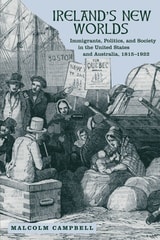
Ireland's New Worlds
Immigrants, Politics, and Society in the United States and Australia, 1815–1922Malcolm Campbell
University of Wisconsin Press, 2007
Ireland’s New Worlds is the first book to compare Irish immigrants in the United States and Australia. In a profound challenge to the national histories that frame most accounts of the Irish diaspora, Malcolm Campbell highlights the ways that economic, social, and cultural conditions shaped distinct experiences for Irish immigrants in each country, and sometimes in different parts of the same country. From differences in the level of hostility that Irish immigrants faced to the contrasting economies of the United States and Australia, Campbell finds that there was much more to the experiences of Irish immigrants than their essential “Irishness.” America’s Irish, for example, were primarily drawn into the population of unskilled laborers congregating in cities, while Australia’s Irish, like their fellow colonialists, were more likely to engage in farming. Campbell shows how local conditions intersected with immigrants’ Irish backgrounds and traditions to create surprisingly varied experiences in Ireland’s new worlds.
“Well conceived and thoroughly researched . . . . This clearly written, thought-provoking work fulfills the considerable ambitions of comparative migration studies.”—Choice
Irish Journal
Heinrich Boll
Northwestern University Press, 1998
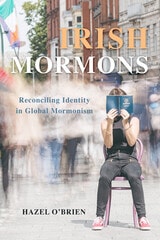
Irish Mormons
Reconciling Identity in Global MormonismHazel O'Brien
University of Illinois Press, 2023
Examining the Latter-day Saint experience against one nation’s rapid social and religious changes, Irish Mormons blends participant observation and interviews with analysis to offer a rare view of the Latter-day Saints in contemporary Ireland.
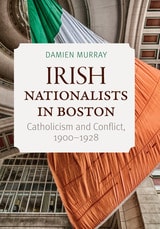
Irish Nationalists in Boston
Catholicism and Conflict, 1900-1928Damien Murray
Catholic University of America Press, 2018
For a brief period after World War I, Irish-American nationalism in Boston became a vehicle for the promotion of wider democratic reform. Though the movement was unable to survive the disagreements surrounding the Anglo-Irish Treaty of 1921, it had been a source of ethnic unity that enabled Boston’s Irish community to negotiate the challenges of the postwar years including the anti-socialist Red Scare and the divisions caused by the Boston Police Strike in the fall of 1919. Furthermore, Boston’s Irish nationalists drew heavily on Catholic Church teachings such that Irish ethnicity came to be more clearly identified with the advocacy of both cultural pluralism and the rights of immigrant and working families in Boston and America.
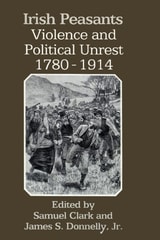
Irish Peasants
Violence and Political Unrest, 1780–1914Samuel Clark
University of Wisconsin Press, 1983
"The strength of this volume cannot be conveyed by an itemisation of its contents; for what it provides is an incisive commentary on the newly-recognised landmarks of Irish agrarian history in the modern period. . . . The importance, even indispensability, of this achievement is compounded by exemplary editing."—Roy Foster, London Times Literary Supplement
"As a whole, the volume demonstrates the wealth, complexity, and sophistication of Irish rural studies. The book is essential reading for anyone involved in modern Irish history. It will also serve as an excellent introduction to this rich field for scholars of other peasant communities and all interested in problems of economic and political developments."—American Historical Review
"A milestone in the evolution of Irish social history. There is a remarkable consistency of style and standard in the essays. . . . This is truly history from the grassroots."—Timothy P. O'Neill, Studia Hibernica
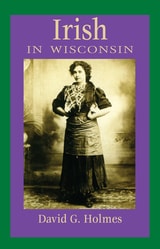
Irish in Wisconsin
David G. Holmes
Wisconsin Historical Society Press, 2004