Results by title
54 books match the query 'Islamic Studies' and 4 start with i

I Want to Get Married!
One Wannabe Bride’s Misadventures with Handsome Houdinis, Technicolor Grooms, Morality Police, and Other Mr. Not Quite RightsBy Ghada Abdel Aal
University of Texas Press, 2010
The rules may differ from country to country, but the dating game is a universal constant.
After years of searching for Mr. Right in living-room meetings arranged by family or friends, Ghada Abdel Aal, a young Egyptian professional, decided to take to the blogosphere to share her experiences and vent her frustrations at being young, single, and female in Egypt. Her blog, I Want to Get Married!, quickly became a hit with both men and women in the Arab world. With a keen sense of humor and biting social commentary, Abdel Aal recounts in painful detail her adventures with failed proposals and unacceptable suitors. There's Mr. Precious, who storms out during their first meeting when he feels his favorite athlete has been slighted, and another suitor who robs her in broad daylight, to name just a few of the characters she runs across in her pursuit of wedded bliss.
I Want to Get Married! has since become a best-selling book in Egypt and the inspiration for a television series. This witty look at dating challenges skewed representations of the Middle East and presents a realistic picture of what it means to be a single young woman in the Arab world, where, like elsewhere, a good man can be hard to find.
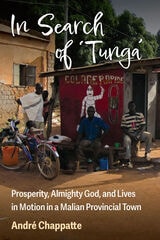
In Search of Tunga
Prosperity, Almighty God, and Lives in Motion in a Malian Provincial TownAndré Chappatte
University of Michigan Press, 2022
In the context of the current global war on terrorism, most studies of Muslim life have focused on the politics of piety of reformist movements, their leaders, and members. By contrast, In Search of “Tunga” takes a perspective from below. It opens piety up to “simply Muslims,” although the religious elites have always claimed authority and legitimacy over piety. Is piety an exclusive field of experiences for those who claim to strive for it? What does piety involve for the majority of Muslims, the non-elite and unaffiliated Muslims? This volume “democratizes” piety by documenting its practice as going beyond sharply defined religious affiliations and Islamic scholarship, and by showing it is both alive and normative, existential and prescriptive. As opposed to studies that build on the classic historical connections between the Maghreb and the Sahel, the southbound migration from the Sahel documented in this book stresses the overlooked historical connections between the southern shores of the Sahara and the lands south of those shores. It demonstrates how the Malian savanna, this former buffer-zone between ancient Mande kingdoms and thereafter remote areas of French Sudan, is increasingly becoming central in today’s Sahel contexts of desiccation and insecurity.

Islamic Activists
The Anti-Enlightenment DemocratsDeina Ali Abdelkader
Pluto Press, 2011
In the hysteria surrounding Political Islam, it is difficult to find analysis that doesn't feel the need to justify the existence of Islamic leaders or react to the West's fear of 'extremists'. In Islamic Activists, Deina Ali Abdelkader shows us what Islamic leaders and activists believe and what they think about just governance.
Explaining and comparing Islamist ideas, including those about leadership, justice and minority rights, Abdelkader explains how these have been represented in the writings of important historical and contemporary Islamists. In doing so, Abdelkader reveals that democracy is not the sole preserve of those who support Enlightenment values, offering the reader a chance to understand the populist non-violent side of Islamic activism. This includes an examination of the ideas of the leaders of the populist Islamist movements in Egypt, Tunisia and Morocco.
Islamically Integrated Psychotherapy
Uniting Faith and Professional PracticeCarrie York Al-Karam
Templeton Press, 2018
Integrating the Islamic faith with modern psychotherapy is at the forefront of the spiritually integrated psychotherapy movement. To bring this work to wider attention and to promote its continuation, Dr. Carrie York Al-Karam has brought together the present volume of nine essays, each of which is written by a Muslim clinician who practices Islamically integrated psychotherapy (IIP)—a modern approach that unites the teachings, principles, and interventions of the faith with Western therapeutic approaches.
As delineated in the Introduction, IIP has emerged from a variety of domains including the psychology of religion and spirituality, multicultural psychology and counseling, transpersonal psychology, Muslim Mental Health, and Islamic Psychology. The individual chapters then describe a variety of ways IIP is practiced by Muslim clinicians in their service provision with Muslim clients.
The contributors discuss a wide range of topics, such as how Islam can be viewed as a system for psychological wellbeing, or a “science of the soul”; what marital counseling can look like from an Islamically-integrated perspective; Prophet Mohammed as a psycho-spiritual exemplar in a new approach called The HEART Method; the use of Quranic stories in family therapy; as well as using Islamic teachings when working with Muslim children and adolescents.
A description of the various approaches is supplemented with discussions of their theoretical underpinnings as well as research-based recommendations for advancing clinical application. What emerges is a vital resource for Muslim and non-Muslim clinicians alike as well as the lay Muslim reader wanting to know more about how the Islamic faith and psychotherapy are engaging with each other in a modern clinical context.