Results by title
356 books match the query 'Jewish Studies' and 14 start with i
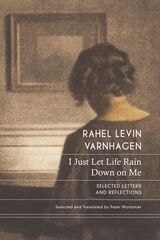
I Just Let Life Rain Down on Me
Selected Letters and ReflectionsRahel Levin Varnhagen
Seagull Books, 2024
At times poetic but not a poem, prosaic but not an essay, a letter is often pure writing for writing’s sake. Such is the case for Rahel Varnhagen von Ense, née Levin, the illustrious German-Jewish Berlin literary salon hostess from the early nineteenth century. She penned over ten thousand letters to more than three hundred recipients, including princes, philosophers, poets, family members, and the family cook. Written with a wink at posterity, collected and first published after her passing by her husband, Karl August Varnhagen von Ense, these letters constitute a singular contribution to German literature.
Varied in subject—from family affairs to linguistic, literary, and pressing social concerns—the poignant lyricism of her letters is all the more remarkable when we take into account that High German was not her first language; she grew up speaking, reading, and writing primarily Yiddish. Her shaky social status as a woman and a member of a precarious minority, combined with an astounding lucidity and a rare capacity to put her thoughts into words, made her a force to be reckoned with in her lifetime and thereafter as one of Germany’s preeminent women of letters. As we see in I Just Let Life Rain Down on Me, her voice is as fresh and original as that of any of the recognized poets and thinkers of her day. As Rahel herself put it: “[O]ur language is our lived life; I invented mine for my own purposes, I was less able than many others to make use of preconceived turns of phrase, which is why mine are often clumsy, and in all respects faulty, but always true.”
Compiled and translated by Peter Wortsman, this rewarding volume affords English-speaking readers the first privileged peek at the mindset of one of Europe’s first and foremost women of letters.

I Never Made Love with James Baldwin
A MemoirStanley Cohen
Seagull Books, 2026
One man's life unfolds into a memoir of the defining cultural figures of the mid-twentieth century and beyond.
I Never Made Love with James Baldwin is a dazzling memoir told through a succession of attorney Stanley Cohen's vivid encounters with some of the most compelling figures of the twentieth century and beyond. Moving between America, Europe, and Asia, Cohen recounts moments shared with artists, writers, jurists, and financiers, including Alexander Calder, Joseph Heller, Robert Caro, Ruth Bader Ginsburg, Yehuda Hanani, and members of the Rothschild family. These figures appear not as distant icons but as sharp, human presences—brilliant, eccentric, generous, and flawed. Cohen’s life unfolds like a performance, shaped less by planning than by intensity: conversations, friendships, arguments, and coincidences that flare briefly and leave lasting marks. With wit, candor, and an eye for the telling detail, he captures a vast social and creative network spanning the mid-twentieth century to the present. The result is an intimate, unconventional portrait of an exceptional life and of the people who lit its path.
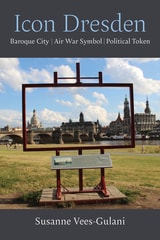
Icon Dresden
Baroque City, Air War Symbol, Political TokenSusanne Vees-Gulani
University of Michigan Press, 2026
Drawing on urban, heritage, and tourism studies, visual and memory studies, and environmental psychology, Icon Dresden examines Dresden’s history, identity, visual representations, and rebuilding decisions. It exposes the narratives that define its place in German and international memory and how, paradoxically, they support both Dresden’s current image as a symbol of peace and reconciliation and its backing of nativist and far-right movements.
Impure Migration
Jews and Sex Work in Golden Age ArgentinaMir Yarfitz
Rutgers University Press, 2019
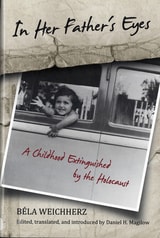
In Her Father's Eyes
A Childhood Extinguished by the HolocaustBéla Weichherz, Edited by Daniel H. Magilow
Rutgers University Press, 2008
In Her Father's Eyes is a moving tale about Jewish life and a father's profound love for his only child. By bridging prewar and wartime periods, the diary also provides a rich context for understanding the history from which the Holocaust emerged.
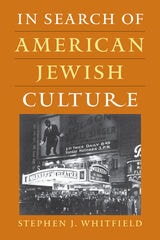
In Search of American Jewish Culture
Stephen J. Whitfield
Brandeis University Press, 2001
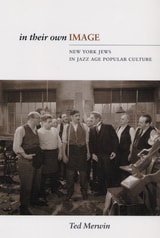
In Their Own Image
New York Jews in Jazz Age Popular CultureMerwin, Ted
Rutgers University Press, 2006
The Jazz Age of the 1920s is an era remembered for illegal liquor, innovative music and dance styles, and burgeoning ideas of social equality. It was also the period during which second-generation Jews began to emerge as a significant demographic in New York City. In TheirOwn Image examines thegrowing cultural visibility of Jewish life amid this vibrant scene.
From the vaudeville routines of Fanny Brice, Eddie Cantor, George Jessel, and Sophie Tucker, to the slew of Broadway comedies about Jewish life and the silent films that showed immigrant families struggling to leave the ghetto, images and representations of Jews became staples of interwar popular culture. Through the performing arts, Jews expressed highly ambivalent feelings about their identification with Jewish and American cultures. Ted Merwin shows how they became American by producing and consuming not images of another group, but images of themselves. As a result, they humanized Jewish stereotypes, softened anti-Semitic attitudes, and laid the groundwork for today’s Jewish comedians.
An entertaining look at the role popular culture plays in promoting the acculturation of an ethnic group, In Their Own Image enhances our understanding of American Jewish history and provides a model for the study of other groups and their integration into mainstream society.
In a Maelstrom
The History of Russian-Jewish Prose, 1860–1940Zsuzsa Hetényi
Central European University Press, 2008
In and Of the Mediterranean
Medieval and Early Modern Iberian StudiesMichelle M. Hamilton
Vanderbilt University Press, 2014
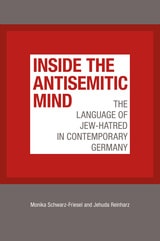
Inside the Antisemitic Mind
The Language of Jew-Hatred in Contemporary GermanyMonika Schwarz-Friesel and Jehuda Reinharz
Brandeis University Press, 2017
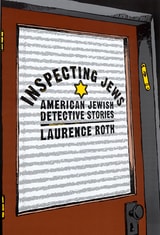
Inspecting Jews
American Jewish Detective StoriesRoth, Laurence
Rutgers University Press, 2003
Inthis book, Laurence Roth argues that the popular genre of Jewish detective stories offers new insights into the construction of ethnic and religious identity. Roth frames his study with the concept of “kosher hybridity” to look at the complex process of mediation between Jewish and American culture in which Jewish writers voice the desire to be both different from and yet the same as other Americans. He argues that the detective story, located at the intersection of narrative and popular culture in modern America, examines the need for order in a disorderly society, and thus offers a window into the negotiation of Jewish identity differing from that of literary fiction. The writers of these popular cultural texts, which are informed by contradiction and which thrive on intended and unintended ironies, formulate idioms for American Jewish identities that intentionally and unintentionally create social, ethnic, and religious syntheses in American Jewish life. Roth examines stories about American Jewish detectives—including Harry Kemelman’s Rabbi Small, Faye Kellerman’s Peter Decker and Rina Lazarus, Stuart Kaminsky’s Abe Lieberman, and Rochelle Krich’s Jessica Drake—not only as a genre of literature but also as a reflection of contemporary acculturation in the American Jewish popular arts.
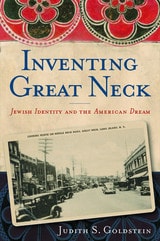
Inventing Great Neck
Jewish Identity and the American DreamGoldstein, Judith S
Rutgers University Press, 2006
Great Neck, New York, is one of America’s most fascinating suburbs. Since the mid-nineteenth century, generations have been attracted to this once quiet enclave for its easy access to New York City and its tranquil setting by the Long Island Sound. It became an illustrious suburb, home to numerous film and theatrical luminaries, among them Groucho Marx, Eddie Cantor, Oscar Hammerstein II, and Alan King. Famous writers who lived there include Ring Lardner and, of course, F. Scott Fitzgerald, who used Great Neck as the inspiration for his classic novel The Great Gatsby.
Although frequently recognized as home to well-known personalities, Great Neck is also notable for the conspicuous way it transformed itself from a Gentile community, to a mixed one, and, finally, in the 1960s, to one in which Jews were the majority. In Inventing Great Neck, Judith Goldstein recounts these histories in which Great Neck emerges as a leader in the reconfiguration of the American suburb.The book spans four decades of rapid change, beginning with the 1920s. First, the community served as a playground for New York’s socialites and celebrities. In the forties, it developed one of the country’s most outstanding school systems and served as the temporary home to the United Nations. In the sixties it provided strong support to the civil rights movement.
Inventing Great Neck is about the allure of suburbia, including the institutions that bind it together, and the social, economic, cultural, and religious tensions that may threaten its vibrancy. Anyone who has lived in a suburban town, particularly one in the greater metropolitan area, will be intrigued by this rich narrative, which illustrates not only Jewish identity in America but the struggle of the American dream itself through the heart of the twentieth century.
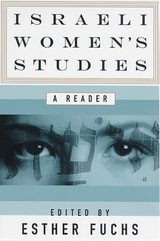
Israeli Women's Studies
A ReaderEdited by Esther Fuchs
Rutgers University Press, 2005
Israeli women do not enjoy the equality, status, and power often attributed to them by the media and popular culture. Despite significant achievements and progress, as a whole they continue to earn less than their male counterparts, are less visible and influential in the political arena, do not share equal responsibilities or privileges in the military, have unequal rights and freedoms in family life and law, and are less influential in shaping the nation's self image and cultural orientation.
Bringing together classic essays by leading scholars of Israeli culture, this reader exposes the hidden causes of ongoing discrimination and links the restrictions that Israeli women experience to deeply entrenched structures, including colonial legacies, religious traditions, capitalism, nationalism, and ongoing political conflict. In contrast, the essays also explore how women act creatively to affect social change and shape public discourse in less ostensible ways.
Providing balanced perspectives from the social sciences and the humanities, this comprehensive reader reflects both an emerging consensus and exciting diversity in the field. It is the definitive text for courses in Israeli women's studies.
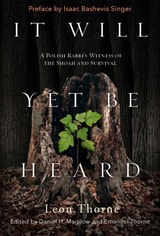
It Will Yet Be Heard
A Polish Rabbi's Witness of the Shoah and SurvivalIsaac Bashevis Singer
Rutgers University Press, 2019
Rabbi Thorne composed his memoir under extraordinary conditions, confined to a small underground bunker below a Polish peasant’s pigsty. But, It Will Yet Be Heard is remarkable not only for the story of its composition, but also for its moral clarity and complexity. A deeply religious man, Rabbi Thorne bore witness to forced labor camps, human degradation, and the murders of entire communities. And once he emerged from hiding, he grappled not only with survivor’s guilt, but also with the lingering antisemitism and anti-Jewish violence in Poland even after the war ended. Harrowing, moving, and deeply insightful, Rabbi Thorne’s firsthand account offers a rediscovered perspective on the twentieth century’s greatest tragedy.