Results by title
74 books match the query 'Kenya' and 2 start with i
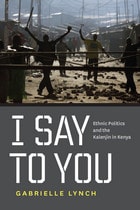
I Say to You
Ethnic Politics and the Kalenjin in KenyaGabrielle Lynch
University of Chicago Press, 2011
In 2007 a disputed election in Kenya erupted into a two-month political crisis that led to the deaths of more than a thousand people and the displacement of almost seven hundred thousand. Much of the violence fell along ethnic lines, the principal perpetrators of which were the Kalenjin, who lashed out at other communities in the Rift Valley. What makes this episode remarkable compared to many other instances of ethnic violence is that the Kalenjin community is a recent construct: the group has only existed since the mid-twentieth century. Drawing on rich archival research and vivid oral testimony, I Say to You is a timely analysis of the creation, development, political relevance, and popular appeal of the Kalenjin identity as well as its violent potential.
Uncovering the Kalenjin’s roots, Gabrielle Lynch examines the ways in which ethnic groups are socially constructed and renegotiated over time. She demonstrates how historical narratives of collective achievement, migration, injustice, and persecution constantly evolve. As a consequence, ethnic identities help politicians mobilize support and help ordinary people lay claim to space, power, and wealth. This kind of ethnic politics, Lynch reveals, encourages a sense of ethnic difference and competition, which can spiral into violent confrontation and retribution.
[more]

Infrastructural Attachments
Austerity, Sovereignty, and Expertise in KenyaEmma Park
Duke University Press, 2024
Set against critiques of neoliberal capitalism in the present, Infrastructural Attachments argues that the technopolitics of austerity have been the organizing logic of statecraft in Kenya since the late nineteenth century, calling into question the novelty of austerity as a mode of governance and a lived experience. Using infrastructures as a lens to explore state formation over the long twentieth century—roads in the early colonial period, radio broadcasting from the interwar through the postwar periods, and mobile phones and digital financial services in the present—historian Emma Park reveals that as the state drew on private capital to make up for limited budgets, it inaugurated a peculiar political-economic form: the corporate-state. For more than a century—in pursuit of minimizing costs and maximizing profits—the corporate-state crucially relied on the exploitation and expropriation of its subject-citizens. By foregrounding these workers, Park interrogates how Kenyans’ knowledge and expertise has been rescaled and subsumed, quietly underwriting the development of infrastructural expertise, the circuits of finance upon which (post)colonial infrastructural expansion has been premised, and the forms of profit-making it has enabled.
[more]