Results by title
135 books match the query 'Landscape' and 3 start with i
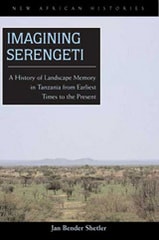
Imagining Serengeti
A History of Landscape Memory in Tanzania from Earliest Times to the PresentJan Bender Shetler
Ohio University Press, 2007
Many students come to African history with a host of stereotypes that are not always easy to dislodge. One of the most common is that of Africa as safari grounds—as the land of expansive, unpopulated game reserves untouched by civilization and preserved in their original pristine state by the tireless efforts of contemporary conservationists. With prose that is elegant in its simplicity and analysis that is forceful and compelling, Jan Bender Shetler brings the landscape memory of the Serengeti to life. She demonstrates how the social identities of western Serengeti peoples are embedded in specific spaces and in their collective memories of those spaces. Using a new methodology to analyze precolonial oral traditions, Shetler identifies core spatial images and reevaluates them in their historical context through the use of archaeological, linguistic, ethnographic, ecological, and archival evidence. Imagining Serengeti is a lively environmental history that will ensure that we never look at images of the African landscape in quite the same way.
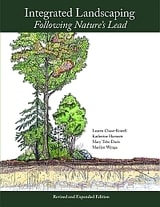
Integrated Landscaping
Following Nature’s LeadLauren Chase-Rowell
University of New Hampshire Press, 2012
Most landscape manuals describe a linear sequence of processes: design, plant selection, installation, and ongoing maintenance. Integrated Landscaping is different. It uses natural ecosystems as models, taking a nonlinear, holistic approach that addresses these processes simultaneously. Integrated Landscaping treats each site as a system of plant and animal communities, considering their interrelationships with each other and their environment.
Integrated Landscaping: Following Nature's Lead is a valuable resource for anyone concerned with helping to shape the landscape we all share. When we see ourselves as part of the whole, we can see that what we do in places where we live, work, and play has a ripple effect far beyond the space each of us calls home.
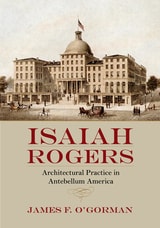
Isaiah Rogers
Architectural Practice in Antebellum AmericaJames F. O'Gorman
University of Massachusetts Press, 2015
When Isaiah Rogers died in 1869, the Cincinnati Daily Times noted that “in his profession he was, perhaps, better known than any other person in the country.” Yet until now there has been no study that fully examines his remarkable, influential, and instructive career. Based largely on Rogers's own diary, this book tells his story and adds much to our understanding of architectural practice in the United States before the Civil War.
In 1944 the distinguished historian Talbot Hamlin wrote of New York's Merchant Exchange (1836–42) that the building had “been so grandly conceived, so simply and directly planned, and so beautifully detailed . . . [that] the whole was welded inextricably into one powerful organic conception that shows Rogers as a great architect in the fullest sense of the word.” Rogers's Tremont House in Boston has been called the world's first modern hotel; it spawned many progeny, from his first Astor House in New York to his Burnet House in Cincinnati and beyond.
Rogers designed buildings from Maine to Georgia and from Boston to Chicago to New Orleans, supervising their construction while traveling widely to procure materials and workmen for the job. He finished his career as Architect of the Treasury Department during the Civil War. In this richly illustrated volume, James F. O'Gorman offers a deft portrait of an energetic practitioner at a key time in architectural history, the period before the founding of the American Institute of Architects in 1857.