Results by title
88 books match the query 'Lawyers' and 2 start with i
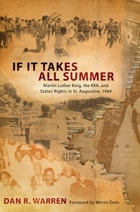
If It Takes All Summer
Martin Luther King, the KKK, and States' Rights in St. Augustine, 1964Dan R. Warren, with foreword by Morris Dees
University of Alabama Press, 2008
An insider’s record of the St. Augustine Civil Rights drama.
This memoir recounts the struggle against segregation in St. Augustine, Florida, in the early and mid-1960s. In the summer of 1964 the nation’s oldest city became the center of the civil rights movement as Martin Luther King Jr., encouraged by President Johnson, a southerner, who made the civil rights bill the center piece of his domestic policy, chose this tourism-driven community as an ideal location to demonstrate the injustice of discrimination and the complicity of southern leaders in its enforcement.
St. Augustine was planning an elaborate celebration of its founding, and expected generous federal and state support. But when the kick-off dinner was announced only whites were invited, and local black leaders protested. The affair alerted the national civil rights leadership to the St. Augustine situation as well as fueling local black resentment.
Ferment in the city grew, convincing King to bring his influence to the leadership of the local struggle. As King and his allies fought for the right to demonstrate, a locally powerful Ku Klux Klan counter-demonstrated. Conflict ensued between civil rights activists, local and from out-of-town, and segregationists, also home-grown and imported. The escalating violence of the Klan led Florida’s Governor to appoint State Attorney Dan Warren as his personal representative in St. Augustine. Warren’s crack down on the Klan and his innovative use of the Grand Jury to appoint a bi-racial committee against the intransigence of the Mayor and other officials, is a fascinating story of moral courage. This is an insider view of a sympathetic middleman in the difficult position of attempting to bring reason and dialog into a volatile situation.

In Pursuit of Justice
The Life of John Albion AndrewStephen D. Engle
University of Massachusetts Press, 2023
Widely known as the “poor man’s lawyer” in antebellum Boston, John Albion Andrew (1818–1867) was involved in nearly every cause and case that advanced social and racial justice in Boston in the years preceding the Civil War. Inspired by the legacies of John Quincy Adams and Ralph Waldo Emerson, and mentored by Charles Sumner, Andrew devoted himself to the battle for equality. By day, he fought to protect those condemned to the death penalty, women seeking divorce, and fugitives ensnared by the Fugitive Slave Law. By night, he coordinated logistics and funding for the Underground Railroad as it ferried enslaved African Americans northward.
In this revealing and accessible biography, Stephen D. Engle traces Andrew’s life and legacy, giving this important, but largely forgotten, figure his due. Rising to national prominence during the Civil War years as the governor of Massachusetts, Andrew raised the African American regiment known as the Glorious 54th and rallied thousands of soldiers to the Union cause. Upon his sudden death in 1867, a correspondent for Harper’s Weekly wrote, “Not since the news came of Abraham Lincoln’s death were so many hearts truly smitten.”