Results by title
97 books match the query 'Lesbians' and 5 start with i

Identity Politics
Lesbian Feminism and the Limits of CommunityShane Phelan
Temple University Press, 1991
"Lesbian feminism began and has fueled itself with the rejection of liberalism.... In this rejection, lesbian feminists were not alone. They were joined by the New Left, by many blacks in the civil rights movement, by male academic theorists.... What all these groups shared was an intense awareness of the ways in which liberalism fails to account for the social reality of the world, through a reliance upon law and legal structure to define membership, through individualism, through its basis in a particular conception of rationality."
In tracing how lesbian feminism came to be defined in uneasy relationships with the Women’s Movement and gay rights groups, Shane Phelan explores the tension between liberal ideals of individual rights and tolerance and communitarian ideals of solidarity. The debate over lesbian sado-masochism—an expression of individual choice or pornographic, anti-feminist behavior?—is considered as a test case.
Phelan addresses the problems faced by "the woman-identified woman" in a liberal society that presumes heterosexuality as the biological, psychological, and moral standard. Often silenced by laws defining their sexual behavior as criminal and censured by a medical establishment that persists in defining homosexuality as perversion, lesbians, like blacks and other groups, have fought to have the same rights as others in their communities and even in their own homes. Lesbian feminists have also sought to define themselves as a community that would be distinctly different, a community that would disavow the traditional American obsession with individual advancement in the world as it is.
In this controversial study of political philosophy and the women’s movement, Phelan argues that "the failure to date to produce a satisfying theory and program for lesbian action is reflective of the failure of modern political thinking to produce a compelling, nonsuspect alternative to liberalism."
In the series Women in the Political Economy, edited by Ronnie J. Steinberg.
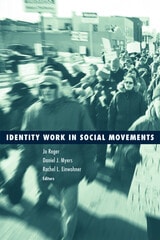
Identity Work in Social Movements
Jo Reger
University of Minnesota Press, 2008
This volume offers new scholarship that explores issues of diversity and uniformity among social movement participants. Featuring case studies that range widely—from Jewish resistance fighters in Nazi-occupied Poland to antigay Christian movements in the United States to online white supremacy groups—the essays show how participants set aside issues of personal identity in order to merge together and how these processes affect mobilization and the attainment of goals.
Contributors: Mary Bernstein, Kimberly B. Dugan, Elizabeth Kaminski, Susan Munkres, Kevin Neuhouser, Benita Roth, Silke Roth, Todd Schroer, Verta Taylor, Jane Ward.

In Changing Times
Gay Men and Lesbians Encounter HIV/AIDSEdited by Martin P. Levine, Peter M. Nardi, and John H. Gagnon
University of Chicago Press, 1997
The distinguished contributors to this volume discuss the ways HIV/AIDS has changed collective and individual identities, as well as lives, of gay men and lesbians, and how these alterations have changed our perceptions of the epidemic. They cover such topics as the impact of the epidemic on small towns, cultural barriers to AIDS prevention, gay youth and intergenerational relations, and the roles of lesbians in AIDS organizations. This collection provides compelling insights into the new communities among gay men and lesbians and the new kinds of identities and relationships that are emerging from the social and cultural ferment engendered by HIV/AIDS.
Contributors include Barry D. Adam, Lourdes Arguelles, Rafael Miguel Diaz, John H. Gagnon, Gilbert Herdt, Gregory M. Herek, Nan D. Hunter, Peter M. Nardi, John L. Peterson, Anne Rivero, Gayle S. Rubin, Beth E. Schneider, and Nancy E. Stoller.

Information Activism
A Queer History of Lesbian Media TechnologiesCait McKinney
Duke University Press, 2020

Intimate Friends
Women Who Loved Women, 1778-1928Martha Vicinus
University of Chicago Press, 2004
Vicinus also considers the nineteenth-century roots of such contemporary issues as homosexual self-hatred, female masculinity, and sadomasochistic desire. Drawing upon diaries, letters, and other archival sources, she brings to life a variety of well known and historically less recognized women, ranging from the predatory Ann Lister, who documented her sexual activities in code; to Mary Benson, the wife of the Archbishop of Canterbury; to the coterie of wealthy Anglo-American lesbians living in Paris.
In vivid and colorful prose, Intimate Friends offers a remarkable picture of women navigating the uncharted territory of same-sex desire.